EUR/USD slips below 1.1700 as core PCE tops estimates, Eurozone data mixed
- EUR/USD pulls back to 1.1695 after hitting yearly peak above 1.1750.
- US core PCE inflation rises above expectations; consumer sentiment improves, weighing on Euro.
- ECB’s Knot sees one more cut in 2025; French inflation cools, Spain’s HICP exceeds 2%.

The EUR/USD retreats from yearly highs above 1.1750, tumbling below 1.1700 despite market participants being convinced that the Federal Reserve (Fed) will cut rates at the September meeting. A mixed inflation report in the United States (US) and optimism among American consumers exerted downward pressure on the pair. At the moment, the pair trades at 1.1695, virtually unchanged.
Economic data is taking center stage on Friday, following the de-escalation of the Middle East conflict and news that China and the US have struck a commercial deal. The US Bureau of Economic Analysis reported that the headline Personal Consumption Expenditures (PCE) was in line with estimates and the figures for April. At the same time, the core PCE, which the Federal Reserve seeks as its preferred inflation gauge, rose above expectations, indicating that prices are climbing modestly.
Across the pond, the European Central Bank's (ECB) Klas Knot commented that at least one more interest rate cut of 25 basis points is anticipated toward the end of 2025. The ECB Vice-President Luis De Guindos said that inflation is about to hit the 2% target.
The Eurozone docket revealed that inflation in France fell, while the Harmonized Index of Consumer Prices (HICP) in Spain exceeded the ECB’s goal.
Daily digest market movers: Increased expectations of a Fed cut in July boost the EUR/USD
- The recovery of the buck capped the EUR/USD advance toward 1.1800. The US Dollar Index (DXY), which tracks the performance of the buck’s value against a basket of rivals, edges up 0.03% to 97.37 after hitting a three-and-a-half-year low of 96.99.
- The US PCE revealed by the BEA rose by 2.3% YoY, unchanged compared to April, and as expected by the median. The core PCE, which excludes volatile items like food and energy, expanded by 2.7% YoY, above estimates and the previous month's 2.6%.
- US Consumer Sentiment in June improved, according to the University of Michigan (UoM). The index improved from 60.5 to 60.7, and Inflation Expectations are seen lower. For 1 year, American households see prices reaching 5%, down from 5.1%. For 5 years, inflation is projected to dip from 4.1% to 4%.
- Minneapolis Fed President Neel Kashkari stated that while a potential uptick in inflation could be on the horizon, current data suggests continued progress toward the Fed’s 2% core inflation target. He added that more time is needed to assess whether the effects of the trade war are merely delayed or less severe than initially anticipated.
- The Wall Street Journal reported that the EU is reportedly considering lowering tariffs on US imports as an effort to curry favor with President Trump. Moreover, the US Secretary of Commerce, Howard Lutnick, said that the EU had a sluggish start but now is doing well, adding that there’s optimism of a deal with Europe.
- The European Commission President, Ursula von der Leyen, said the EU is prepared for both a deal and a no-deal outcome, stating that all options remain on the table.
- Money markets suggest that traders are pricing in 59 basis points of easing toward the end of the year, according to Prime Market Terminal data.
Euro technical outlook: EUR/USD set to test 1.1800 in the near-term
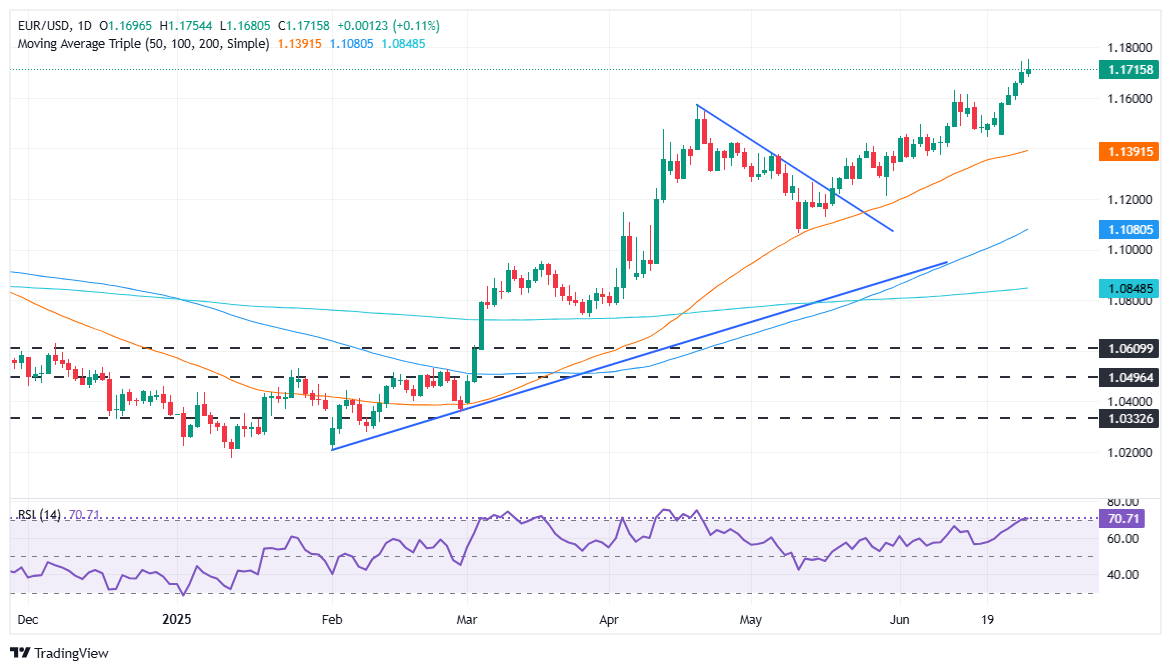
The uptrend remains intact after printing a successive series of higher highs and higher lows, indicating that buyers remain in control. Although the Relative Strength Index (RSI) has reached overbought conditions, opening the door for a pullback, the EUR/USD is likely to experience a dip, providing an opportunity for buying to push the exchange rate toward 1.1800. A breach of the latter will expose 1.1900 and 1.2000.
Conversely, if EUR/USD drops below 1.1700, the first support would be the June 26 daily low of 1.1653. Once cleared, the next support would be 1.1600, ahead of the 50-day SMA at 1.1515.
Euro FAQs
The Euro is the currency for the 19 European Union countries that belong to the Eurozone. It is the second most heavily traded currency in the world behind the US Dollar. In 2022, it accounted for 31% of all foreign exchange transactions, with an average daily turnover of over $2.2 trillion a day. EUR/USD is the most heavily traded currency pair in the world, accounting for an estimated 30% off all transactions, followed by EUR/JPY (4%), EUR/GBP (3%) and EUR/AUD (2%).
The European Central Bank (ECB) in Frankfurt, Germany, is the reserve bank for the Eurozone. The ECB sets interest rates and manages monetary policy. The ECB’s primary mandate is to maintain price stability, which means either controlling inflation or stimulating growth. Its primary tool is the raising or lowering of interest rates. Relatively high interest rates – or the expectation of higher rates – will usually benefit the Euro and vice versa. The ECB Governing Council makes monetary policy decisions at meetings held eight times a year. Decisions are made by heads of the Eurozone national banks and six permanent members, including the President of the ECB, Christine Lagarde.
Eurozone inflation data, measured by the Harmonized Index of Consumer Prices (HICP), is an important econometric for the Euro. If inflation rises more than expected, especially if above the ECB’s 2% target, it obliges the ECB to raise interest rates to bring it back under control. Relatively high interest rates compared to its counterparts will usually benefit the Euro, as it makes the region more attractive as a place for global investors to park their money.
Data releases gauge the health of the economy and can impact on the Euro. Indicators such as GDP, Manufacturing and Services PMIs, employment, and consumer sentiment surveys can all influence the direction of the single currency. A strong economy is good for the Euro. Not only does it attract more foreign investment but it may encourage the ECB to put up interest rates, which will directly strengthen the Euro. Otherwise, if economic data is weak, the Euro is likely to fall. Economic data for the four largest economies in the euro area (Germany, France, Italy and Spain) are especially significant, as they account for 75% of the Eurozone’s economy.
Another significant data release for the Euro is the Trade Balance. This indicator measures the difference between what a country earns from its exports and what it spends on imports over a given period. If a country produces highly sought after exports then its currency will gain in value purely from the extra demand created from foreign buyers seeking to purchase these goods. Therefore, a positive net Trade Balance strengthens a currency and vice versa for a negative balance.
Author

Christian Borjon Valencia
FXStreet
Markets analyst, news editor, and trading instructor with over 14 years of experience across FX, commodities, US equity indices, and global macro markets.