EUR/USD slips below 1.13 as Fed turns cautious amid looming stagflationary risk
- Fed Minutes warn of persistent inflation and stagflation risks amid tariff-driven uncertainty.
- DXY rises 0.26% as markets favor the Greenback ahead of key economic data.
- ECB’s Lane dismisses sub-1.5% rates unless inflation outlook deteriorates sharply.

The EUR/USD retreats below 1.1300 during the North American session as the US Dollar (USD) remains bid ahead following the release of the latest Federal Reserve (Fed) meeting minutes. High US bond yields and a slightly sour mood have driven the Greenback higher against most G7 currencies.
On May 6-7, the Fed decided to keep rates unchanged, citing uncertainty about the impact of tariffs on the economy. The minutes revealed that policymakers were concerned that inflation could be more persistent, fueled by inflation-prone trade policies enacted by the Trump administration.
Policymakers acknowledged some stagflation risks as they noted the “Committee might face difficult tradeoffs if inflation proves to be more persistent while the outlooks for growth and employment weaken.”
Therefore, the Fed has taken a cautious approach regarding monetary policy, waiting for the “net economic effects of the array of changes to government policies to become clearer.” It is worth noting that the Fed meeting took place before Trump reduced tariffs on China from 145% to 30%.
Meanwhile, traders bought the Greenback, which, according to the US Dollar Index (DXY), is up 0.26% and is now just shy of testing the 100.00 figure.
Tuesday’s upbeat Consumer Confidence report in the US offset a worse-than-expected US Durable Goods Orders report, which felt the impact of US President Donald Trump’s controversial trade policies.
Across the pond, the European Central Bank (ECB) Consumer’s Expectation Survey in April revealed that consumers are expecting higher prices, as inflation expectations rose due to high uncertainty over US tariffs.
Meanwhile, the ECB Chief Economist Philip Lane said the central bank is unlikely to lower rates below 1.50%. Lane said, “Rates below 1.5% are clearly accommodative. Going there would only be appropriate in the event of more substantial downside risks to inflation, or a more significant slowdown in the economy. I do not see that at the moment.”
EUR/USD daily market movers: Undermined by solid US data, FED minutes
- US Treasury bond yields are rising, as the 10-year Treasury note yield increases by four and a half basis points (bps) to 4.493%, a headwind for the EUR/USD pair as the Greenback appreciates further.
- On Wednesday, the New York Fed President John Williams stated that inflation expectations are well-anchored. He added that he wants to avoid inflation becoming highly persistent, as that could become permanent.
- US Consumer Confidence in May rose by 98.0, the highest level seen in the last four years. Other data disappointed investors, as US Durable Goods Orders plunged 6.3% MoM in April, down from March's 7.6% increase but exceeding forecasts of a 7.8% contraction.
- ECB officials delivered dovish remarks, increasing the chances for a rate cut at the June meeting. Francois Villeroy stated that he does not see inflation picking up in Europe. Meanwhile, Klaas Knot hinted that near-term growth and inflation risks are tilted to the downside.
- ECB’s Consumer Expectations Survey showed that inflation is expected to rise by 3.1%, up from 2.9% predicted a month ago, and well above the ECB’s 2% target.
- The Unemployment Rate in Germany stood at 6.3% as expected, unchanged from April.
- Financial market players had fully priced in that the ECB would reduce its Deposit Facility Rate by 25 basis points (bps) to 2% at the monetary policy meeting next week.
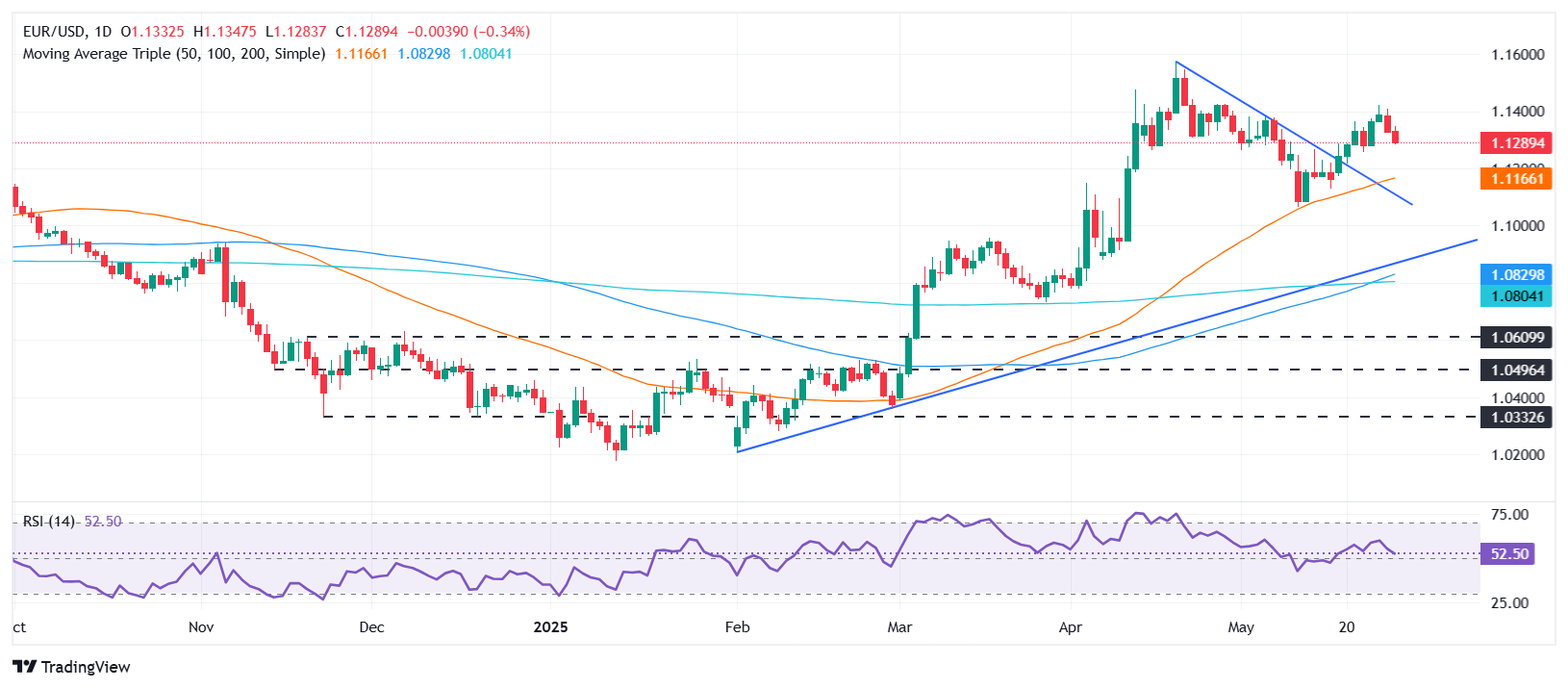
EUR/USD technical outlook: Struggles at 1.14, dives beneath 1.1300
EUR/USD uptrend has paused, as the shared currency failed to clear the 1.14 figure and opened the door for the pullback, with sellers eyeing dynamic support at 1.1265, the 20-day Simple Moving Average (SMA). Nevertheless, they must first clear the 1.1250 psychological level.
Although buyers seem to lose some steam, sellers need to clear the May 12 swing low of 1.1064 to declare that the uptrend is questionable, opening the door for a deeper pullback. But momentum, as measured by the Relative Strength Index (RSI), remains bullish.
On the upside, the EUR/USD can resume its uptrend, with a daily close above 1.1300, which could clear the path to test 1.1350 and a May 27 peak of 1.1407.
Euro FAQs
The Euro is the currency for the 19 European Union countries that belong to the Eurozone. It is the second most heavily traded currency in the world behind the US Dollar. In 2022, it accounted for 31% of all foreign exchange transactions, with an average daily turnover of over $2.2 trillion a day. EUR/USD is the most heavily traded currency pair in the world, accounting for an estimated 30% off all transactions, followed by EUR/JPY (4%), EUR/GBP (3%) and EUR/AUD (2%).
The European Central Bank (ECB) in Frankfurt, Germany, is the reserve bank for the Eurozone. The ECB sets interest rates and manages monetary policy. The ECB’s primary mandate is to maintain price stability, which means either controlling inflation or stimulating growth. Its primary tool is the raising or lowering of interest rates. Relatively high interest rates – or the expectation of higher rates – will usually benefit the Euro and vice versa. The ECB Governing Council makes monetary policy decisions at meetings held eight times a year. Decisions are made by heads of the Eurozone national banks and six permanent members, including the President of the ECB, Christine Lagarde.
Eurozone inflation data, measured by the Harmonized Index of Consumer Prices (HICP), is an important econometric for the Euro. If inflation rises more than expected, especially if above the ECB’s 2% target, it obliges the ECB to raise interest rates to bring it back under control. Relatively high interest rates compared to its counterparts will usually benefit the Euro, as it makes the region more attractive as a place for global investors to park their money.
Data releases gauge the health of the economy and can impact on the Euro. Indicators such as GDP, Manufacturing and Services PMIs, employment, and consumer sentiment surveys can all influence the direction of the single currency. A strong economy is good for the Euro. Not only does it attract more foreign investment but it may encourage the ECB to put up interest rates, which will directly strengthen the Euro. Otherwise, if economic data is weak, the Euro is likely to fall. Economic data for the four largest economies in the euro area (Germany, France, Italy and Spain) are especially significant, as they account for 75% of the Eurozone’s economy.
Another significant data release for the Euro is the Trade Balance. This indicator measures the difference between what a country earns from its exports and what it spends on imports over a given period. If a country produces highly sought after exports then its currency will gain in value purely from the extra demand created from foreign buyers seeking to purchase these goods. Therefore, a positive net Trade Balance strengthens a currency and vice versa for a negative balance.
Author

Christian Borjon Valencia
FXStreet
Markets analyst, news editor, and trading instructor with over 14 years of experience across FX, commodities, US equity indices, and global macro markets.