EUR/USD slips as firm US services data, soft Eurozone inflation weigh
- EUR/USD dips as strong US services PMI data supports the Dollar despite emerging labor market softness.
- Softer Eurozone HICP inflation boosts expectations of a rate cut by the European Central Bank.
- Focus turns to the ECB decision and remarks from Christine Lagarde on policy outlook and Euro strength.

The Euro falls during the North American session, down more than 0.10% as the Dollar recovers from Tuesday’s losses. Solid US business activity data is a headwind for the EUR/USD pair. A softer than expected inflation report in the Eurozone increases the chances that the European Central Bank (ECB) will need to lower rates to stimulate the economy. At the time of writing, the EUR/USD trades at 1.1800.
Euro edges lower near 1.1800 as resilient US activity contrasts with easing Eurozone inflation pressures
The US economic docket featured the Institute for Supply Management (ISM) Purchasers Management Index (PMI) for the services sector, which exceeded estimates amid increasing input costs. Other data show that private companies hired less people than expected by the economists, an indication of softness in the labor market.
The short US government shutdown has affected the release of crucial jobs data. The JOLTS report, which was expected to be released today, moved to February 5. Meanwhile, the Nonfarm Payrolls will be announced on February 11, while the Consumer Price Index (CPI) moved back to February 13.
Across the pond, the Harmonized Index of Consumer Prices (HICP) in January was softer than expected at 1.7% YoY, while core figures stood at 2.2% YoY. The Eurozone headline inflation had increased the odds for a cut, rather than a rate hike, for the ECB. Meanwhile, traders eye the ECB’s monetary policy outcome, along with the President Christine Lagarde’s press conference.
Of note would be if she spoke about the Euro’s strength, sponsored by overall US Dollar weakness.
Euro Price This week
The table below shows the percentage change of Euro (EUR) against listed major currencies this week. Euro was the strongest against the Japanese Yen.
| USD | EUR | GBP | JPY | CAD | AUD | NZD | CHF | |
|---|---|---|---|---|---|---|---|---|
| USD | 0.36% | 0.30% | 1.27% | 0.39% | -0.65% | 0.19% | 0.67% | |
| EUR | -0.36% | -0.11% | 0.94% | 0.02% | -1.01% | -0.17% | 0.30% | |
| GBP | -0.30% | 0.11% | 0.92% | 0.12% | -0.90% | -0.07% | 0.39% | |
| JPY | -1.27% | -0.94% | -0.92% | -0.87% | -1.92% | -1.01% | -0.88% | |
| CAD | -0.39% | -0.02% | -0.12% | 0.87% | -1.00% | -0.17% | 0.26% | |
| AUD | 0.65% | 1.01% | 0.90% | 1.92% | 1.00% | 0.85% | 1.30% | |
| NZD | -0.19% | 0.17% | 0.07% | 1.01% | 0.17% | -0.85% | 0.46% | |
| CHF | -0.67% | -0.30% | -0.39% | 0.88% | -0.26% | -1.30% | -0.46% |
The heat map shows percentage changes of major currencies against each other. The base currency is picked from the left column, while the quote currency is picked from the top row. For example, if you pick the Euro from the left column and move along the horizontal line to the US Dollar, the percentage change displayed in the box will represent EUR (base)/USD (quote).
Daily digest market movers: Upbeat US data weighs on the Euro
- A better-than-expected reading of the Institute for Supply Management Services PMI in January diminishes the chances of rate cuts in the near term. The index rose to 53.8 versus forecasts of 53.5 and matched December’s print.
- The ISM Employment Index sub-component rose for a second straight month, albeit at a slower pace than in December, while the Prices Paid Index increased to 66.6 from 65.1, marking its highest level in two months.
- The US ADP Employment Change report for January showed private-sector payrolls increased by just 22K, falling well short of expectations for a 48K gain.
- The US President Donald Trump said that he sustained an excellent telephone conversation with President Xi of China. Trump revealed that he would be traveling to China in April and that they discussed about trader, military, Taiwan, the Russia/Ukraine war, Iran and China’s purchasing oil and gas from the US.
- The US Treasury Secretary Scott Bessent revealed that is in the country’s interest the strong Dollar policy. When asked about whether Trump has the authority to fire Fed chair or board member of a policy disagreement, said that he has no opinion.
- Money markets had priced in 47 basis points of Fed easing towards the year end, revealed data from Prime Market Terminal data.
- On Thursday, the ECB is expected to hold rates unchanged. Nevertheless, companies revealing that they have experienced a decline in profits, in the latest ECB’s safety survey, increase the odds that the next move on interest rates would be a rate cut rather than a hike.
Technical outlook: EUR/USD trades sideways ahead of ECB’s meeting
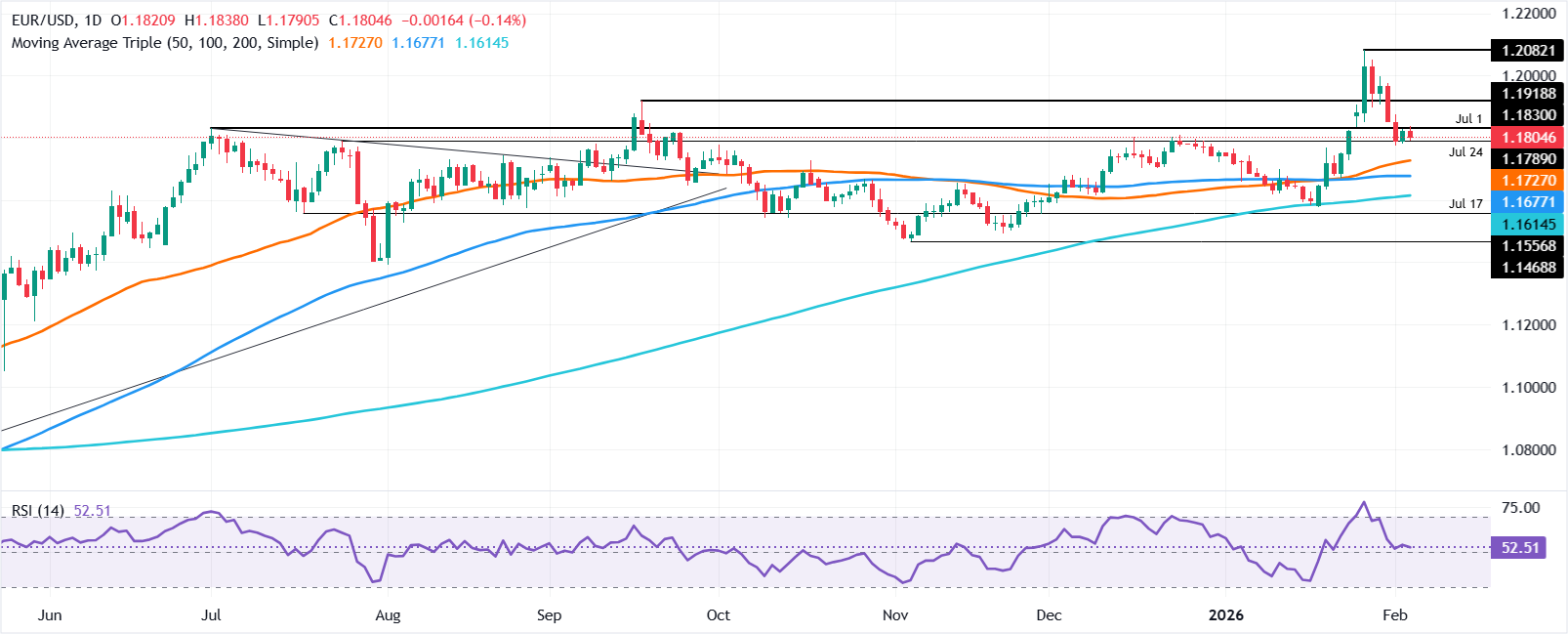
The EUR/USD trades sideways as investors wait for the ECB’s decision and Lagarde’s press conference. The ongoing downtrend was halted after reaching February 2’s daily low of 1.1775. Since then, the pair consolidated around 1.1770-1.1837. If the top of the range is cleared, up next lies 1.1850 followed by 1.1900.
Conversely, a drop below 1.1770 would extend its losses to the 20-day SMA at 1.1759, followed by the 50-day SMA at 1.1719 and the 100-day SMA at 1.1678.
Euro FAQs
The Euro is the currency for the 20 European Union countries that belong to the Eurozone. It is the second most heavily traded currency in the world behind the US Dollar. In 2022, it accounted for 31% of all foreign exchange transactions, with an average daily turnover of over $2.2 trillion a day. EUR/USD is the most heavily traded currency pair in the world, accounting for an estimated 30% off all transactions, followed by EUR/JPY (4%), EUR/GBP (3%) and EUR/AUD (2%).
The European Central Bank (ECB) in Frankfurt, Germany, is the reserve bank for the Eurozone. The ECB sets interest rates and manages monetary policy. The ECB’s primary mandate is to maintain price stability, which means either controlling inflation or stimulating growth. Its primary tool is the raising or lowering of interest rates. Relatively high interest rates – or the expectation of higher rates – will usually benefit the Euro and vice versa. The ECB Governing Council makes monetary policy decisions at meetings held eight times a year. Decisions are made by heads of the Eurozone national banks and six permanent members, including the President of the ECB, Christine Lagarde.
Eurozone inflation data, measured by the Harmonized Index of Consumer Prices (HICP), is an important econometric for the Euro. If inflation rises more than expected, especially if above the ECB’s 2% target, it obliges the ECB to raise interest rates to bring it back under control. Relatively high interest rates compared to its counterparts will usually benefit the Euro, as it makes the region more attractive as a place for global investors to park their money.
Data releases gauge the health of the economy and can impact on the Euro. Indicators such as GDP, Manufacturing and Services PMIs, employment, and consumer sentiment surveys can all influence the direction of the single currency. A strong economy is good for the Euro. Not only does it attract more foreign investment but it may encourage the ECB to put up interest rates, which will directly strengthen the Euro. Otherwise, if economic data is weak, the Euro is likely to fall. Economic data for the four largest economies in the euro area (Germany, France, Italy and Spain) are especially significant, as they account for 75% of the Eurozone’s economy.
Another significant data release for the Euro is the Trade Balance. This indicator measures the difference between what a country earns from its exports and what it spends on imports over a given period. If a country produces highly sought after exports then its currency will gain in value purely from the extra demand created from foreign buyers seeking to purchase these goods. Therefore, a positive net Trade Balance strengthens a currency and vice versa for a negative balance.
Author

Christian Borjon Valencia
FXStreet
Markets analyst, news editor, and trading instructor with over 14 years of experience across FX, commodities, US equity indices, and global macro markets.

















