EUR/USD declines as US Dollar extends upside after US Q1 GDP data
- EUR/USD slumps to near 1.1350 as the US Dollar gains after the release of the US ADP Employment and Q1 GDP data.
- The US economy has contracted for the first time in a quarter in three years.
- The Eurozone economy rose at a higher-than-expected pace of 0.4% in the first quarter of the year.

EUR/USD slides to near 1.1350 during North American trading hours on Wednesday. The major currency pair weakens as the US Dollar (USD) extends its initial gains after the release of a string of United States (US) economic data. The US Dollar Index (DXY), which tracks the Greenback's value against six major currencies, climbs to near 99.50.
Each of the economic data points to a serious impact of the tariff policy imposed by US President Donald Trump on the so-called "Liberation Day" on April 2. Notably, the US economy has contracted by 0.3% in the first quarter of the year on an annualized basis due to a sharp increase in imports. The GDP report has shown that US importers frontloaded goods from their foreign vendors ahead of tariffs announced by Trump. This is the first time since the first quarter of 2022 that the US economy has declined. Economists expected the US economy to have grown at a moderate pace of 0.4%, substantially slower than the 2.4% growth seen in the previous quarter.
The ADP Employment Change data for April has missed estimates by a wide margin. The ADP reported that private employers hired 62K fresh workers, significantly lower than estimates of 108K and the prior release of 147K, revised lower from 155K.
Meanwhile, US core Personal Consumption Expenditure Price Index (PCE) data for March has decelerated to 2.6% year-on-year, as expected, from 2.8% in February.
Economic contraction, soft employment, and cooling inflationary pressures are expected to boost market expectations that the Federal Reserve (Fed) could start reducing interest rates right from the May policy meeting. According to the MCE FedWatch tool, traders are almost confident that the Fed will keep interest rates in the current range of 4.25%-4.50% next month.
The overall outlook of the US Dollar was already grim amid uncertainty over trade relations between the US and China. Market participants have become increasingly confident that the tariff war between the world’s two largest powerhouses will not resolve in the near term, as comments from US Treasury Secretary Scott Bessent have indicated that he wants Beijing to be the one to initiate rolling back additional import duties imposed on Washington. China raised levies on the US by 125% in retaliation for the 145% tariffs imposed by Donald Trump.
On Monday, Scott Bessent said in an interview with CNBC: “I believe that it’s up to China to de-escalate, because they sell five times more to us than we sell to them, and so these 120%, 145% tariffs are unsustainable.”
Meanwhile, China has listed a number of imports from the US that will be exempted from tariffs, Reuters reported. Investors should not take this move by China as an attempt to de-escalate the trade war, assuming that these products are ones whose substitutes are not currently available in their domestic facilities due to technological or resource limitations.
Daily digest market movers: EUR/USD weakens as US Dollar moves higher
- EUR/USD bounces back as the US Dollar retreats in the North American session. The Euro (EUR) trades cautiously amid a slowdown in the preliminary April Harmonized Index of Consumer Prices (HICP) data from Germany and France, as well as stable inflation in Italy and Spain.
- Year-on-year, German HICP rose by 2.2%, faster than expectations of 2.1% but slower than March's reading of 2.3%. Inflationary pressures in the German economy were expected to decelerate after scrutinizing the price index data from its six states, released earlier in the day.
- The yearly HICP data from four German states came in lower than the previous readings, while the rest showed faster price growth, suggesting that inflation for the whole of Germany could also fall. In the same period, France's Consumer Price Index (CPI) (EU Norm) rose by 0.8%, faster than estimates of 0.7% but lower than the 0.9% growth seen in March. In Italy, inflation remained at 2.1%, while data released Tuesday showed that price growth in Spain was also stable.
- Overall, the inflation data from the largest nations of the Eurozone indicate that price pressures have grown moderately. Such a scenario is unfavorable for the Euro as soft inflation data supports market expectations that the European Central Bank (ECB) could continue to cut interest rates.
- Traders have almost priced in a 25 basis points (bps) interest rate reduction by the ECB in the June policy meeting. A slew of ECB officials have projected more slowdown in inflation and economic growth in the face of tariffs imposed by the United States (US) on its trading partners.
- On Tuesday, ECB executive board member Piero Cipollone warned that lower economic and inflation growth due to the US-led global trade war could have an "unambiguously recessionary effect" on the countries involved, Reuters reported. Cipollone anticipated that the recent increase in trade policy uncertainty could reduce “euro area business investment by 1.1% in the first year and real GDP growth by around 0.2 percentage points in 2025-26".
- Data released on early Wednesday showed that for now, the Eurozone economy is broadly holding up. The preliminary Eurozone Q1 Gross Domestic Product (GDP) came in better-than-expected on both a quarterly and annual basis. Eurostat reported that the economy grew by 0.4% quarter-on-quarter, higher than what economists had expected and than the previous reading of 0.2%.
Technical Analysis: EUR/USD falls to near 1.1350
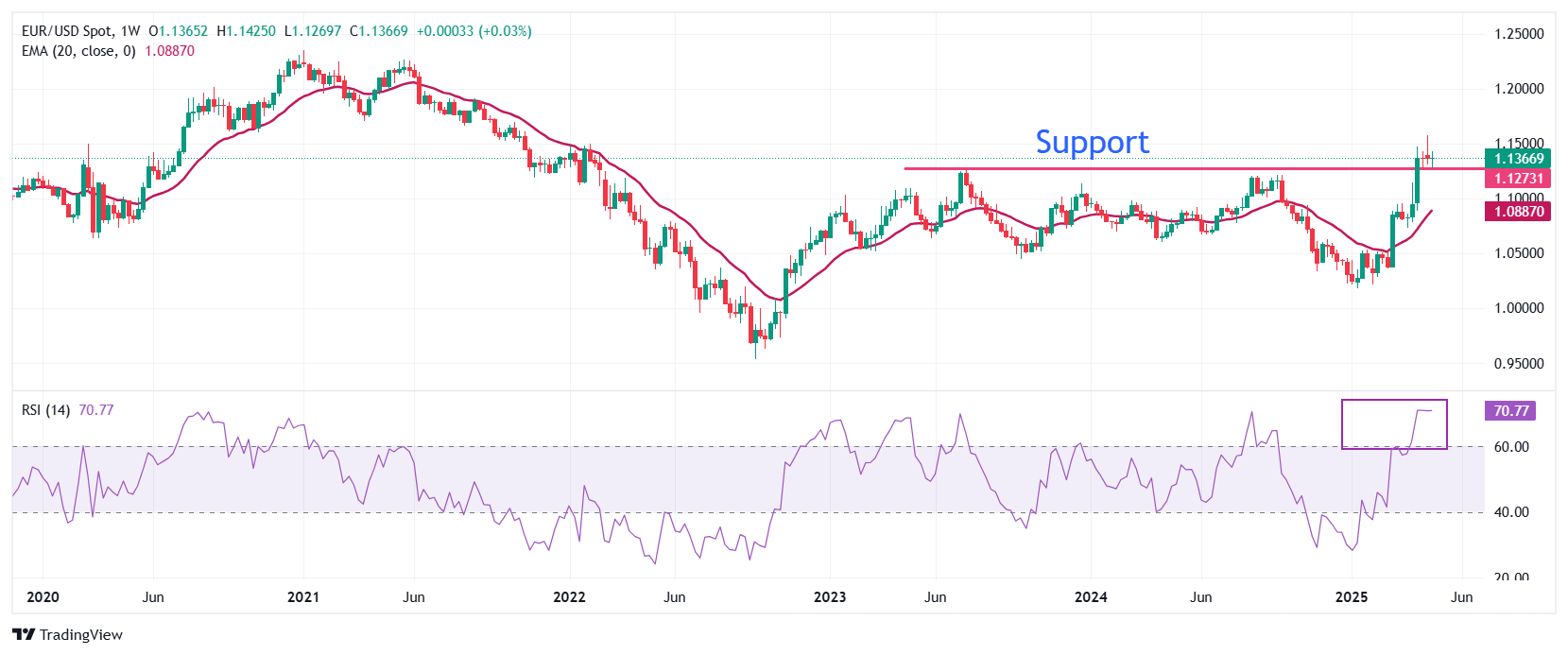
EUR/USD slips to near 1.1350 in Wednesday’s North American session. The outlook of the major currency pair remains bullish as the 20-week Exponential Moving Average (EMA) is sloping higher around 1.0890.
The 14-week Relative Strength Index (RSI) climbs to near overbought levels above 70.00 in the weekly chart, which indicates a strong bullish momentum, but chances of some correction cannot be ruled out.
Looking up, the psychological level of 1.1500 will be the major resistance for the pair. Conversely, the July 2023 high of 1.1276 will be a key support for the Euro bulls.
US Dollar FAQs
The US Dollar (USD) is the official currency of the United States of America, and the ‘de facto’ currency of a significant number of other countries where it is found in circulation alongside local notes. It is the most heavily traded currency in the world, accounting for over 88% of all global foreign exchange turnover, or an average of $6.6 trillion in transactions per day, according to data from 2022. Following the second world war, the USD took over from the British Pound as the world’s reserve currency. For most of its history, the US Dollar was backed by Gold, until the Bretton Woods Agreement in 1971 when the Gold Standard went away.
The most important single factor impacting on the value of the US Dollar is monetary policy, which is shaped by the Federal Reserve (Fed). The Fed has two mandates: to achieve price stability (control inflation) and foster full employment. Its primary tool to achieve these two goals is by adjusting interest rates. When prices are rising too quickly and inflation is above the Fed’s 2% target, the Fed will raise rates, which helps the USD value. When inflation falls below 2% or the Unemployment Rate is too high, the Fed may lower interest rates, which weighs on the Greenback.
In extreme situations, the Federal Reserve can also print more Dollars and enact quantitative easing (QE). QE is the process by which the Fed substantially increases the flow of credit in a stuck financial system. It is a non-standard policy measure used when credit has dried up because banks will not lend to each other (out of the fear of counterparty default). It is a last resort when simply lowering interest rates is unlikely to achieve the necessary result. It was the Fed’s weapon of choice to combat the credit crunch that occurred during the Great Financial Crisis in 2008. It involves the Fed printing more Dollars and using them to buy US government bonds predominantly from financial institutions. QE usually leads to a weaker US Dollar.
Quantitative tightening (QT) is the reverse process whereby the Federal Reserve stops buying bonds from financial institutions and does not reinvest the principal from the bonds it holds maturing in new purchases. It is usually positive for the US Dollar.
Author

Sagar Dua
FXStreet
Sagar Dua is associated with the financial markets from his college days. Along with pursuing post-graduation in Commerce in 2014, he started his markets training with chart analysis.

















