EUR/USD slides below 1.1700 as tariff fears lift Dollar to 2-week high
- EUR/USD posts first weekly loss in three weeks, ending at 1.1688.
- Trump eyes blanket tariffs, including on EU and copper exports.
- Dollar marks strongest week since March amid broad risk-off tone.

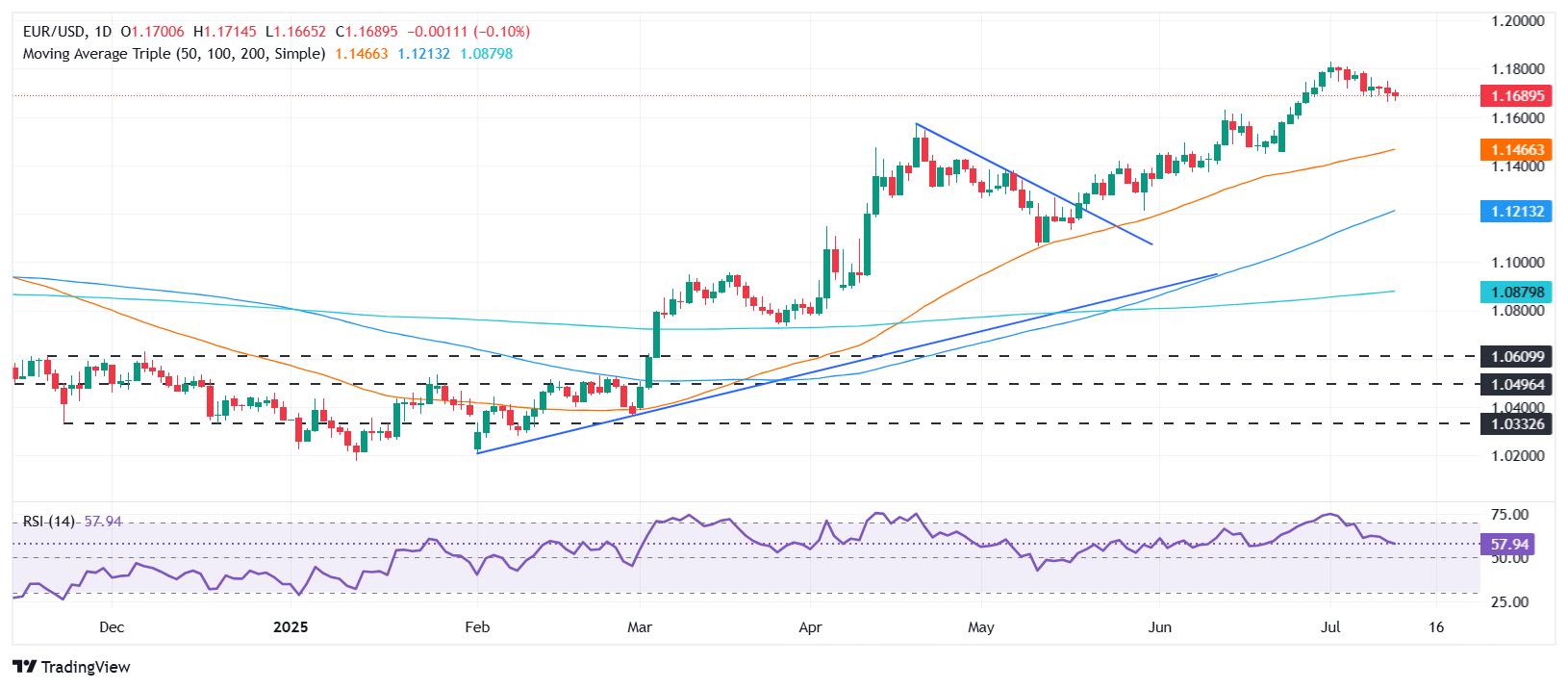
EUR/USD finished the week with losses of over 0.70% and ended Friday’s session down 0.10% trading below the 1.1700 figure, cementing the case for a pullback to test key support levels as the Greenback posts its best week in four months. At the time of writing, the pair trades at 1.1688.
A risk-off mood was triggered by US President Donald Trump, who remains focused in broadening tariffs to countries but also to commodities like copper. News emerged that he could be imposing blanket tariffs and that his sights are set on a letter to the European Union (EU), which posts its first weekly loss in the last three weeks.
A light economic docket on both sides of the Atlantic featured media appearances of Federal Reserve (Fed) officials, alongside Wholesale Prices data for June, revealed in Germany.
Daily digest market movers: Euro pressured as Trump threats to sent EU’s tariff letter
- The Euro was on the defensive as news reports revealed Trump’s intention to send a letter to the EU. In addition to this, he enacted 35% tariffs on Canada, and it is reported that he is eyeing blanket tariffs of 15% to 20%, signaling an escalation of the trade war.
- Chicago Fed President Austan Goolsbee (voter in 2025) said that the new round of tariffs makes it messy to reveal the true economic performance. He said that tariffs could delay rate cuts and that he wants to wait until the anxiety dies down before being comfortable that the US is back on track to a soft landing.
- Across the pond, European Central Bank (ECB) officials revealed mixed stances on monetary policy. Schnabel was hawkish, stating that "the bar for another rate cut is very high" and dismissing the need for further easing unless inflation materially deviates from the ECB’s 2% target over the medium term — something she currently sees no evidence of.
- ECB Fabio Panetta was slightly dovish, noting that if the downside risks to growth intensified and reinforced disinflationary pressures, it could require further monetary easing.
- Wholesale Prices in Germany rose by 0.2% MoM in June as expected, crushing May´s -0.3% fall. Yearly, Prices jumped from 0.4% to 0.9% for the same period.
Euro technical outlook: EUR/USD tumbles below 1.1700 as sellers eye 1.1500
The EUR/USD cracked below the 1.1700 figure yet it remains on top of the 20-day Simple Moving Average (SMA) of 1.1662. Although it bounced to current price levels, the pair staying below 1.1700, paves the way for further downside.
The first support would be the 20-day SMA. Once surpassed, the next stop would be 1.1650, followed by the 50-day SMA at 1.1464.
Euro FAQs
The Euro is the currency for the 19 European Union countries that belong to the Eurozone. It is the second most heavily traded currency in the world behind the US Dollar. In 2022, it accounted for 31% of all foreign exchange transactions, with an average daily turnover of over $2.2 trillion a day. EUR/USD is the most heavily traded currency pair in the world, accounting for an estimated 30% off all transactions, followed by EUR/JPY (4%), EUR/GBP (3%) and EUR/AUD (2%).
The European Central Bank (ECB) in Frankfurt, Germany, is the reserve bank for the Eurozone. The ECB sets interest rates and manages monetary policy. The ECB’s primary mandate is to maintain price stability, which means either controlling inflation or stimulating growth. Its primary tool is the raising or lowering of interest rates. Relatively high interest rates – or the expectation of higher rates – will usually benefit the Euro and vice versa. The ECB Governing Council makes monetary policy decisions at meetings held eight times a year. Decisions are made by heads of the Eurozone national banks and six permanent members, including the President of the ECB, Christine Lagarde.
Eurozone inflation data, measured by the Harmonized Index of Consumer Prices (HICP), is an important econometric for the Euro. If inflation rises more than expected, especially if above the ECB’s 2% target, it obliges the ECB to raise interest rates to bring it back under control. Relatively high interest rates compared to its counterparts will usually benefit the Euro, as it makes the region more attractive as a place for global investors to park their money.
Data releases gauge the health of the economy and can impact on the Euro. Indicators such as GDP, Manufacturing and Services PMIs, employment, and consumer sentiment surveys can all influence the direction of the single currency. A strong economy is good for the Euro. Not only does it attract more foreign investment but it may encourage the ECB to put up interest rates, which will directly strengthen the Euro. Otherwise, if economic data is weak, the Euro is likely to fall. Economic data for the four largest economies in the euro area (Germany, France, Italy and Spain) are especially significant, as they account for 75% of the Eurozone’s economy.
Another significant data release for the Euro is the Trade Balance. This indicator measures the difference between what a country earns from its exports and what it spends on imports over a given period. If a country produces highly sought after exports then its currency will gain in value purely from the extra demand created from foreign buyers seeking to purchase these goods. Therefore, a positive net Trade Balance strengthens a currency and vice versa for a negative balance.
Author

Christian Borjon Valencia
FXStreet
Markets analyst, news editor, and trading instructor with over 14 years of experience across FX, commodities, US equity indices, and global macro markets.