EUR/USD gains further despite ECB cuts interest rates amid downside economic risks
- EUR/USD moves higher to near 1.0840 as the ECB reduces its Deposit Facility rate by 25 bps to 2.5%.
- The ECB sees the core inflation averaging to 2.2% by the year-end.
- US President Trump provides one month of tariff relaxation on automobiles from Canada and Mexico.

EUR/USD gains further to near 1.0840 in Thursday’s North American session after the European Central Bank’s (ECB) monetary policy decision. The ECB reduces its Deposit Facility Rate by 25 basis points (bps) for the fifth time in a row, pushing it lower to 2.5%, as expected. The Main Refinancing Operations Rate is also slashed by 25 bps to 2.65% in line with expectations.
After the policy decision, the ECB said that inflation has continued to develop broadly as staff "expected", and the latest projections closely align with the previous inflation outlook. The ECB staff sees the core inflation - which excludes volatile food and energy prices - averaging 2.2% in 2025, 2.0% in 2026, and 1.9% in 2027.
ECB President Christine Lagarde said in the press conference that the rationale behind the dovish interest rate decision was to support economic stability. Lagarde warned that risks to growth remain tilted to the "downside". She guided that trade tensions due to United States (US) President Donald Trump-led tariff war could weigh on "growth further".
Market experts believe that Trump’s tariffs could weigh on the shared continent’s economic outlook, which is already fractured due to weak demand from domestic and overseas markets. Till now, Trump has threatened to impose 25% levies on foreign automobiles and introduce reciprocal tariffs soon. Investors seek whether the US will impose 10% or 25% tariffs on German cars.
Lagarde didn't guide over the monetary policy outlook and reiterated, "The ECB remains data-dependent, and decisions on rates will be made on a meeting-by-meeting basis". Before the ECB's policy decision, traders had pared some bets supporting the ECB to cut interest rates two times by the summer as Germany’s likely next chancellor, Frederich Merz, and the Social Democratic Party (SDP) agreed to create a 500 billion Euro (EUR) infrastructure fund and stretch borrowing limit on Tuesday. Investors expect such reforms could escalate inflation and stimulate economic growth in the German economy, the locomotive of the Eurozone.
Lagarde refrained from gauging the impact of German debt reforms and said the increased defense and infrastructure spending is still a "work in progress" and the ECB "needs time" to understand the impact.
During the European session on Thursday, Reuters reported that Germany's lower house of parliament will start discussing boosting defense and infrastructure spending as well as sweeping changes to state borrowing rules from March 13. The agency added that the Bundestag (German parliament) lower house will vote on the "debt brake" reforms on March 18.
On the economic front, Month-on-month Eurozone Retail Sales surprisingly declined by 0.3% in January after remaining flat in December. Economists expected the Retail Sales data, a measure of consumer spending, to have increased by 0.1%. On year, the consumer spending measure rose by 1.5%, slower than estimates of 1.9% and the former reading of 2.2%.
Daily digest market movers: EUR/USD shows strength amid sheer weakness in US Dollar
- Sheer strength in the EUR/USD pair is also driven by the significant US Dollar weakness (USD). The US Dollar Index (DXY), which tracks the Greenback’s value against six major currencies, extends its losing streak for the fourth trading day and slides to near 104.00, the lowest level seen in four months.
- Investors expect the trade war led by US President Trump won’t be as disruptive as they had previously anticipated, resulting in a decline in the US Dollar’s risk premium.
- On Wednesday, commentaries from the White House Press Secretary Karoline Leavitt indicated that Donald Trump is allowing a one-month exemption of 25% tariffs on automobiles coming from Mexico and Canada, which he imposed on Tuesday. Also, Trump is considering providing an exemption for some agricultural products.
- After Trump’s relaxation on automobiles from Canada and Mexico, Meanwhile, soft US private employment data has also contributed to weakness in the US Dollar. The ADP reported on Wednesday that the US private sector added 77K fresh workers, lower than estimates of 140K and the former release of 186K. Soft labor demand in the US private sector is expected to prompt Fed dovish bets, which have already increased lately. According to the CME FedWatch tool, the probability of the Fed cutting interest rates in the June meeting has increased to 76% from 70% a week ago.
- For more clues on the current employment status, investors will focus on the US Nonfarm Payrolls (NFP) data for February, which will be published on Friday.
Technical Analysis: EUR/USD holds above 1.0800
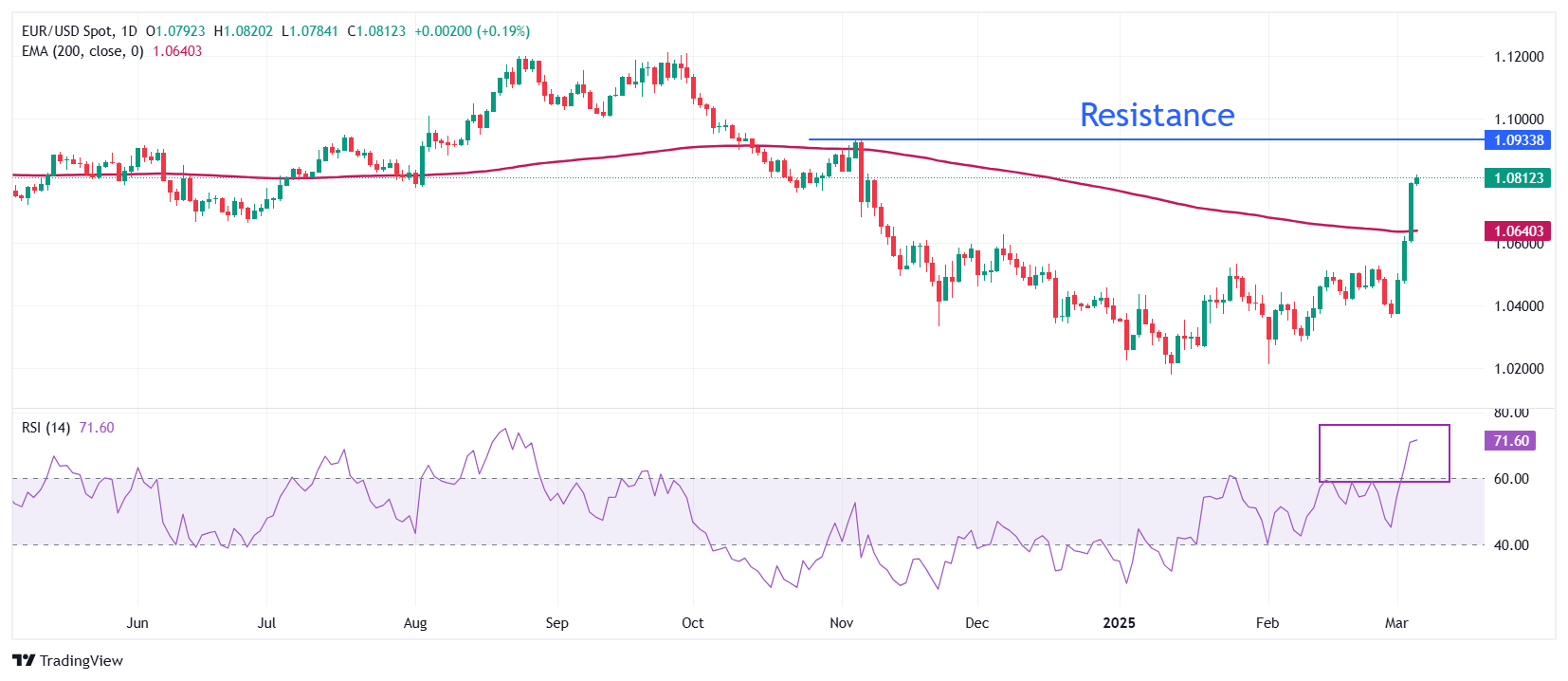
EUR/USD surges to near 1.0840 after a decisive breakout above the December 6 high of 1.0630 on Wednesday. The long-term outlook of the major currency pair strengthens as it holds above the 200-day Exponential Moving Average (EMA), which trades around 1.0640.
The 14-day Relative Strength Index (RSI) jumps above 60.00, indicating a strong bullish momentum.
Looking down, the January 27 high of 1.0533 will act as the major support zone for the pair. Conversely, the November 6 high of 1.0937 will be the key barrier for the Euro bulls.
Author

Sagar Dua
FXStreet
Sagar Dua is associated with the financial markets from his college days. Along with pursuing post-graduation in Commerce in 2014, he started his markets training with chart analysis.