EUR/USD rises above 1.0900 on growing speculation for a Fed pause
- US JOLTs reports revealing a drop of 32,000 job openings, increasing assumptions that the labor market is cooling.
- The US Department of Commerce reported a 0.7% MoM drop in orders.
- ECB’s Makhlouf: The impact of rate hikes is “well underway,” as it emphasizes that the ECB must be ready to tackle inflation.

The EUR/USD edges above the 1.0900 figure for the second consecutive day after data from the United States (US) shifted expectations that the US Federal Reserve (Fed) would pause its tightening cycle. At the time of writing, the EUR/USD is trading at 1.0947 after hitting a low of 1.0882.
EUR/USD rises above 1.0900 as bad US economic data turns negative for the US Dollar
Sentiment shifted sour as of late after a round of labor market data in the US has shown signs of cooling down. Job openings in February, reported in the JOLTs reports, dropped from 10.4 million to 9.931 million, a drop of 32,000. This could be a prelude that the labor market is cooling. Further data will be revealed during the week, with ADP Employment figures shown on Wednesday, followed by Initial Jobless Claims and the US Nonfarm Payrolls report.
At the same time, Factory Orders in the US dropped for the second straight month. Orders plummeted 0.7% MoM, worst than the estimated 0.5% decrease, as the US Department of Commerce reported.
Investors expect a pause on the Fed's May meeting
Of late, traders see a 57% probability of a Fed pause at the May 2-3 meeting vs. a 43% chance the day before. investors forecast a 43% chance of a 25 bps rate hike while estimating two rate cuts by the year's end.
The EUR/USD rose from 1.0886 towards 1.0973, its daily high, before stabilizing at around 1.0947, sponsored by broad US Dollar weakness. The US Dollar Index, which tracks the value of a basket of six currencies vs. the American Dollar (USD), falls 0.41%, at 101.628, blamed on falling US T-bond yields.
On the European front, the Producer Price Index (PPI) for February continued its downward trend, while the German Balance of Trader for the same period remained flat at €16B. In the meantime, the European Central Bank (ECB) Governing Council member, Gabriel Makhlouf, said that the impact of higher borrowing costs is “well underway.” He added that the ECB must remain steadfast and ready to act as required” to ensure inflation returns to target over the medium-term.
EUR/USD Technical analysis
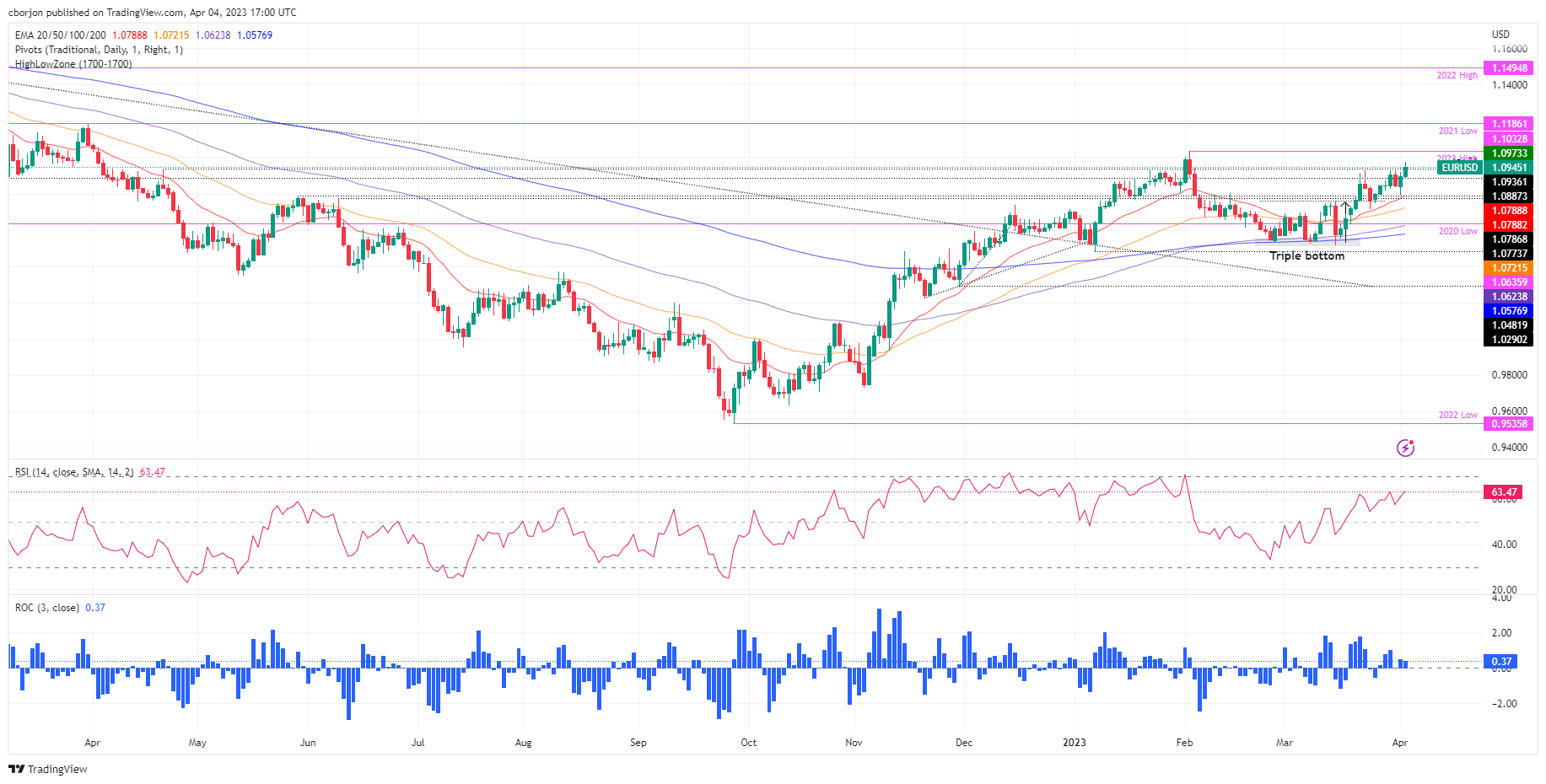
From a daily chart perspective, the EUR/USD triplet bottom remains in play, targeting 1.1000. On Monday, the EUR/USD dipped and tested the 20-day EMA at 1.0788 before skyrocketing above 1.0900. That exacerbated a continuation of the uptrend and has opened the door for further upside. The EUR/USD first resistance would be 1.0973, followed by 1.1000, and then the YTD high at 1.1033. On the other hand, the EUR/USD first support would be 1.0900, followed by the 20-day EMA At 1.0788.
Author

Christian Borjon Valencia
FXStreet
Markets analyst, news editor, and trading instructor with over 14 years of experience across FX, commodities, US equity indices, and global macro markets.

















