EUR/USD reverses initial gains and approaches 1.2200
- EUR/USD fades the initial optimism and approaches 1.2200.
- The greenback regains some composure amidst lower yields.
- German flash Manufacturing PMI missed estimates in May.

The single currency gives away initial gains and drags EUR/USD to the proximity of the 1.2200 neighbourhood.
EUR/USD weaker post-data
EUR/USD fades the earlier spike to highs near 1.2240 on the back of mixed results in the domestic docket and declining yields in the German 10-year reference.
In fact, Markit’s flash Manufacturing PMI came in short of estimates for the month of May at 64.0, also lower than April’s 66.2. In the broader Euroland, the same gauge surprised to the upside at 62.8 albeit losing a bit of momentum from the previous reading (62.9).
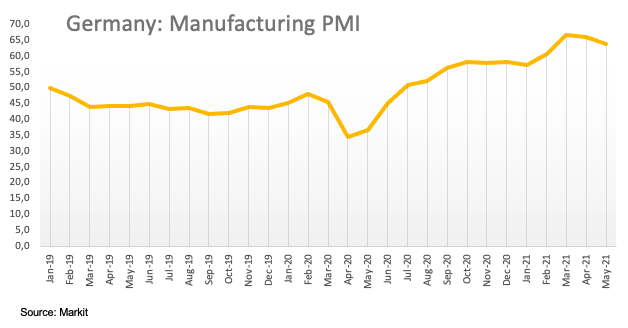
In addition, yields of the German 10-year Bund navigate the area of daily lows in the -0.12% region, putting the European currency under extra downside pressure. Additionally, the European Commission will release the flash Consumer Confidence result for the current month.
Later in the NA session, Markit will also publish its preliminary gauges for the Manufacturing and Services PMIs along with Existing Home Sales during the month of April.
What to look for around EUR
EUR/USD met decent resistance in the 1.2250 region earlier in the week, extending the bounce off last week’s lows in the mid-1.2000s and always on the back of the strong bounce in yields of the German 10-year Bund and the generalized upbeat tone in the risk complex. The sustained rebound in the pair also comes in response to the investors’ shift to the improved growth outlook in the Old Continent now that the vaccine campaign appears to have gained some serious pace and solid results from key fundamentals pari passu with the surging morale in the bloc.
Key events in the euro area this week: German/EMU flash May PMIs, advanced Consumer Confidence, ECB's Lagarde press conference at the Eurogroup meeting in Portugal (Friday).
Eminent issues on the back boiler: Asymmetric economic recovery in the region. Sustainability of the pick-up in inflation figures. Progress of the vaccine rollout. Probable political effervescence around the EU Recovery Fund. German elections.
EUR/USD levels to watch
So far, spot is losing 0.05% at 1.2221 and a break below 1.2051 (weekly low May 13) would target 1.1985 (monthly low May 5) en route to 1.1962 (200-day SMA). On the other hand, the next hurdle emerges at 1.2245 (monthly high May 19) followed by 1.2300 (round level) and finally 1.2349 (2021 high Jan.6).
Author

Pablo Piovano
FXStreet
Born and bred in Argentina, Pablo has been carrying on with his passion for FX markets and trading since his first college years.