EUR/USD extends losses as the US Dollar stands tall in risk aversion
- The Euro extends its reversal below 1.1500 as the US Dollar strengthens on risk aversion.
- Israel’s attack on Iran has offset the impact of soft US inflation data.
- EUR/USD correction remains contained above previous highs.

The EUR/USD pair snaps a four-day rally on Friday, retreating from nearly four-year highs above 1.1600 to levels right below 1.1500 at the moment of writing. Israel’s attack on Iran triggered a risk-averse market reaction, with investors rushing to safe assets like the US Dollar (USD).
Tensions in the Middle East are escalating after Israel struck Iran’s nuclear plants and killed several high-ranking Revolutionary Guard military officers. Iran retaliated with a drone attack and walked off the nuclear talks with the US, increasing concerns of a full-blown war in the area and putting investors on their heels.
The risk-averse scenario has provided significant support to the US Dollar, which, hitherto, was depressed at multi-year lows after US inflation figures boosted hopes that the Federal Reserve (Fed) will cut interest rates in September.
The US Producer Prices Index (PPI) data released on Thursday revealed slower-than-expected price pressures at the factory gate in May. These figures follow another moderate Consumer Price Index (CPI) increase seen earlier this week, and have eased fears of the inflationary impact of tariffs, at least for now.
In the Eurozone, Industrial production disappointed, with a 2.4% contraction, its largest decline in almost two years. April's decline exceeds the 1.7% contraction expected by the market and reverses a 2.4% increase in March. These figures have added bearish pressure on the Euro.
Euro PRICE Today
The table below shows the percentage change of Euro (EUR) against listed major currencies today. Euro was the strongest against the New Zealand Dollar.
| USD | EUR | GBP | JPY | CAD | AUD | NZD | CHF | |
|---|---|---|---|---|---|---|---|---|
| USD | 0.71% | 0.55% | 0.59% | 0.24% | 0.99% | 1.19% | 0.46% | |
| EUR | -0.71% | -0.11% | -0.05% | -0.40% | 0.37% | 0.45% | -0.25% | |
| GBP | -0.55% | 0.11% | 0.00% | -0.37% | 0.39% | 0.55% | -0.12% | |
| JPY | -0.59% | 0.05% | 0.00% | -0.33% | 0.41% | 0.58% | -0.12% | |
| CAD | -0.24% | 0.40% | 0.37% | 0.33% | 0.73% | 0.95% | 0.25% | |
| AUD | -0.99% | -0.37% | -0.39% | -0.41% | -0.73% | 0.17% | -0.51% | |
| NZD | -1.19% | -0.45% | -0.55% | -0.58% | -0.95% | -0.17% | -0.68% | |
| CHF | -0.46% | 0.25% | 0.12% | 0.12% | -0.25% | 0.51% | 0.68% |
The heat map shows percentage changes of major currencies against each other. The base currency is picked from the left column, while the quote currency is picked from the top row. For example, if you pick the Euro from the left column and move along the horizontal line to the US Dollar, the percentage change displayed in the box will represent EUR (base)/USD (quote).
Daily digest market movers: Geopolitical tensions bring life to the US Dollar
- Israel’s pounding on Tehran has given a fresh boost to the US Dollar, sending the Euro 0.7% below the multi-year highs hit on Thursday. The common currency, however, remains on track for a 1.3% weekly rally. The Greenback had tumbled through the week, weighed by the lack of details of the US-China trade deal and soft inflation data.
- Thursday’s data revealed that US PPI grew at a 0.1% monthly rate in May, below the market consensus of a 0.2% advance, and by 2.6% year-on-year, as expected. The core PPI posted another 0.1% monthly increase, well below the 0.3% expected, and 3% year-on-year. The market consensus anticipated a 3.1% reading from April’s 3.2%.
- US Consumer Prices in May moderated to a 0.1% increase from the previous month and 2.4% from the same month last year, below the market consensus of 0.2% and 2.5% increases, respectively.
- With the Federal Reserve in a blackout period ahead of next week’s meeting, these figures have heightened hopes of a rate cut in September. The CME Group’s Fed Watch tool is showing a 60% chance of a 25 basis points cut after the summer, up from nearly 50% last week.
- In Europe, European Central Bank officials have kept endorsing ECB President Christine Lagarde’s hawkish stance, highlighting a monetary divergence with the US central bank, which supported the Euro through the week.
- On Thursday, ECB member Isabel Schnabel observed that the Eurozone's growth outlook is "broadly stable" with inflation stabilizing at the 2% target before stating that the view that the bank's monetary cycle is coming to an end.
- German final CPI figures justified those arguments on Friday. Consumer inflation grew at a 0.1% pace in May and 2.1% year-on-year, in line with the expectations and at the same pace seen in April.
Technical analysis: EUR/USD on a bearish correction, testing support at 1.1495
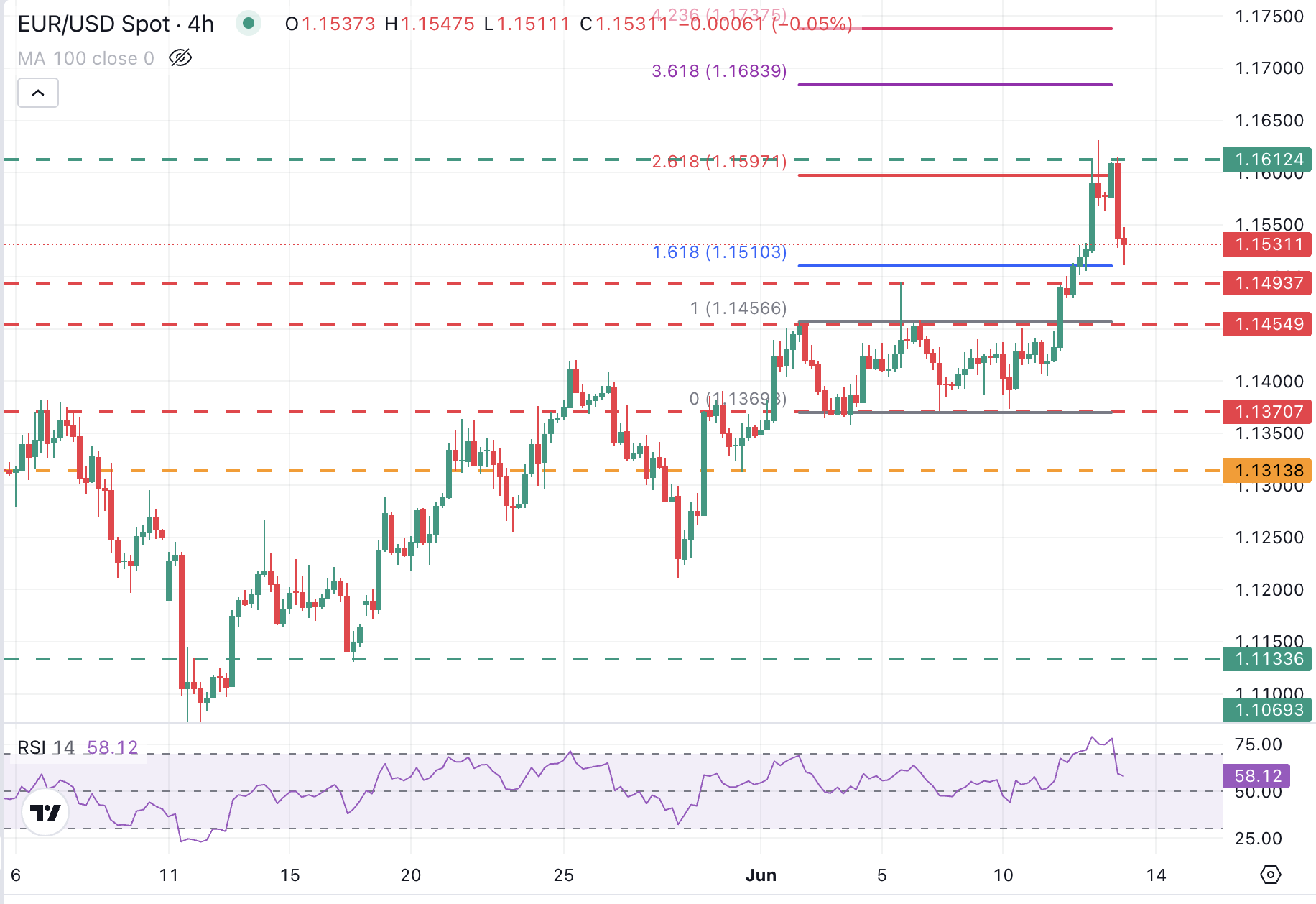
EUR/USD has been rejected at the 1.1600 area and is correcting lower. The broader trend, however, remains positive, but the 4-hour RSI seems about to cross to bearish territory, below the 50 level as the pair tests the June 5 high, at 1.1495.
A confirmation below here would bring increased pressure towards the 1.1460 support area, which broadly aligns with the highs from June 2 and 10. Further decline beyond this level would put the bullish trend into question.
On the upside, resistances are at 1.1612 (intra-day high) and then probably at 1.1685, the 361.8% Fibonacci extension of early June’s trading range.
US Dollar FAQs
The US Dollar (USD) is the official currency of the United States of America, and the ‘de facto’ currency of a significant number of other countries where it is found in circulation alongside local notes. It is the most heavily traded currency in the world, accounting for over 88% of all global foreign exchange turnover, or an average of $6.6 trillion in transactions per day, according to data from 2022. Following the second world war, the USD took over from the British Pound as the world’s reserve currency. For most of its history, the US Dollar was backed by Gold, until the Bretton Woods Agreement in 1971 when the Gold Standard went away.
The most important single factor impacting on the value of the US Dollar is monetary policy, which is shaped by the Federal Reserve (Fed). The Fed has two mandates: to achieve price stability (control inflation) and foster full employment. Its primary tool to achieve these two goals is by adjusting interest rates. When prices are rising too quickly and inflation is above the Fed’s 2% target, the Fed will raise rates, which helps the USD value. When inflation falls below 2% or the Unemployment Rate is too high, the Fed may lower interest rates, which weighs on the Greenback.
In extreme situations, the Federal Reserve can also print more Dollars and enact quantitative easing (QE). QE is the process by which the Fed substantially increases the flow of credit in a stuck financial system. It is a non-standard policy measure used when credit has dried up because banks will not lend to each other (out of the fear of counterparty default). It is a last resort when simply lowering interest rates is unlikely to achieve the necessary result. It was the Fed’s weapon of choice to combat the credit crunch that occurred during the Great Financial Crisis in 2008. It involves the Fed printing more Dollars and using them to buy US government bonds predominantly from financial institutions. QE usually leads to a weaker US Dollar.
Quantitative tightening (QT) is the reverse process whereby the Federal Reserve stops buying bonds from financial institutions and does not reinvest the principal from the bonds it holds maturing in new purchases. It is usually positive for the US Dollar.
Author

Guillermo Alcala
FXStreet
Graduated in Communication Sciences at the Universidad del Pais Vasco and Universiteit van Amsterdam, Guillermo has been working as financial news editor and copywriter in diverse Forex-related firms, like FXStreet and Kantox.