EUR/USD resumes the downside, falters ahead of 1.0200 again
- EUR/USD’s upside momentum falters near the 1.0200 mark.
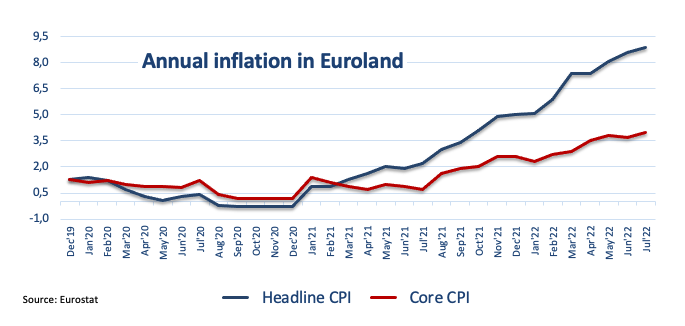
- Final Inflation Rate in the euro area came at 8.9% in July.
- US Initial Claims, Philly Fed Index take centre stage across the pond.

The selling pressure returns to the European currency and forces EUR/USD to give away part of the recent gains and return to the mid-1.0100s.
EUR/USD weaker on USD-buying
EUR/USD fades two consecutive daily advances and comes under pressure amidst shy losses on Thursday, all against the backdrop of some unostentatious rebound in the greenback.
Indeed, not much happening in the FX universe, as market participants refocus on upcoming US data and continue to digest Wednesday’s release of the FOMC Minutes.
The move lower in the pair also comes in tandem with further recovery in the German 10y Bund yields, which so far clinch the third consecutive daily gain near the 1.15% region.
In the euro docket, final inflation figures in the euro area showed the headline CPI rose 8.9% in the year to July and 0.1% vs. the previous month.
In the US calendar, usual weekly Claims and the Philly Fed Manufacturing Index will take centre stage seconded by the CB Leading Index, Existing Home Sales and speeches by FOMC’s George and Kashkari.
What to look for around EUR
EUR/USD now appears somewhat stabilized in the 1.0150 region against the backdrop of a firm recovery in the demand for the US dollar.
Price action around the European currency, in the meantime, is expected to closely follow dollar dynamics, geopolitical concerns, fragmentation worries and the Fed-ECB divergence
On the negatives for the single currency emerge the so far increasing speculation of a potential recession in the region, which looks propped up by dwindling sentiment gauges and the incipient slowdown in some fundamentals.
Key events in the euro area this week: EMU Final Inflation Rate (Thursday).
Eminent issues on the back boiler: Continuation of the ECB hiking cycle. Italian elections in late September. Fragmentation risks amidst the ECB’s normalization of its monetary conditions. Impact of the war in Ukraine on the region’s growth prospects and inflation.
EUR/USD levels to watch
So far, spot is losing 0.14% at 1.0164 and a break below 1.0096 (weekly low July 27) would target 1.0000 (psychological level) en route to 0.9952 (2022 low July 14). On the other hand, the next up barrier comes at 1.0368 (monthly high August 10) seconded by 1.0486 (100-day SMA) and finally 1.0615 (weekly high June 27).
Author

Pablo Piovano
FXStreet
Born and bred in Argentina, Pablo has been carrying on with his passion for FX markets and trading since his first college years.