EUR/USD stalls near three-week lows with all eyes on the US PPI release
- The Euro corrects higher on Wednesday against the US Dollar following a 0.5% decline on Tuesday.
- Higher US consumer prices confirmed the inflationary effect of tariffs and curbed hopes of Fed interest-rate cuts.
- EUR/USD keeps trading within a bearish trend with the 1.1600 resistance area coming into play.

The EUR/USD pair is posting minor gains on Wednesday, correcting higher after losing more than 0.5% on Tuesday. US Consumer Prices Index (CPI) figures confirmed the inflationary trend foreseen by the Federal Reserve (Fed), curbing hopes of rate cuts in the coming months. US Treasury yields and the US Dollar (USD) rallied after the data release.
The Euro (EUR) bounced up from three-week lows right above 1.1600 earlier on Wednesday, but it has remained capped below 1.1630 during the European trading session, well below Tuesday's high of 1.1695. Recent price action confirms the broader bearish trend, as the pair keeps posting lower highs and lower lows since peaking at 1.1830 on July 1.
US data released on Tuesday showed a notable increase in consumer inflation, with prices of various products rising, and particularly those of imported goods. These figures have endorsed Fed Chairman Jerome Powell's cautious stance, calling for more time to assess the real impact of US President Donald Trump's tariffs, and have prompted investors to trim rate cut bets for the coming months.
Meanwhile, trade uncertainty remains high amid the lack of progress in EU-US negotiations. Trump touted a deal with Indonesia, which, however, will not avoid a 15% tariff, and announced a new round of letters to small countries, which will be notified of levies "a little above 10%".
The Eurozone calendar is thin on Wednesday, and investors' focus will be on the US Producer Prices Index (PPI) due at 12:30 GMT. The PPI will be observed with particular interest to confirm the higher inflationary pressures shown by Tuesday's consumer prices. If that is the case, the US Dollar could rally further on risk aversion.
Euro PRICE Today
The table below shows the percentage change of Euro (EUR) against listed major currencies today. Euro was the strongest against the US Dollar.
| USD | EUR | GBP | JPY | CAD | AUD | NZD | CHF | |
|---|---|---|---|---|---|---|---|---|
| USD | -0.18% | -0.17% | -0.03% | -0.08% | -0.17% | 0.00% | -0.06% | |
| EUR | 0.18% | 0.02% | 0.16% | 0.09% | -0.04% | 0.13% | 0.13% | |
| GBP | 0.17% | -0.02% | 0.12% | 0.09% | -0.04% | 0.11% | 0.11% | |
| JPY | 0.03% | -0.16% | -0.12% | -0.05% | -0.09% | 0.00% | 0.02% | |
| CAD | 0.08% | -0.09% | -0.09% | 0.05% | -0.10% | -0.03% | 0.02% | |
| AUD | 0.17% | 0.04% | 0.04% | 0.09% | 0.10% | 0.14% | 0.15% | |
| NZD | -0.00% | -0.13% | -0.11% | -0.01% | 0.03% | -0.14% | 0.00% | |
| CHF | 0.06% | -0.13% | -0.11% | -0.02% | -0.02% | -0.15% | -0.00% |
The heat map shows percentage changes of major currencies against each other. The base currency is picked from the left column, while the quote currency is picked from the top row. For example, if you pick the Euro from the left column and move along the horizontal line to the US Dollar, the percentage change displayed in the box will represent EUR (base)/USD (quote).
Daily digest market movers: Euro rallies likely to be limited amid the cautious market mood
- The Euro is coming up from fresh multi-week lows on Wednesday, but upside attempts are likely to be limited. Investors' concerns about higher inflationary risks in the US and dwindling hopes of Fed cuts are likely to weigh on risk appetite, underpinning demand for the safe-haven US Dollar.
- On Tuesday, data from the US Bureau of Labor Statistics revealed that consumer prices grew at a 0.3% pace in June, accelerating to a 2.7% pace in the last 12 months, up from 0.1% and 2.4%, respectively. The core CPI, which strips the seasonal impact of food and energy, rose at a 2.9% yearly rate from the previous month's 2.8%, below market expectations of a 3% reading.
- Hopes of Fed courts in July fell to 3% from above 6% before the CPI release, while bets on a September cut dropped to 54% from just above 60%, according to data by the CME Group's Fed Watch Tool. The market is now pricing about 43 basis points (bps) cuts in 2025, from above 50 bps earlier this week.
- Despite the acceleration in price growth, Trump continued to pressure the central bank to ease its monetary policy. "Consumer Prices LOW. Bring down the Fed Rate, NOW!!!" posted the president on his Truth Social platform. Some Senate lawmakers are exploring a new way to oust the Fed's chairman, alleging cost overruns on the renovation of Washington's headquarters.
- The focus on Wednesday is on June's PPI data, which is due at 12:30 GMT. Market forecasts anticipate a slight decline in yearly inflation, with the headline reading easing to a 2.5% year-on-year rate from May's 2.6% and the core PPI easing to 2.7% from the previous month's 3% reading.
- The Eurozone trade surplus widened well beyond expectations in May, according to data from Eurostat, increasing to EUR16.2 billion from EUR9.9 billion in the previous month, and beating expectations of a mode moderate increment, to EUR13 billion.
- Italian CPI data has shown that inflation accelerated to 1.8% in the last 12 months to June, from the previous 1.7%. These figures are still below the European Central Bank's (ECB) 2% target, and therefore, the impact on the Euro has been marginal.
EUR/USD keeps trading within a bearish channel, with 1.1600 support in focus
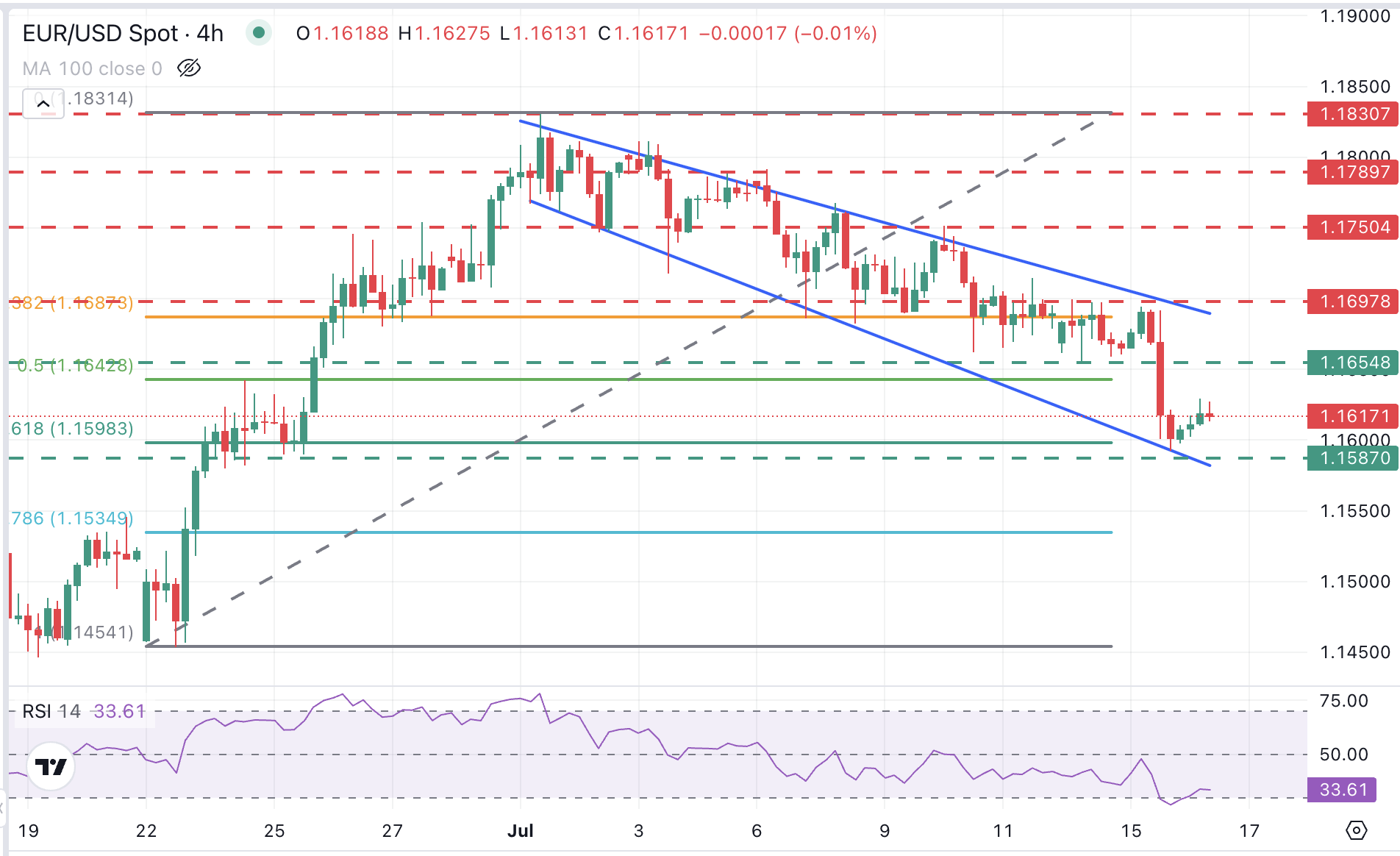
EUR/USD maintains its bearish trend from the July 1 high intact. The pair is bouncing up from lows, but upside attempts are highly likely to remain limited unless US PPI data comes out way below expectations or Trump announces a significant breakthrough on the EU-US trade talks.
The pair is correcting higher, with technical indicators in the 4-hour chart, picking up from oversold levels, but upside attempts are likely to be challenged at the previous support area at 1.1555-1.1560 (July 13 and 14 lows). Above here, the next target would be the July 14 and 15 highs, which cross the trendline resistance at the 1.1700 area.
On the downside, the pair has significant support at the 1.1585-1.1600 area, where the 61.8% Fibonacci retracement of the late June rally, a common target for corrections, meets the channel bottom and the lows of June 24 and 25. Further down, the 78.6% Fibonacci retracement of the mentioned cycle lies at 1.1535.
Economic Indicator
Producer Price Index (YoY)
The Producer Price Index released by the Bureau of Labor statistics, Department of Labor measures the average changes in prices in primary markets of the US by producers of commodities in all states of processing. Changes in the PPI are widely followed as an indicator of commodity inflation. Generally speaking, a high reading is seen as positive (or bullish) for the USD, whereas a low reading is seen as negative (or bearish).
Read more.Last release: Thu Jun 12, 2025 12:30
Frequency: Monthly
Actual: 2.6%
Consensus: 2.6%
Previous: 2.4%
Source: US Bureau of Labor Statistics
Economic Indicator
Producer Price Index ex Food & Energy (YoY)
The Producer Price Index ex Food & energy released by the Bureau of Labor statistics, Department of Labor measures the average changes in prices in primary markets of the US by producers of commodities in all states of processing. Those volatile products such as food and energy are excluded in order to capture an accurate calculation. Generally speaking, a high reading is seen as positive (or bullish) for the USD, whereas a low reading is seen as negative (or bearish).
Read more.Last release: Thu Jun 12, 2025 12:30
Frequency: Monthly
Actual: 3%
Consensus: 3.1%
Previous: 3.1%
Source: US Bureau of Labor Statistics
Author

Guillermo Alcala
FXStreet
Graduated in Communication Sciences at the Universidad del Pais Vasco and Universiteit van Amsterdam, Guillermo has been working as financial news editor and copywriter in diverse Forex-related firms, like FXStreet and Kantox.

















