EUR/USD strengthens on soft US ADP Employment, German debt reforms
- EUR/USD posts a fresh year-to-date high above 1.0700 as the US Dollar weakens amid uncertainty over US growth prospects.
- US President Trump reiterates that reciprocal tariffs to take effect on April 2.
- The ECB is expected to reduce interest rates by 25 bps on Thursday.
EUR/USD rallies to near 1.0720 in Wednesday's North American session, the highest level seen this year. The major currency pair gains as investors continue to dump the US Dollar (USD) amid growing concerns about the US economic outlook. The US Dollar Index (DXY), which tracks the Greenback’s value against six major currencies, slides to an over three-month low of 105.15.
A slew of events has changed the perception of market participants towards United States (US) President Donald Trump’s tariff agenda. Investors are anticipating that Trump tariffs will slow down US economic growth rather than being pro-growth and inflationary for the economy, which they had projected earlier.
Also, soft US ADP Employment Change data for February demonstrates the pressure of Trump tariffs on business operations, which was released during North American trading hours on Wednesday. The ADP reported that the private sector added 77K workers, lower than expectations of 140K and the former reading of 186K.
“Given the tight linkages in supply chains across the United States, Mexico, and Canada (USMCA) countries – most notably in the auto industry – tariffs left on for more than a matter of a week or two are likely to have a substantial impact on growth,” Citi said in a report.
The bank also expects a 0.1% decline in the Q1 real Gross Domestic Product (GDP) and expects the Federal Reserve (Fed) to resume its policy-easing cycle, which it paused in December, in the May meeting.
With tariffs now in effect, inflation cooling, equity markets declining, and consumer spending slowing, Citi expects the likelihood of a Fed rate cut in May has swelled.
Meanwhile, 25% tariffs on Canada and Mexico and an additional 10% on China took effect on Tuesday. Moreover, President Trump confirmed that reciprocal tariffs will be imposed from April 2 while addressing Congress on Tuesday.
Daily digest market movers: EUR/USD refreshes over three-month high as Germany confirms debt reforms
- EUR/USD extends the prior day’s strong upside move as the Euro (EUR) strengthens across the board after Germany’s likely next chancellor, Frederich Merz, and the Social Democratic Party (SDP) agreed to create a 500 billion Euro (EUR) infrastructure fund and widen the borrowing limit on Tuesday to boost defense spending and uplift economic growth in the Eurozone. Such reforms could escalate inflation in the Eurozone economy.
- Meanwhile, investors await the European Central Bank’s (ECB) monetary policy decision, which will be announced on Thursday. The ECB is almost certain to cut its Deposit Facility Rate by 25 basis points (bps) for the fifth time in a row. Therefore, investors will pay close attention to ECB President Christine Lagarde’s press conference after the policy meeting.
- Lagarde is expected to ensure that the monetary policy path is clear but won’t provide a specific monetary expansion plan. Investors would like to know the impact of Trump tariffs and Germany’s debt restructuring on the Eurozone inflation outlook.
- Still, investors remain worried that United States (US) President Donald Trump’s tariff agenda could spoil the party for Euro bulls. The Eurozone’s locomotive, Germany, is one of the major auto exporters to the US. Trump has already announced that he will charge 25% tariffs on foreign cars, which is currently 2.5% on automobiles from Germany.
Technical Analysis: EUR/USD rallies above 1.0700
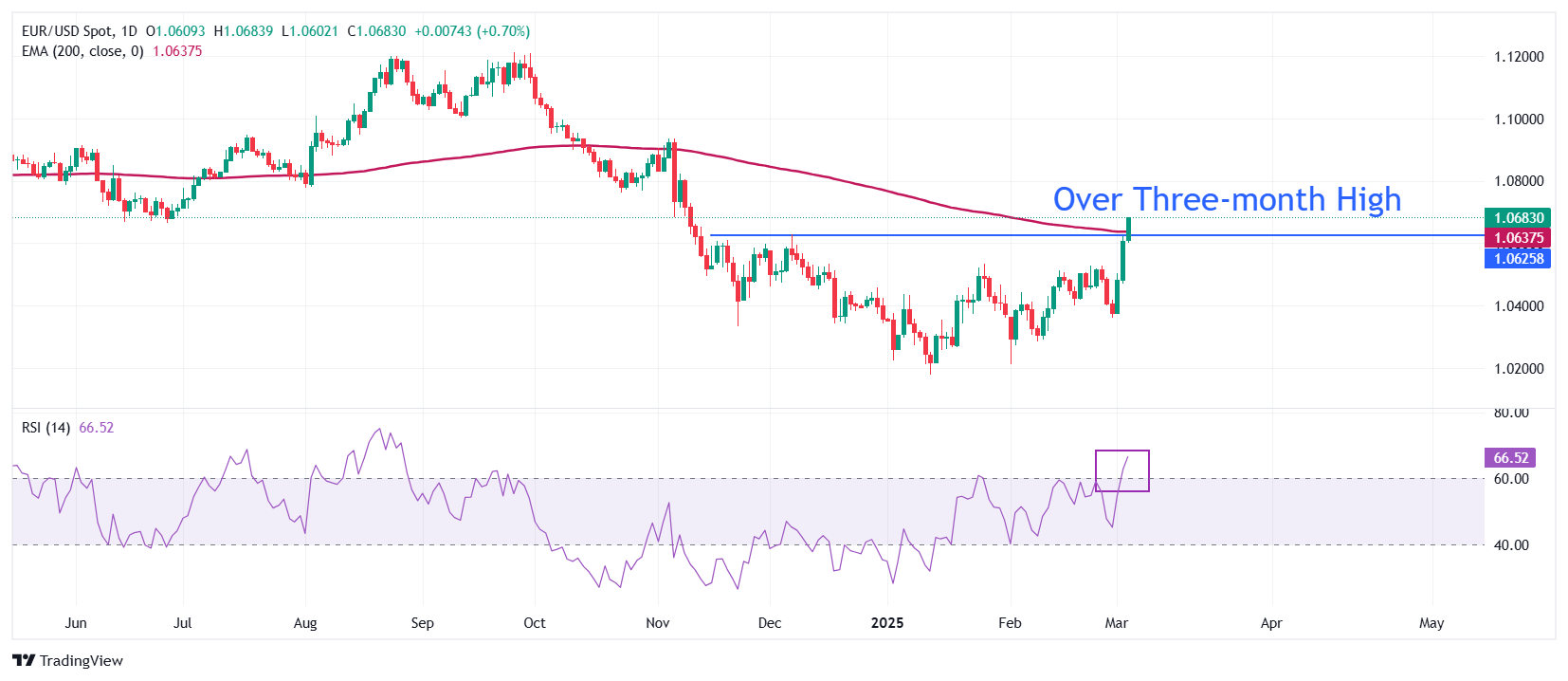
EUR/USD posts a fresh over three-month high above 1.0700, recovering above the 200-day Exponential Moving Average (EMA) for the first time since early November. The major currency pair strengthened on Tuesday after a decisive breakout above the January 27 high of 1.0533.
The 14-day Relative Strength Index (RSI) jumps above 60.00. A bullish momentum would trigger if the RSI stays above that level.
Looking down, the January 27 high of 1.0533 will act as the major support zone for the pair. Conversely, the November 6 high of 1.0937 will be the key barrier for the Euro bulls.
German economy FAQs
The German economy has a significant impact on the Euro due to its status as the largest economy within the Eurozone. Germany's economic performance, its GDP, employment, and inflation, can greatly influence the overall stability and confidence in the Euro. As Germany's economy strengthens, it can bolster the Euro's value, while the opposite is true if it weakens. Overall, the German economy plays a crucial role in shaping the Euro's strength and perception in global markets.
Germany is the largest economy in the Eurozone and therefore an influential actor in the region. During the Eurozone sovereign debt crisis in 2009-12, Germany was pivotal in setting up various stability funds to bail out debtor countries. It took a leadership role in the implementation of the 'Fiscal Compact' following the crisis – a set of more stringent rules to manage member states’ finances and punish ‘debt sinners’. Germany spearheaded a culture of ‘Financial Stability’ and the German economic model has been widely used as a blueprint for economic growth by fellow Eurozone members.
Bunds are bonds issued by the German government. Like all bonds they pay holders a regular interest payment, or coupon, followed by the full value of the loan, or principal, at maturity. Because Germany has the largest economy in the Eurozone, Bunds are used as a benchmark for other European government bonds. Long-term Bunds are viewed as a solid, risk-free investment as they are backed by the full faith and credit of the German nation. For this reason they are treated as a safe-haven by investors – gaining in value in times of crisis, whilst falling during periods of prosperity.
German Bund Yields measure the annual return an investor can expect from holding German government bonds, or Bunds. Like other bonds, Bunds pay holders interest at regular intervals, called the ‘coupon’, followed by the full value of the bond at maturity. Whilst the coupon is fixed, the Yield varies as it takes into account changes in the bond's price, and it is therefore considered a more accurate reflection of return. A decline in the bund's price raises the coupon as a percentage of the loan, resulting in a higher Yield and vice versa for a rise. This explains why Bund Yields move inversely to prices.
The Bundesbank is the central bank of Germany. It plays a key role in implementing monetary policy within Germany, and central banks in the region more broadly. Its goal is price stability, or keeping inflation low and predictable. It is responsible for ensuring the smooth operation of payment systems in Germany and participates in the oversight of financial institutions. The Bundesbank has a reputation for being conservative, prioritizing the fight against inflation over economic growth. It has been influential in the setup and policy of the European Central Bank (ECB).
Author

Sagar Dua
FXStreet
Sagar Dua is associated with the financial markets from his college days. Along with pursuing post-graduation in Commerce in 2014, he started his markets training with chart analysis.

















