EUR/USD stays resilient despite US data disappointments
- EUR/USD climbs over 0.50% as US services sector contracts, private hiring disappoints.
- Trump doubles tariffs on steel and aluminum; markets await Xi call for US-China clarity.
- Mixed Eurozone PMIs and soft inflation may justify ECB rate cut at Thursday’s meeting.

The EUR/USD advances on Wednesday, edging up over 0.42% as the Greenback erases Tuesday’s gains following the release of weaker-than-expected economic data from the United States (US). This, along with uncertainty fueled by the trade war, pushed the pair past the 1.1400 figure after hitting a daily low of 1.1356.
Late on Tuesday, US President Donald Trump signed an executive order that doubled steel and aluminum tariffs from 25% to 50%, effective June 4, for most countries, except the UK, which remains at 25%. In the meantime, traders brace for Trump’s call with Chinese President Xi Jinping later this week, according to the White House.
US data revealed that business activity in the services sector is slowing, according to the Institute for Supply Management (ISM). Earlier, ADP reported that private companies hired fewer people than projected in May, which disappointed investors and could be a prelude to a soft Nonfarm Payrolls report on Friday.
In the Eurozone, HCOB Services and Composite Purchasing Managers Indexes (PMIs) showed mixed results, with some measures expanding while the majority remained in contraction territory. This, along with last Tuesday’s inflation report in the bloc, could justify the European Central Bank (ECB) lowering rates by 25 basis points (bps) at the June 5 meeting.
The EU economic docket will report inflation figures on the producer side, along with the ECB’s decision and President Christine Lagarde’s press conference. Across the pond, the US schedule will feature Initial Jobless Claims for the last week and speeches by Federal Reserve (Fed) officials.
Euro PRICE This week
The table below shows the percentage change of Euro (EUR) against listed major currencies this week. Euro was the strongest against the US Dollar.
| USD | EUR | GBP | JPY | CAD | AUD | NZD | CHF | |
|---|---|---|---|---|---|---|---|---|
| USD | -0.64% | -0.69% | -0.73% | -0.52% | -0.98% | -1.15% | -0.67% | |
| EUR | 0.64% | -0.06% | -0.08% | 0.11% | -0.34% | -0.54% | -0.04% | |
| GBP | 0.69% | 0.06% | 0.00% | 0.17% | -0.28% | -0.48% | 0.02% | |
| JPY | 0.73% | 0.08% | 0.00% | 0.20% | -0.27% | -0.44% | -0.04% | |
| CAD | 0.52% | -0.11% | -0.17% | -0.20% | -0.46% | -0.65% | -0.15% | |
| AUD | 0.98% | 0.34% | 0.28% | 0.27% | 0.46% | -0.14% | 0.39% | |
| NZD | 1.15% | 0.54% | 0.48% | 0.44% | 0.65% | 0.14% | 0.51% | |
| CHF | 0.67% | 0.04% | -0.02% | 0.04% | 0.15% | -0.39% | -0.51% |
The heat map shows percentage changes of major currencies against each other. The base currency is picked from the left column, while the quote currency is picked from the top row. For example, if you pick the Euro from the left column and move along the horizontal line to the US Dollar, the percentage change displayed in the box will represent EUR (base)/USD (quote).
EUR/USD daily market movers: Euro boosted ahead ECB’s monetary policy
- EUR/USD uptrend remains intact, but it is responding to US and Eurozone economic data during the week.
- US ADP National Employment Change in May rose by just 37K, missing forecasts of 110K and down from April’s revised 60K, indicating weak private hiring.
- The US ISM Services PMI fell to 49.9 in May from 51.6, below the expected 52.0, signaling contraction in the services sector.
- The EU HCOB Services PMI improved in May, from 48.9 to 49.7, exceeding estimates for an unchanged figure. The Composite PMI expanded from 49.5 to 50.2, suggesting that overall business activity seems to be gathering steam.
- Financial market players have fully priced in the expectation that the ECB will reduce its Deposit Facility Rate by 25 basis points (bps) to 2% at the upcoming monetary policy meeting.
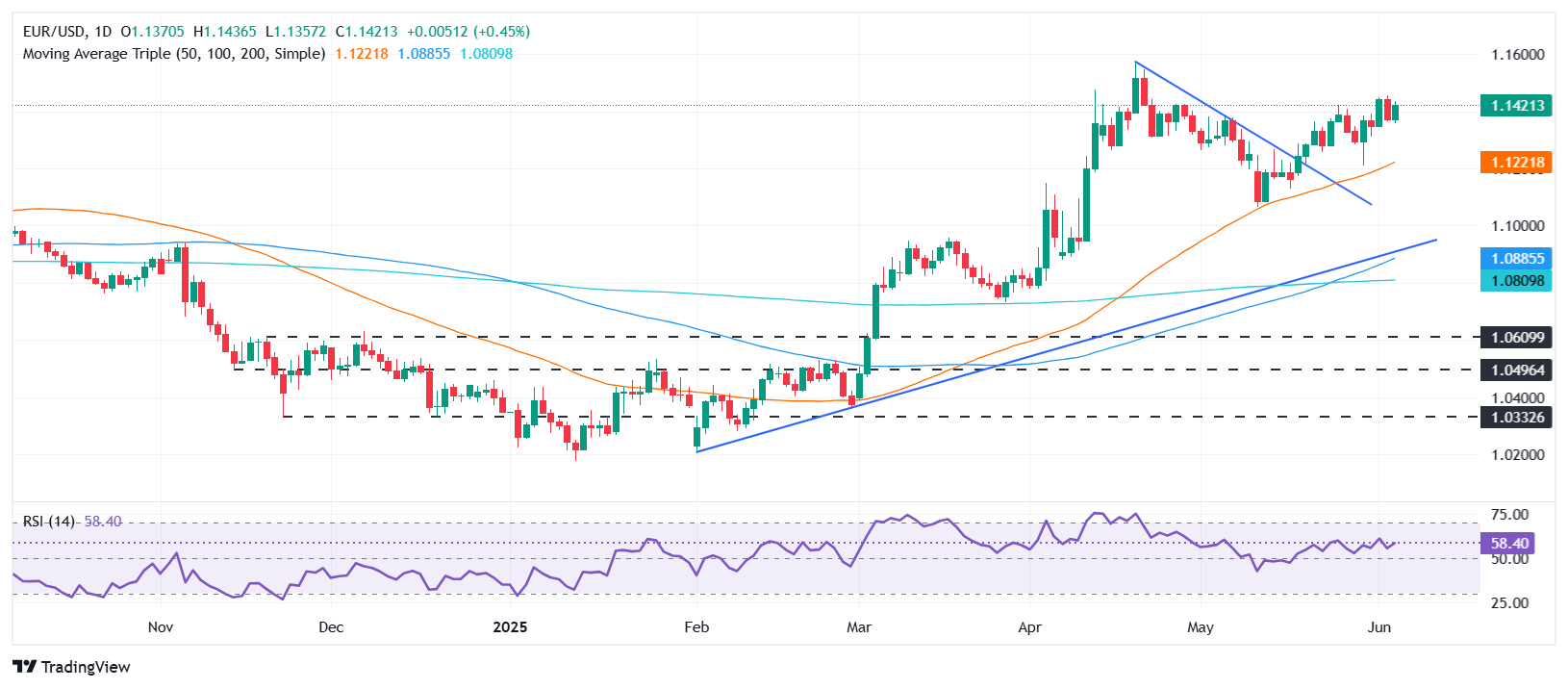
Euro technical outlook: EUR/USD cracks below 1.1400, bears eye 1.1300
The EUR/USD is upwardly biased, but so far failure to crack the weekly high of 1.1454 reached on June 3 paves the way for a pullback before the uptrend resumes. It should be said the pair hit a lower low during the current session, which means that a daily close below 1.14 could set the stage for a test of 1.13.
If EUR/USD clears 1.1454, the next resistance is 1.1500. Further gains lie overhead, with the next ceiling level seen at April highs of 1.1572, ahead of 1.16.
Conversely, If EUR/USD falls below the June 2 daily low of 1.1344, a move to 1.13 is on the cards. A breach of the latter would expose the 20-day Simple Moving Average (SMA) at 1.1284, followed by the 50-day SMA at 1.1218 and 1.1200.
Economic Indicator
ISM Services PMI
The Institute for Supply Management (ISM) Services Purchasing Managers Index (PMI), released on a monthly basis, is a leading indicator gauging business activity in the US services sector, which makes up most of the economy. The indicator is obtained from a survey of supply executives across the US based on information they have collected within their respective organizations. Survey responses reflect the change, if any, in the current month compared to the previous month. A reading above 50 indicates that the services economy is generally expanding, a bullish sign for the US Dollar (USD). A reading below 50 signals that services sector activity is generally declining, which is seen as bearish for USD.
Read more.Last release: Wed Jun 04, 2025 14:00
Frequency: Monthly
Actual: 49.9
Consensus: 52
Previous: 51.6
Source: Institute for Supply Management
The Institute for Supply Management’s (ISM) Services Purchasing Managers Index (PMI) reveals the current conditions in the US service sector, which has historically been a large GDP contributor. A print above 50 shows expansion in the service sector’s economic activity. Stronger-than-expected readings usually help the USD gather strength against its rivals. In addition to the headline PMI, the Employment Index and the Prices Paid Index numbers are also watched closely by investors as they provide useful insights regarding the state of the labour market and inflation.
Author

Christian Borjon Valencia
FXStreet
Markets analyst, news editor, and trading instructor with over 14 years of experience across FX, commodities, US equity indices, and global macro markets.