EUR/USD rebounds, Fed considers tightening as US inflation sticks
- EUR/USD bounces back from the daily low and reclaims 1.1000 after US data.
- US inflation on the rise: core PCE at 4.6% in March, unchanged from February.
- EUR/USD Price Analysis: Likely to test 1.1100 above 1.1000; otherwise, it could test the 20-day EMA in the near term.

The EUR/USD recovered from earlier losses that dragged the pair towards its daily low of 1.0962 and is trading at around the 1.1020s area after inflation in the United States (US) proved to be stickier than expected, warranting further tightening by the Federal Reserve (Fed).
EUR/USD climbed despite high inflation in the US, warrants higher rates
Wall Street prints solid gains in the mid-day of the New York session. The US Department of Commerce revealed that the Fed’s preferred gauge for inflation, the core Personal Consumption Expenditure (PCE) in March, rose by 4.6%, unchanged from February’s data. Therefore, further tightening is expected by the Federal Reserve, even though the headline figure slowed to 0.1% MoM less than the prior’s month 0.3%, and the annual figures slowed from 5.1% to 4.2%.
In the initial reaction, the EUR/USD dipped to its daily low, but since then, the shared currency posted an 80-pip gain before stabilizing at current exchange rates.
Other data reported from the University of Michigan (UoM), Consumer Sentiment, remained unchanged at 63.5, while Inflation expectations for 1-year stood at 4.6%, and for a 5-year horizon at 3%.
Regarding the following week’s Federal Reserve’s monetary policy meeting, traders appeared convinced that the US central bank will increase rates by 25 bps, as shown by the CME FedWatch Tool odds of 88%. However, they remained skeptical about the Fed’s rhetoric of going higher for longer, as the swaps market estimates 50 bps rate cuts for the year’s second half.
Therefore, the US Dollar seesawed between gains and losses, as shown by the US Dollar Index, oscillating around 101.500s, registering minuscule gains of 0.10%. BBH analysts say, “Recent data have been dollar-supportive, but until rate cuts this year are finally priced out, the dollar is likely to remain vulnerable.”
Across the pond, Germany’s GDP for Q4 improved to 0%, from Q3’s -0.4% contraction, but missed estimates of 0.2%. In the meantime, the Eurozone (EU) reported GDP at 0.1% for Q4 and also missed the 0.2% projected by the consensus.
EUR/USD Technical Analysis
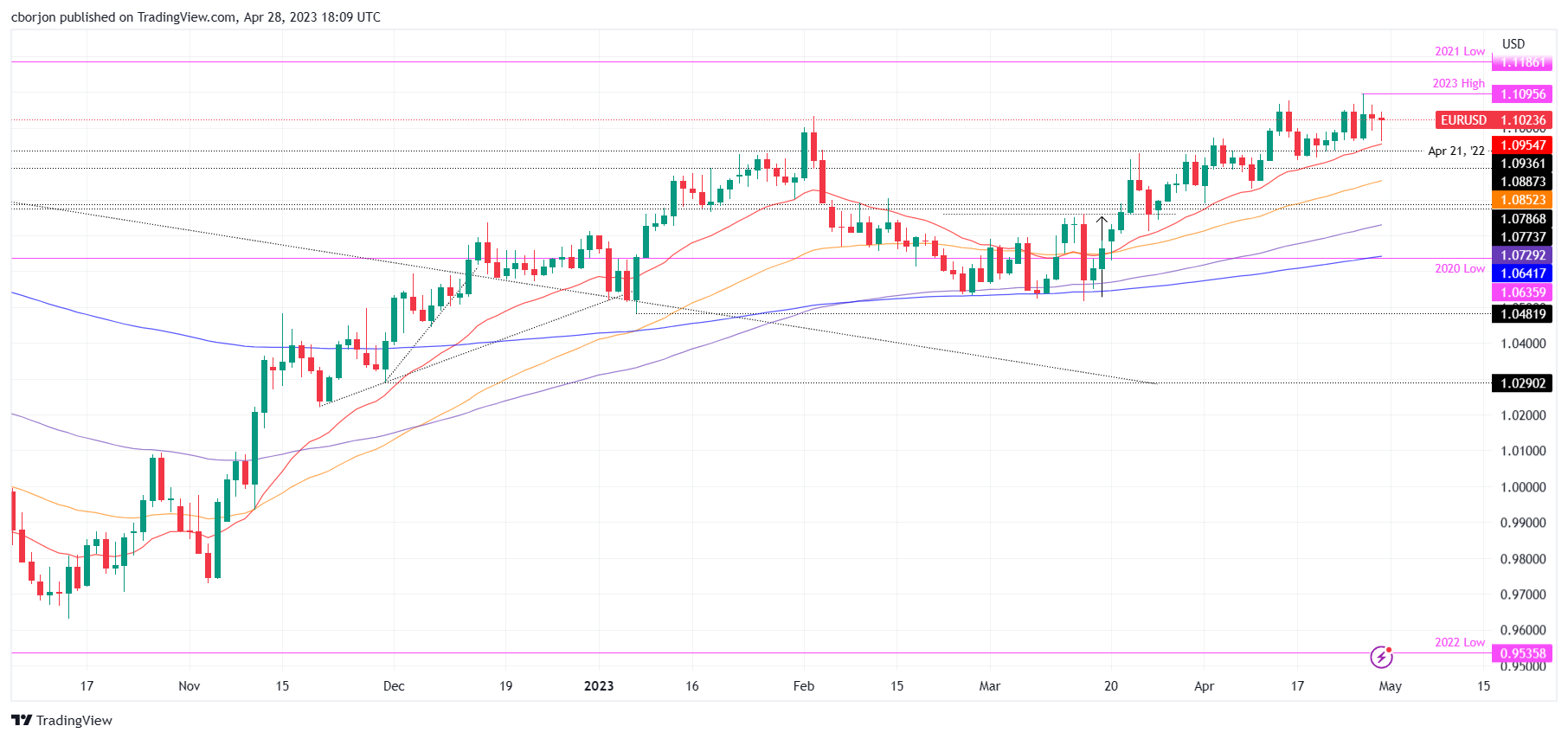
The EUR/USD remained supported by the 20-day EMA, which, acting as dynamic support, remains sought by buyers, as the pair has bounced from that area since mid-March. Additionally, the Relative STrengh Index (RSI) indicator continued to be in bullish territory, though its slope turned flat, as buyers took a respite after a failing attempt to 1.1100. If EUR/USD breaks the YTD high at 1.1095, 1.1100 would be up for grabs. Once conquered, buyers would look to challenge the 2021 cycle low turned resistance at 1.1186, ahead of 1.1200. On the flip side, the EUR/USD could remain sideways and test the 20-day EMA at 1.0955
Author

Christian Borjon Valencia
FXStreet
Markets analyst, news editor, and trading instructor with over 14 years of experience across FX, commodities, US equity indices, and global macro markets.
















