EUR/USD jumps as Trump holds fire on Iran, Waller fuels cut bets
- EUR/USD up 0.36%, set to end week flat after Trump delays military action against Iran.
- Waller’s call for a July cut contrasts with Fed report and Barkin’s cautious stance.
- EU–US trade deal in jeopardy as July 9 deadline nears, capping upside potential.

The Euro recovers some ground against the US Dollar on Friday and is set to finish the week virtually flat as risk appetite deteriorates. This is taking place despite US President Donald Trump delaying a military intervention in the Israel–Iran conflict. At the time of writing, the EUR/USD trades at 1.1534, up 0.36%.
Market appetite has turned negative due to US trade policies restricting chipmakers with production interests in China as a top US official seeking to revoke waivers sent major US indices tumbling. In the meantime, Trump’s decision to support diplomacy over fighting, delaying a possible attack for two weeks, underpinned the shared currency. Nevertheless, Iran said it would not negotiate while Israel continued hostilities.
Another event that boosted the Euro was Federal Reserve (Fed) Governor Christopher Waller announcing that he supports a rate cut in July. Contrarily, the Fed monetary policy report suggested that current policy is well-positioned amid uncertainty of external shocks, while Richmond Fed President Thomas Barkin favored further patience before reducing rates.
Despite this, the EUR/USD could be pressured due to the failure to reach a trade agreement between the European Union (EU) and the United States. The chances of a deal are diminishing as the clock ticks to the July 9 deadline.
On the data front, the EU revealed that the EU Consumer Confidence index disappointed investors, though traders shrugged off the bad reading and drove the EUR/USD higher.
Euro PRICE This week
The table below shows the percentage change of Euro (EUR) against listed major currencies this week. Euro was the strongest against the Canadian Dollar.
| USD | EUR | GBP | JPY | CAD | AUD | NZD | CHF | |
|---|---|---|---|---|---|---|---|---|
| USD | 0.18% | 0.88% | 1.05% | 1.17% | 0.53% | 0.88% | 0.80% | |
| EUR | -0.18% | 0.59% | 0.86% | 1.00% | 0.49% | 0.71% | 0.62% | |
| GBP | -0.88% | -0.59% | 0.29% | 0.41% | -0.11% | 0.12% | 0.04% | |
| JPY | -1.05% | -0.86% | -0.29% | 0.11% | -0.82% | -0.54% | -0.66% | |
| CAD | -1.17% | -1.00% | -0.41% | -0.11% | -0.56% | -0.29% | -0.37% | |
| AUD | -0.53% | -0.49% | 0.11% | 0.82% | 0.56% | 0.23% | 0.14% | |
| NZD | -0.88% | -0.71% | -0.12% | 0.54% | 0.29% | -0.23% | -0.08% | |
| CHF | -0.80% | -0.62% | -0.04% | 0.66% | 0.37% | -0.14% | 0.08% |
The heat map shows percentage changes of major currencies against each other. The base currency is picked from the left column, while the quote currency is picked from the top row. For example, if you pick the Euro from the left column and move along the horizontal line to the US Dollar, the percentage change displayed in the box will represent EUR (base)/USD (quote).
Daily digest market movers: EUR/USD shrugs off Fed hawkishness and rallies
- Geopolitics will continue to drive price action, which so far has benefited further US Dollar appreciation. Hence, a risk-off environment is most likely to push the EUR/USD downward, even though the “Sell America” trade remains intact.
- Fresh data from the United States signaled a cooling economy, with the Philadelphia Fed Manufacturing Index holding at -4 in June, unchanged from May but falling short of expectations for a more minor contraction of -1.
- Fed Chair Jerome Powell said the bank is in wait-and-see mode, adding that policy is modestly restrictive. He added that as long as the labor market remains solid and inflation cools down, holding rates is the “right thing to do.”
- During the week, the Fed held rates unchanged at 4.25%-4.50%. Fed officials updated their economic projections, downgrading the 2025 GDP growth outlook to 1.4% from 1.7% in March. The Unemployment Rate forecast was revised up to 4.5% from 4.4%, while the core PCE inflation projection rose to 3.1% from 2.8%.
- EU Consumer Confidence in June fell to -15.3, worse than the expected -14.5 improvement.
- Financial market players do not expect that the ECB will reduce its Deposit Facility Rate by 25 basis points (bps) at the July monetary policy meeting.
Euro technical outlook: EUR/USD climbs above 1.1500, bulls target 1.1550
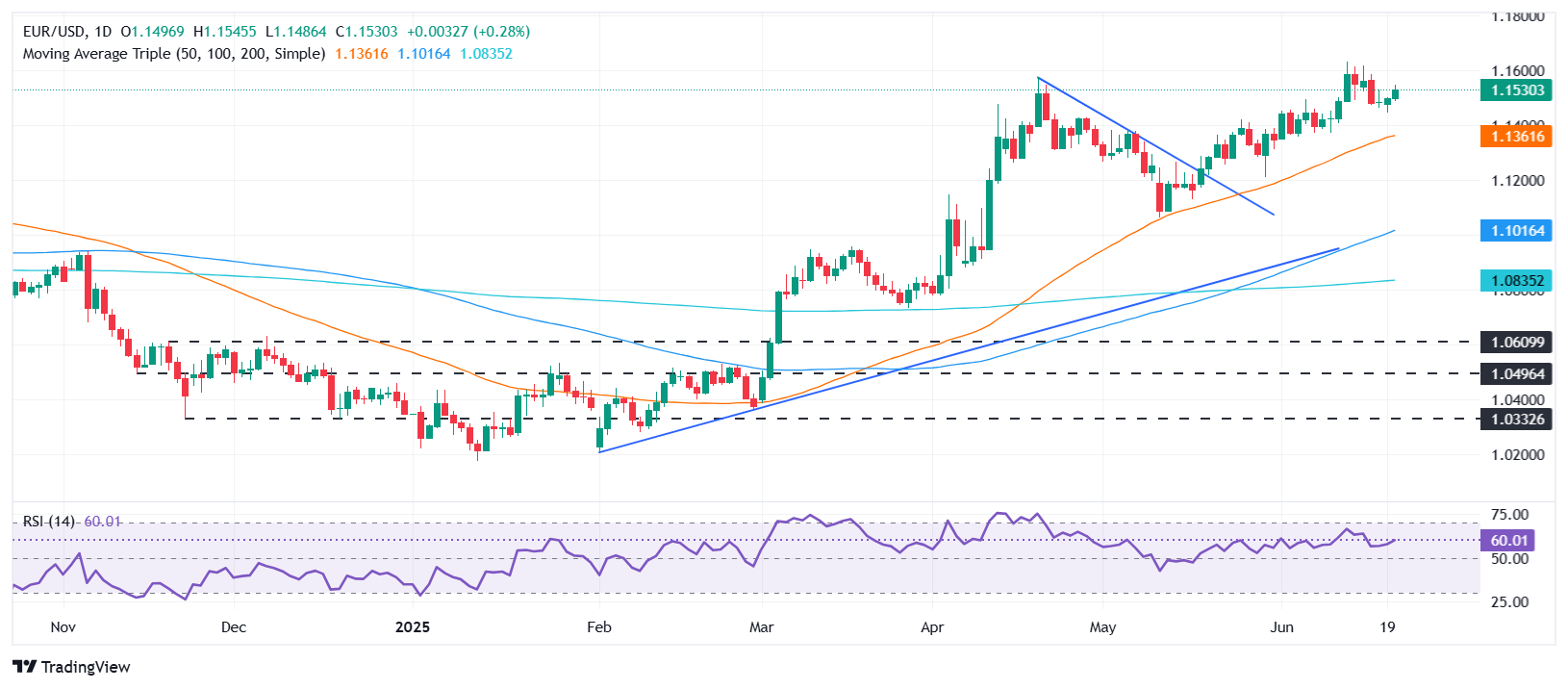
From a technical standpoint, the EUR/USD uptrend is resuming. Price action suggests that a “morning star” three-candle chart pattern implies that buyers are accumulating, poised to drive the exchange rate higher. Further confirmation is provided by the Relative Strength Index (RSI), which is aiming upwards after stalling for two days.
Hence, the EUR/USD first resistance would be 1.1550. A breach of the latter will expose 1.1600, followed by the YTD high of 1.1631. Conversely, a daily close below 1.1500 paves the way to test 1.1450. The next key support would be the 20-day Simple Moving Average (SMA) at 1.1438, followed by 1.1400.
ECB FAQs
The European Central Bank (ECB) in Frankfurt, Germany, is the reserve bank for the Eurozone. The ECB sets interest rates and manages monetary policy for the region. The ECB primary mandate is to maintain price stability, which means keeping inflation at around 2%. Its primary tool for achieving this is by raising or lowering interest rates. Relatively high interest rates will usually result in a stronger Euro and vice versa. The ECB Governing Council makes monetary policy decisions at meetings held eight times a year. Decisions are made by heads of the Eurozone national banks and six permanent members, including the President of the ECB, Christine Lagarde.
In extreme situations, the European Central Bank can enact a policy tool called Quantitative Easing. QE is the process by which the ECB prints Euros and uses them to buy assets – usually government or corporate bonds – from banks and other financial institutions. QE usually results in a weaker Euro. QE is a last resort when simply lowering interest rates is unlikely to achieve the objective of price stability. The ECB used it during the Great Financial Crisis in 2009-11, in 2015 when inflation remained stubbornly low, as well as during the covid pandemic.
Quantitative tightening (QT) is the reverse of QE. It is undertaken after QE when an economic recovery is underway and inflation starts rising. Whilst in QE the European Central Bank (ECB) purchases government and corporate bonds from financial institutions to provide them with liquidity, in QT the ECB stops buying more bonds, and stops reinvesting the principal maturing on the bonds it already holds. It is usually positive (or bullish) for the Euro.
Author

Christian Borjon Valencia
FXStreet
Markets analyst, news editor, and trading instructor with over 14 years of experience across FX, commodities, US equity indices, and global macro markets.