EUR/USD jumps as traders look past Iran-Israel turmoil ahead of US Retail Sales
- EUR/USD climbs to 1.1572 as market shrugs off new missile attacks on Israel.
- Fed’s dovish shift in sentiment follows weak US Empire State Manufacturing data.
- ECB officials speak as traders await Fed’s June 18 policy decision and projections.

EUR/USD recovered after posting a loss of 0.25% last Friday, as hostilities between Israel and Iran began, which boosted the Greenback’s appeal. Nevertheless, with both parties set to continue exchanging blows and a slightly diminished risk of turning into a regional conflict, an improvement in risk appetite underpins the shared currency.
The EUR/USD trades at 1.1572, up 0.17%, after reaching a daily low of 1.1523. The Greenback trades on the back foot. A scarce economic docket in the United States (US) revealed that manufacturing activity in the New York area plunged to its weakest reading since March’s two-year low, indicating the ongoing economic slowdown.
Meanwhile, the majority of the news headlines are focused on the Israel-Iran conflict, which is set to continue despite the White House exerting pressure on Tehran to reach a deal. Iranian state TV announced that a new wave of Iranian missile attacks on Israel has begun, targeting Tel Aviv and Haifa.
Earlier, the Eurozone (EU) economic docket featured speakers from the European Central Bank (ECB), led by Vice-President Luis de Guindos and Bundesbank President Joachim Nagel. Other data showed that S&P affirmed Germany's creditworthiness at ‘AAA’ rating with a stable outlook.
Market mood improved even though the Middle East conflict continued. Traders are watching the Federal Reserve's (Fed) monetary policy decision on June 18, followed by the press conference of Fed Chair Jerome Powell. Alongside this, Fed officials would update their economic projections, which would be crucial in setting the path of monetary policy and could influence the direction of the EUR/USD.
Daily digest market movers: EUR/USD recovers as market sentiment improves
- Despite retreating, EUR/USD appears poised to resume its uptrend as ECB officials have become slightly hawkish, and news has emerged that US-China talks could provide relief for investors. Nonetheless, an escalation of the Israel-Iran war exerts downward pressure on the pair.
- ECB’s De Guindos commented that the EUR/USD at 1.15 is not a big obstacle, as appreciation is not rapid and volatility is not extreme. He said that markets understood the ECB’s stance that the bank is close to target. He added that the risk of undershooting inflation is minimal and that risks of inflation are balanced.
- ECB’s Nagel said that it is not sensible to signal either a rate pause or cut, given the exceptional uncertainty.
- The New York Fed Empire State Manufacturing Index in June plummeted by 16 points, down from May’s -5.5 contraction, painting a gloomy economic outlook for the New York region.
- On Tuesday, US Retail Sales for May are expected to show a contraction of -0.7%, down from April’s 0.1% growth, as revealed by the US Census Bureau. If the data comes as expected, sales will dip to their second-lowest level after February’s -0.9% MoM reading.
- On June 17-18, the Fed will host its latest monetary policy meeting. Traders have priced in that rates would remain unchanged, but they’re eyeing the update of the Summary of Economic Projections (SEP).
- Across the pond, the EU economic docket will feature the ZEW Survey of Economic Sentiment for June, which is projected to rise from 11.6 in May to 23.5 MoM.
- Financial market players do not expect that the ECB will reduce its Deposit Facility Rate by 25 basis points (bps) at the July monetary policy meeting.
Euro technical outlook: EUR/USD hovers above 1.1550, clings to gains
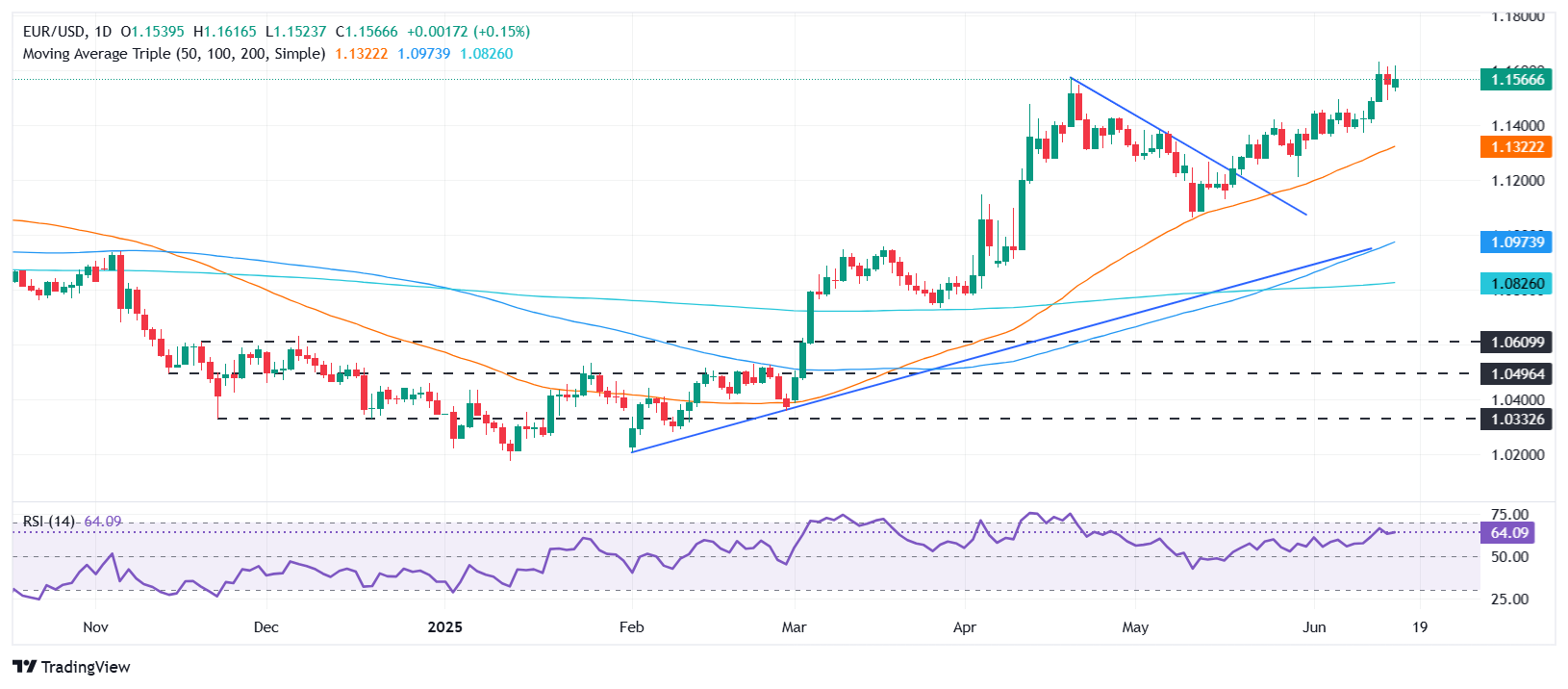
The EUR/USD uptrend remains in place, though it is facing stiff resistance at 1.1600. Buyers' reluctance to decisively clear the latter has opened the door for a retracement. The Relative Strength Index (RSI) indicates a lack of commitment among buyers, as the RSI, despite being bullish, dips toward its neutral line.
If EUR/USD drops below 1.1550, the next support level would be 1.1500. If surpassed, the next stop would be the 1.1450 figure, followed by the 20-day Simple Moving Average (SMA) at 1.1386.
On the flip side, if EUR/USD holds above 1.1550, buyers could drive the exchange rate to 1.1614, the June 16 peak, ahead of 1.1600 to test the year-to-date (YTD) high at 1.1631. Up next lies 1.1700.
ECB FAQs
The European Central Bank (ECB) in Frankfurt, Germany, is the reserve bank for the Eurozone. The ECB sets interest rates and manages monetary policy for the region. The ECB primary mandate is to maintain price stability, which means keeping inflation at around 2%. Its primary tool for achieving this is by raising or lowering interest rates. Relatively high interest rates will usually result in a stronger Euro and vice versa. The ECB Governing Council makes monetary policy decisions at meetings held eight times a year. Decisions are made by heads of the Eurozone national banks and six permanent members, including the President of the ECB, Christine Lagarde.
In extreme situations, the European Central Bank can enact a policy tool called Quantitative Easing. QE is the process by which the ECB prints Euros and uses them to buy assets – usually government or corporate bonds – from banks and other financial institutions. QE usually results in a weaker Euro. QE is a last resort when simply lowering interest rates is unlikely to achieve the objective of price stability. The ECB used it during the Great Financial Crisis in 2009-11, in 2015 when inflation remained stubbornly low, as well as during the covid pandemic.
Quantitative tightening (QT) is the reverse of QE. It is undertaken after QE when an economic recovery is underway and inflation starts rising. Whilst in QE the European Central Bank (ECB) purchases government and corporate bonds from financial institutions to provide them with liquidity, in QT the ECB stops buying more bonds, and stops reinvesting the principal maturing on the bonds it already holds. It is usually positive (or bullish) for the Euro.
Author

Christian Borjon Valencia
FXStreet
Markets analyst, news editor, and trading instructor with over 14 years of experience across FX, commodities, US equity indices, and global macro markets.