EUR/USD rallies to 1.1800 as Dollar slumps ahead of Powell
- Fed speakers split, with Bostic, Musalem, Hammack hawkish; Miran dovish, calling neutral rate at just 2%.
- Dollar Index tumbles 0.34% to 97.31, driving broad USD weakness and supporting EUR/USD upside momentum.
- Traders await Powell’s Tuesday speech and Flash PMI data in US and Europe for fresh directional cues.

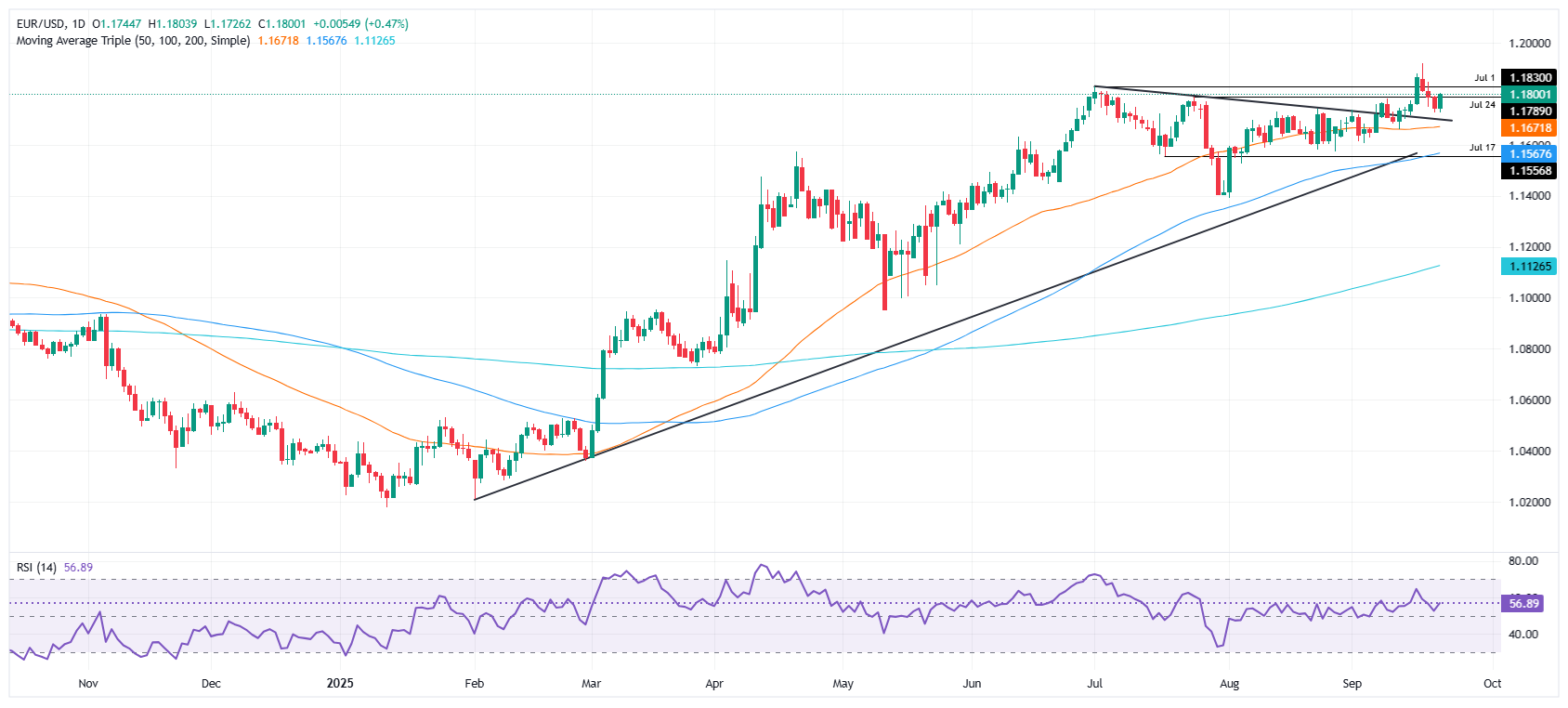
EUR/USD rallies as the Greenback gets hammered, hovers around 1.1800 up 0.47% in the day as market players wait for clues of further easing by the Federal Reserve, as a flurry of officials would cross the wires during the week.
Greenback weakens on dovish Fed signals; Euro gains as traders eye PMIs on both sides of the Atlantic
On Monday, Fed policymakers crossed the wires. Atlanta’s Fed President Raphael Bostic, St. Louis Fed Alberto Musalem, Richmond Fed Thomas Barkin, Cleveland Fed Beth Hammack and Fed Governor Stephen Miran delivered remarks, ahead of Chair Jerome Powell speech on Tuesday.
On the hawkish side lie Bostic, Musalem and Hammack, while Barkin tilted neutral. On the dovish front lies Miran, who amongst the comments he made, was that he sees the fed funds rate neutral rate at 2%.
The Euro is boosted by overall Dollar weakness as depicted by the US Dollar Index (DXY). The DXY which tracks the American currency value against other six currencies, falls 0.34% at 97.31.
Across the pond, the Bundesbank President and European Central Bank (ECB) member Joachim Nagel said that the current valuation of the Euro, does not worry him. Aside from this, focus in both sides of the Atlantic would lie on the release of Flash PMIs, revealed by S&P Global in the US and by the HCOB in Europe.
Daily market movers: EUR/USD shrugs off hawkish comment by Fed officials
- Atlanta Fed President Raphael Bostic told the Wall Street Journal he remains cautious about backing a rate cut in October due to inflation risks, though he acknowledged growing downside risks to employment.
- St. Louis Fed’s Alberto Musalem supported the recent cut as a precautionary step to aid the labor market, adding he would favor further easing if jobs data weakens and inflation expectations stay anchored.
- Fed Governor Stephen Miran argued policy is “very restrictive,” projecting the neutral fed funds rate near 2%. Richmond Fed’s Thomas Barkin said consumers are shouldering modest tariff costs, while economic uncertainty is beginning to ease.
- Cleveland Fed’s Beth Hammack stressed the Fed faces challenges on both sides of its mandate, citing greater inflation risks. On jobs, she described the current backdrop as a “low-hiring, low-firing” market, with firms hesitant to bring on workers.
- EU’s Kallas said it is no accident that Russia violated European air space three times in two weeks, adding that Russia is testing European borders and undermining its security, and will continue to provoke if it is allowed to do so, according to Reuters. EU's Kallas said if Russian planes are violating air space every country has right to defend itself.
- The Kremlin dismissed alleged violations of airspace by Russian jets, calling the claims baseless and aimed at escalating tensions, according to Reuters.
- Consumer Confidence in the Euro area improved to -14.9 in September, up from August’s -15.5 and better than estimates of -15.3.
- Futures markets are pricing a 90% probability of a 25-basis-point Fed rate cut this month, along with nearly an 80% chance of another quarter-point reduction in December.
Technical outlook: EUR/USD bulls emerge, drive prices towards 1.1800
EUR/USD remains upward biased after forming a ‘bullish engulfing’ candle chart pattern, which implies that buyers are poised to drive higher prices. As momentum builds, the Relative Strength Index (RSI) slope turned higher in bullish territory. If the RSI clears its latest peak at 65.44, it will mean that the trend is getting stronger.
If EUR/USD clears 1.1800, the first resistance would be 1.1850 ahead of the yearly peak at 1.1918. A breach of the latter will expose 1.2000. Conversely, a drop below 1.1750 would open the door for further downside. The first support would be 1.1700, ahead of the confluence of the 100-day SMA and the August 27 swing low near 1.1560–1.1574.
Euro FAQs
The Euro is the currency for the 19 European Union countries that belong to the Eurozone. It is the second most heavily traded currency in the world behind the US Dollar. In 2022, it accounted for 31% of all foreign exchange transactions, with an average daily turnover of over $2.2 trillion a day. EUR/USD is the most heavily traded currency pair in the world, accounting for an estimated 30% off all transactions, followed by EUR/JPY (4%), EUR/GBP (3%) and EUR/AUD (2%).
The European Central Bank (ECB) in Frankfurt, Germany, is the reserve bank for the Eurozone. The ECB sets interest rates and manages monetary policy. The ECB’s primary mandate is to maintain price stability, which means either controlling inflation or stimulating growth. Its primary tool is the raising or lowering of interest rates. Relatively high interest rates – or the expectation of higher rates – will usually benefit the Euro and vice versa. The ECB Governing Council makes monetary policy decisions at meetings held eight times a year. Decisions are made by heads of the Eurozone national banks and six permanent members, including the President of the ECB, Christine Lagarde.
Eurozone inflation data, measured by the Harmonized Index of Consumer Prices (HICP), is an important econometric for the Euro. If inflation rises more than expected, especially if above the ECB’s 2% target, it obliges the ECB to raise interest rates to bring it back under control. Relatively high interest rates compared to its counterparts will usually benefit the Euro, as it makes the region more attractive as a place for global investors to park their money.
Data releases gauge the health of the economy and can impact on the Euro. Indicators such as GDP, Manufacturing and Services PMIs, employment, and consumer sentiment surveys can all influence the direction of the single currency. A strong economy is good for the Euro. Not only does it attract more foreign investment but it may encourage the ECB to put up interest rates, which will directly strengthen the Euro. Otherwise, if economic data is weak, the Euro is likely to fall. Economic data for the four largest economies in the euro area (Germany, France, Italy and Spain) are especially significant, as they account for 75% of the Eurozone’s economy.
Another significant data release for the Euro is the Trade Balance. This indicator measures the difference between what a country earns from its exports and what it spends on imports over a given period. If a country produces highly sought after exports then its currency will gain in value purely from the extra demand created from foreign buyers seeking to purchase these goods. Therefore, a positive net Trade Balance strengthens a currency and vice versa for a negative balance.
Author

Christian Borjon Valencia
FXStreet
Markets analyst, news editor, and trading instructor with over 14 years of experience across FX, commodities, US equity indices, and global macro markets.

















