EUR/USD extends rally as US fiscal woes escalate, US budget vote looms
- Moody’s cuts US debt rating, igniting US Dollar selloff and boosting EUR/USD.
- Euro gains despite light data flow as ECB and Fed speeches guide sentiment.
- Traders eye PMIs and jobless claims for fresh cues amid fiscal uncertainty.

EUR/USD extended its rally for the third consecutive day on Wednesday as the US Dollar (USD) continued to face headwinds following the credit downgrade of the United States last Friday. This, along with the vote for Trump's “One Big, Beautiful Bill,” is weighing on traders, as it will increase the national debt, which has been deemed unsustainable by Federal Reserve (Fed) Chair Jerome Powell.
The single currency continues to capitalize on broad US Dollar weakness. Moody’s downward revision to the US government debt rating from AAA to Aa1 on Friday ignited investors' fears over the weekend as the Trump administration budget will be subject to a vote in the US Congress.
The lack of economic data in the Eurozone (EU) and the US keeps traders entertained by speeches from European Central Bank (ECB) and Fed officials. Additionally, US trade deal talks, market sentiment and geopolitics have helped shape the EUR/USD’s path.
Recently, ECB member Jose Luis Escriva commented that the recent appreciation of the Euro had been a surprise, adding that it would be more challenging to predict how tariffs impact inflation.
On Thursday, the economic schedule will feature HCOB Purchasing Managers Index (PMI) data for May in the EU, Germany and France. Across the pond, the US economic docket will feature Initial Jobless Claims data and S&P Global PMIs, which are expected to remain unchanged, according to estimates.
EUR/USD daily market movers: Boosted by USD sell-off as markets punish US policies
- US House Majority Leader Scalise said that the US House of Representatives will vote on Trump’s tax bill late Wednesday. Earlier, US President Donald Trump expressed confidence in the bill's progress in Congress.
- Trump confirmed that truce talks between Russia and Ukraine would commence; he stated that the negotiations would take place in Vatican City.
- A ceasefire between Russia and Ukraine will benefit both countries, easing supply chain disruptions across Europe.
- Interest rate probabilities indicate a 58% chance that the ECB will reduce rates by 25 basis points at the upcoming June 5 meeting. Most ECB officials had expressed favoring a cut at the next meeting, followed by a pause.
- HCOB PMI data in the EU is expected to show a minimal improvement in the Manufacturing PMI, but not in Services and Composite. Despite remaining in expansionary territory, this highlights the ongoing global economic slowdown.
- German PM Merz confirmed a meeting with US President Trump and indicated a proposal to eliminate tariffs mutually. Merz expressed optimism that the US may be open to pursuing a trade agreement with the EU, signaling a potential thaw in transatlantic trade tensions.
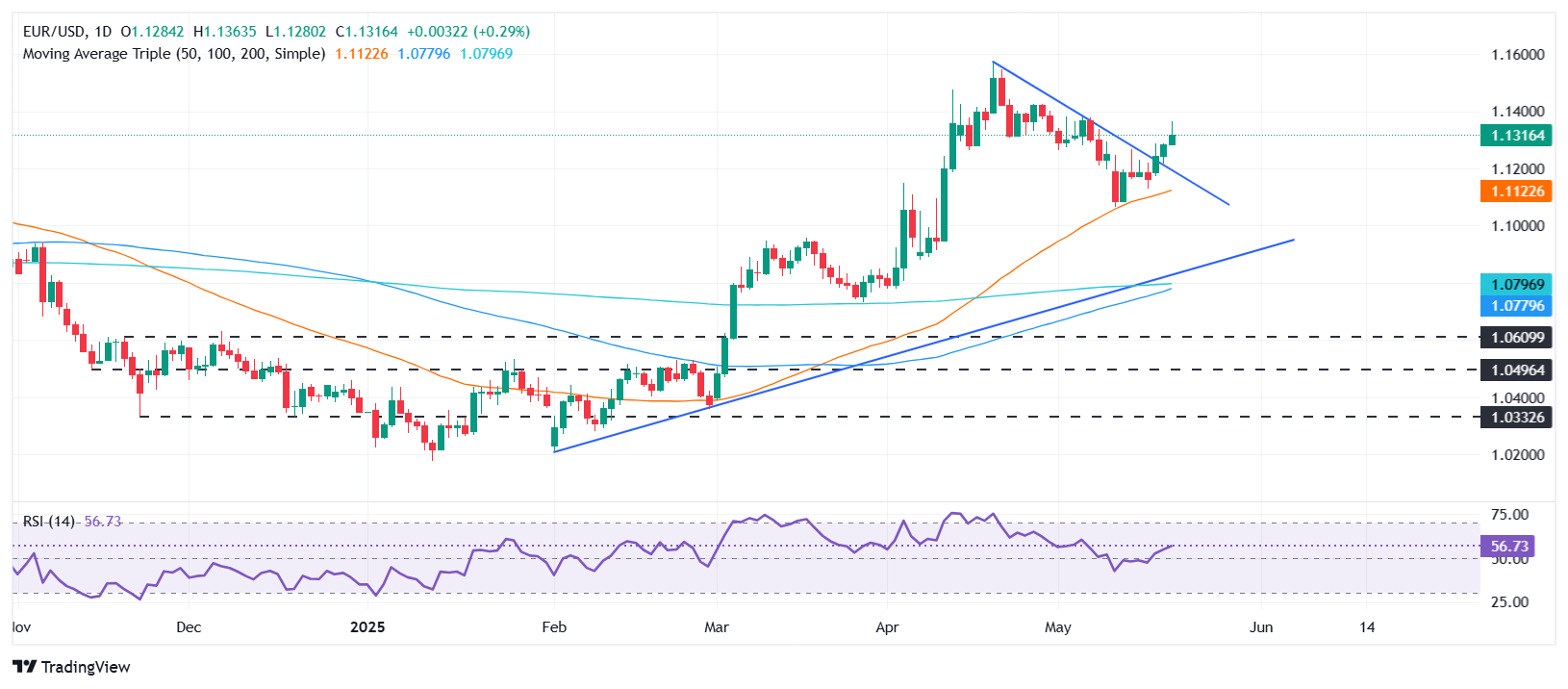
EUR/USD technical outlook: Bulls ready to challenge 1.1400
The EUR/USD remains bullishly biased. The pair cleared the 20-day Simple Moving Average (SMA) at 1.1277 and is on its way to hit a two-week high of 1.1362, surpassing the 1.1300 mark.
The Relative Strength Index (RSI) shows that momentum favors buyers.
Hence, the EUR/USD next resistance would be 1.1400. A breach of the latter will expose the April 29 peak at 1.1421, followed by the April 11 high of 1.1473 and 1.15.
On the bearish front, sellers need to pull prices below 1.1300. This would pave the way to test the May 20 daily low of 1.1217, followed by 1.12 and the 50-day SMA at 1.1130.
Interest rates FAQs
Interest rates are charged by financial institutions on loans to borrowers and are paid as interest to savers and depositors. They are influenced by base lending rates, which are set by central banks in response to changes in the economy. Central banks normally have a mandate to ensure price stability, which in most cases means targeting a core inflation rate of around 2%. If inflation falls below target the central bank may cut base lending rates, with a view to stimulating lending and boosting the economy. If inflation rises substantially above 2% it normally results in the central bank raising base lending rates in an attempt to lower inflation.
Higher interest rates generally help strengthen a country’s currency as they make it a more attractive place for global investors to park their money.
Higher interest rates overall weigh on the price of Gold because they increase the opportunity cost of holding Gold instead of investing in an interest-bearing asset or placing cash in the bank. If interest rates are high that usually pushes up the price of the US Dollar (USD), and since Gold is priced in Dollars, this has the effect of lowering the price of Gold.
The Fed funds rate is the overnight rate at which US banks lend to each other. It is the oft-quoted headline rate set by the Federal Reserve at its FOMC meetings. It is set as a range, for example 4.75%-5.00%, though the upper limit (in that case 5.00%) is the quoted figure. Market expectations for future Fed funds rate are tracked by the CME FedWatch tool, which shapes how many financial markets behave in anticipation of future Federal Reserve monetary policy decisions.
Author

Christian Borjon Valencia
FXStreet
Markets analyst, news editor, and trading instructor with over 14 years of experience across FX, commodities, US equity indices, and global macro markets.