EUR/USD Price Forecast: EUR/USD stalls below 1.1650 as Dollar firms ahead of Fed decision
- EUR/USD slips toward a one-week low as the US Dollar rebounds from recent lows.
- Markets await the Fed's interest rate decision on Wednesday, with expectations leaning toward another rate cut.
- Technical setup highlights strong resistance at 1.1650, while the 21-day and 50-day SMAs cushion the downside.

The Euro edges lower against the US Dollar on Monday, with EUR/USD reversing earlier gains as the Greenback stages a rebound from recent lows, weighing on the shared currency. At the time of writing, EUR/USD is trading near 1.1623, close to a one-week low, after touching an intraday high of 1.1672 during the European session.
The US Dollar Index (DXY), which tracks the Greenback against a basket of six major currencies, is trading around 99.20, after dipping to 98.79 earlier in the Asian session.
Despite the pullback, the broader fundamental backdrop remains supportive for the Euro. The Federal Reserve (Fed) is widely expected to deliver another interest rate cut on Wednesday, while the European Central Bank (ECB) is seen keeping rates unchanged at its upcoming policy meeting later this month. The diverging central-bank outlook keeps downside in EUR/USD somewhat contained, even as short-term flows favour the Dollar.
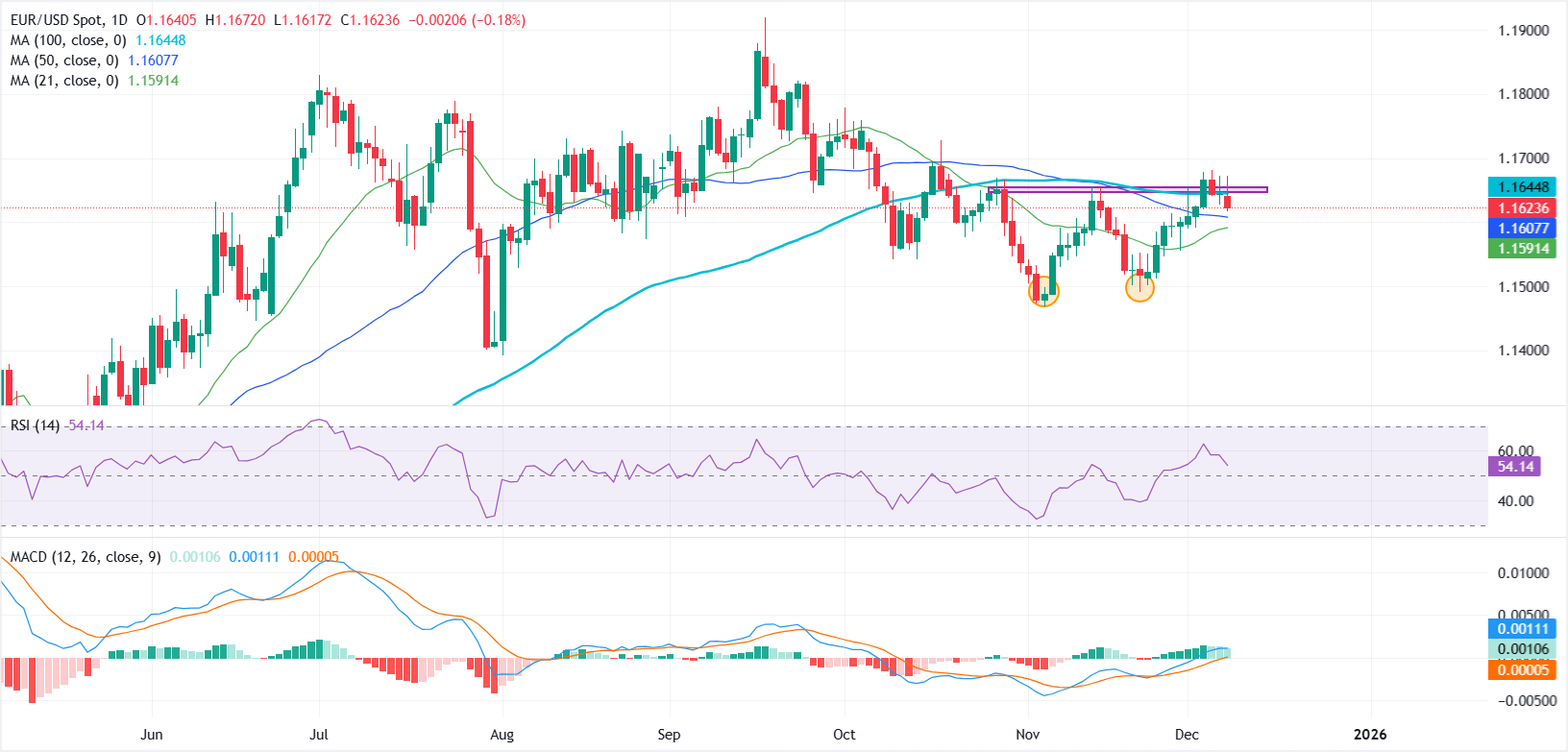
From a technical perspective, the daily chart shows EUR/USD posting consecutive green candles in recent days, steadily climbing above the 21-day and 50-day Simple Moving Averages (SMAs).
The advance followed a clean double-bottom formation around the 1.1500 psychological zone in late November. However, bulls continue to struggle at the neckline of that pattern, where the 100-day SMA intersects, creating a strong confluence barrier near 1.1650.
A decisive close above this region would reinforce bullish momentum and open the door toward 1.1700 and 1.1750. On the downside, the 21-day and 50-day SMAs provide immediate support.
Sustained trade above these averages keeps the near-term bias constructive, while a break below them would expose fresh downside pressure, potentially dragging EUR/USD back toward 1.1500.
Momentum signals remain broadly supportive but lack strong conviction. The Moving Average Convergence Divergence (MACD) histogram stays positive, indicating the MACD line above the Signal line, though its recent contraction suggests moderating momentum.
Meanwhile, the Relative Strength Index (RSI) sits near 54, reflecting a neutral bias after cooling from recent highs. A shift toward the 60 level would suggest strengthening buying interest and could help validate a continued push higher if price action breaks above the key 1.1650 resistance zone.
Euro Price Today
The table below shows the percentage change of Euro (EUR) against listed major currencies today. Euro was the strongest against the Swiss Franc.
| USD | EUR | GBP | JPY | CAD | AUD | NZD | CHF | |
|---|---|---|---|---|---|---|---|---|
| USD | 0.18% | 0.14% | 0.37% | 0.13% | 0.30% | 0.18% | 0.44% | |
| EUR | -0.18% | -0.04% | 0.20% | -0.05% | 0.10% | -0.00% | 0.27% | |
| GBP | -0.14% | 0.04% | 0.23% | -0.01% | 0.16% | 0.04% | 0.31% | |
| JPY | -0.37% | -0.20% | -0.23% | -0.23% | -0.06% | -0.19% | 0.08% | |
| CAD | -0.13% | 0.05% | 0.00% | 0.23% | 0.17% | 0.05% | 0.32% | |
| AUD | -0.30% | -0.10% | -0.16% | 0.06% | -0.17% | -0.12% | 0.15% | |
| NZD | -0.18% | 0.00% | -0.04% | 0.19% | -0.05% | 0.12% | 0.27% | |
| CHF | -0.44% | -0.27% | -0.31% | -0.08% | -0.32% | -0.15% | -0.27% |
The heat map shows percentage changes of major currencies against each other. The base currency is picked from the left column, while the quote currency is picked from the top row. For example, if you pick the Euro from the left column and move along the horizontal line to the US Dollar, the percentage change displayed in the box will represent EUR (base)/USD (quote).
Author

Vishal Chaturvedi
FXStreet
I am a macro-focused research analyst with over four years of experience covering forex and commodities market. I enjoy breaking down complex economic trends and turning them into clear, actionable insights that help traders stay ahead of the curve.