EUR/USD Price Forecast: Bulls have the upper hand while above 100-hour SMA, around 1.1380 area
- EUR/USD regains positive traction on Monday amid a broadly weaker USD.
- The technical setup favors bulls and supports prospects for further gains.
- Corrective slides to the 1.1370 zone could be seen as a buying opportunity.

The EUR/USD pair attracts some dip-buying at the start of a new week, reversing a part of Friday's slide and stalling last week's pullback from the highest level since April 22. Spot prices trade around the 1.1420 area, up over 0.20% for the day, and seem poised to climb further amid a broadly weaker US Dollar (USD).
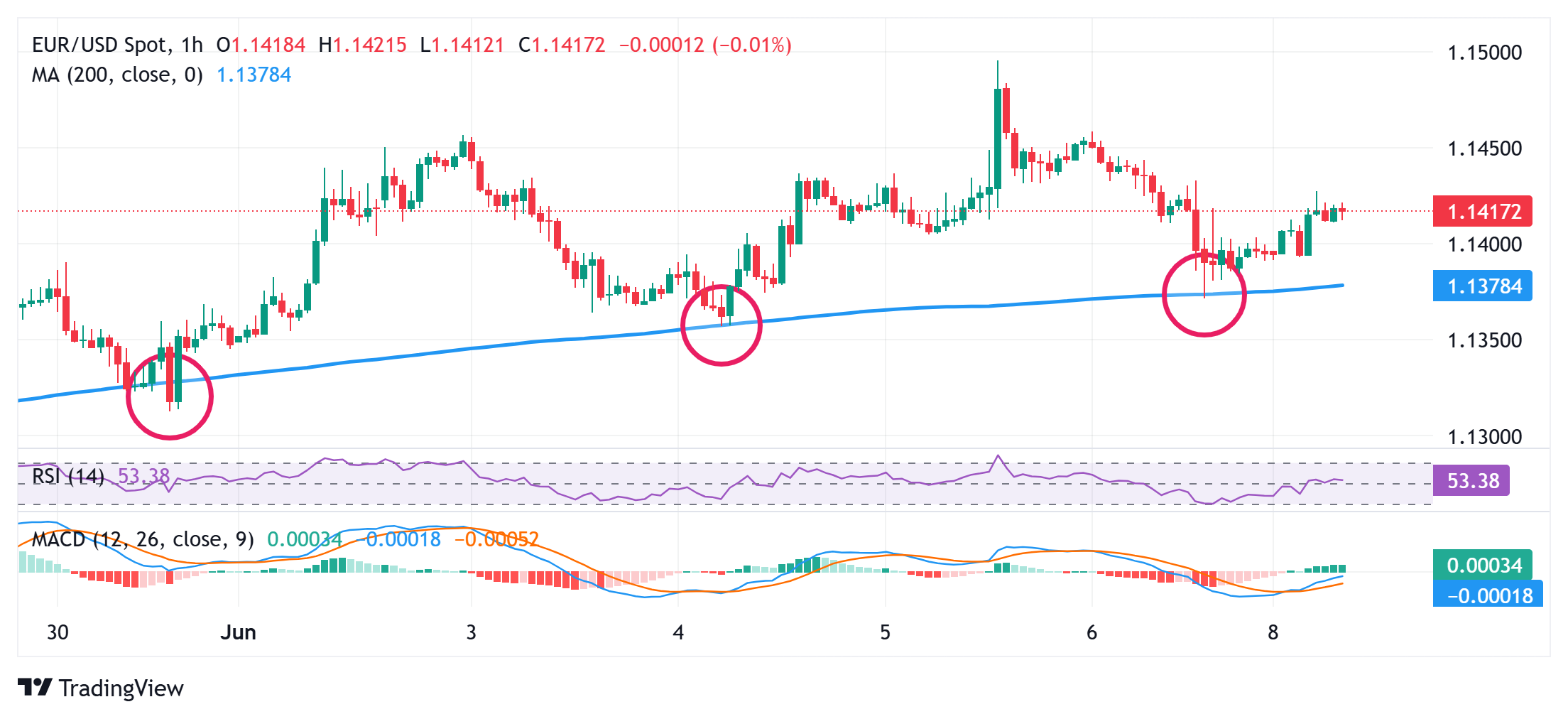
From a technical perspective, the EUR/USD pair once again showed resilience and bounced off the 100-hour Simple Moving Average (SMA) support on Friday. The subsequent move-up and positive oscillators on the daily chart favor bulls. Hence, some follow-through strength towards the 1.1450-1.1455 horizontal resistance en route to last week's swing high, closer to the 1.1500 psychological mark, looks like a distinct possibility.
A sustained strength and acceptance above the latter will be seen as a fresh trigger for bullish traders and set the stage for an extension of the EUR/USD pair's recent well-established uptrend witnessed over the past four weeks or so. The momentum could extend further towards the 1.1550 intermediate resistance before spot prices aim to challenge the year-to-date high, around the 1.1575 region touched in April.
On the flip side, Friday's low, around the 1.1370 zone, might now protect the immediate downside, below which the EUR/USD pair could slide to the 1.1340 intermediate support before dropping to sub-1.1300 levels. Some follow-through selling could drag spot prices to the 1.1210 pivotal support tested on May 29. Failure to defend the said support levels might negate the positive outlook and shift the bias in favor of bearish traders.
EUR/USD 1-hour chart
Euro FAQs
The Euro is the currency for the 19 European Union countries that belong to the Eurozone. It is the second most heavily traded currency in the world behind the US Dollar. In 2022, it accounted for 31% of all foreign exchange transactions, with an average daily turnover of over $2.2 trillion a day. EUR/USD is the most heavily traded currency pair in the world, accounting for an estimated 30% off all transactions, followed by EUR/JPY (4%), EUR/GBP (3%) and EUR/AUD (2%).
The European Central Bank (ECB) in Frankfurt, Germany, is the reserve bank for the Eurozone. The ECB sets interest rates and manages monetary policy. The ECB’s primary mandate is to maintain price stability, which means either controlling inflation or stimulating growth. Its primary tool is the raising or lowering of interest rates. Relatively high interest rates – or the expectation of higher rates – will usually benefit the Euro and vice versa. The ECB Governing Council makes monetary policy decisions at meetings held eight times a year. Decisions are made by heads of the Eurozone national banks and six permanent members, including the President of the ECB, Christine Lagarde.
Eurozone inflation data, measured by the Harmonized Index of Consumer Prices (HICP), is an important econometric for the Euro. If inflation rises more than expected, especially if above the ECB’s 2% target, it obliges the ECB to raise interest rates to bring it back under control. Relatively high interest rates compared to its counterparts will usually benefit the Euro, as it makes the region more attractive as a place for global investors to park their money.
Data releases gauge the health of the economy and can impact on the Euro. Indicators such as GDP, Manufacturing and Services PMIs, employment, and consumer sentiment surveys can all influence the direction of the single currency. A strong economy is good for the Euro. Not only does it attract more foreign investment but it may encourage the ECB to put up interest rates, which will directly strengthen the Euro. Otherwise, if economic data is weak, the Euro is likely to fall. Economic data for the four largest economies in the euro area (Germany, France, Italy and Spain) are especially significant, as they account for 75% of the Eurozone’s economy.
Another significant data release for the Euro is the Trade Balance. This indicator measures the difference between what a country earns from its exports and what it spends on imports over a given period. If a country produces highly sought after exports then its currency will gain in value purely from the extra demand created from foreign buyers seeking to purchase these goods. Therefore, a positive net Trade Balance strengthens a currency and vice versa for a negative balance.
Author

Haresh Menghani
FXStreet
Haresh Menghani is a detail-oriented professional with 10+ years of extensive experience in analysing the global financial markets.