|

EUR/USD Price Analysis: Pair trims losses after sharp drop, remains below 20-day SMA

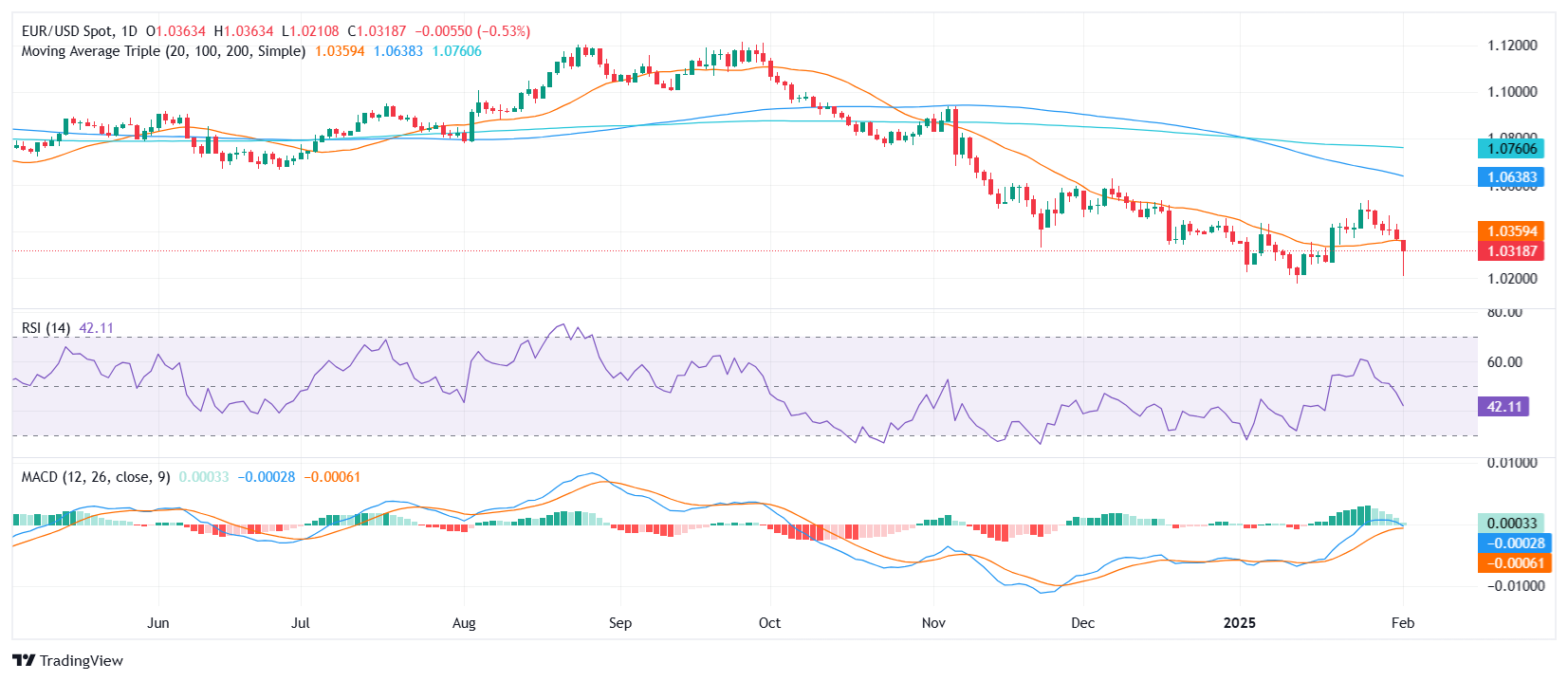
  • EUR/USD declines to lows around 1.0200 on Monday, marking a 0.90% drop as bearish pressure intensifies.
  • The pair managed to trim losses towards 1.0300 but the outlook remains negative.
  • RSI declines to 42, signaling weakening momentum, while MACD prints rising red bars, reflecting persistent bearish traction.

The EUR/USD pair continued its downward trajectory on Monday, slipping to a low around 1.0200 before staging a brief rebound to 1.0300. However, the failed attempt to extend gains highlights the prevailing selling pressure, keeping the pair below its 20-day Simple Moving Average (SMA) and maintaining a bearish outlook.

Technical indicators further support the negative bias. The Relative Strength Index (RSI) has declined to 42, suggesting that downside momentum is gaining traction. Meanwhile, the Moving Average Convergence Divergence (MACD) histogram is showing rising red bars, indicating that selling pressure remains dominant despite intermittent recovery attempts.

Looking ahead, immediate support stands at 1.0200, a key level that, if broken, could trigger a move toward 1.0150. On the upside, the first resistance appears at 1.0300, followed by the 20-day SMA near 1.0350. Until the pair clears these resistance zones, the broader trend remains tilted to the downside.

EUR/USD daily chart
Author

Patricio Martín

Patricio is an economist from Argentina passionate about global finance and understanding the daily movements of the markets.


More from Patricio Martín
Share:

Editor's Picks

AUD/USD hovers around 0.7000, over one-week low ahead of RBA decision

AUD/USD consolidates the previous day's losses to an over one-week low, holding steady around 0.7000 during the Asian session on Tuesday ahead of the RBA rate decision. Meanwhile, the US Dollar remains depressed as hopes for a diplomatic resolution to end the US-Iran war counter Fed hike bets amid market anxiety ahead of the US midterm elections, further supporting the currency pair.


USD/JPY fails near 159.00 amid weak USD, intervention risks

USD/JPY edges lower during Tuesday’s Asian session, reversing part of the previous day's gains to 158.00 as the US Dollar remains depressed amid hopes for Iran diplomacy and ahead of US midterm elections. Meanwhile, intervention risks support the Japanese Yen, though the uncertainty over the timing of the next BoJ rate hike caps gains. This keeps the pair confined within a familiar range and warrants caution before placing directional bets.


Gold consolidates near $3,950 as Fed hike bets counter weak USD ahead of US elections

Gold holds steady around $3,950 through Tuesday’s Asian session, consolidating the previous day's recovery gains from the lowest level since October 2025, touched last week. Hopes for Iran optimism keep the safe-haven US Dollar depressed, which, along with anxiety ahead of US midterm elections, supports the bullion. However, Fed rate-hike bets and a modest bounce in US bond yields cap gains for the non-yielding yellow metal.

RBA expected to raise interest rate to 4.85%

The Reserve Bank of Australia will announce its monetary policy decision on Tuesday and is widely anticipated to raise the Official Cash Rate by 25 basis points to 4.85% from 4.6%. If the RBA delivers as expected, it will be the fifth interest rate hike of 2026, and the OCR will hit an 18-year high.

Strong iPhone sales fortify Apple's Q4 result

A robust fourth-quarter for Apple's iPhone sales helped the tech titan beat Wall Street's consensus on Monday. Apple reported $57.58 billion in iPhone sales in Q4, beating the average analyst estimate by more than a billion. However, AAPL stock shed close to 4% afterhours despite the top and bottom line beat.

The 2% inflation target came from a throwaway remark. It now moves trillions
The Federal Reserve's 2% inflation goal grew out of an off-the-cuff remark by a New Zealand politician in 1988. Bond investors still price long-term US debt as if 2% holds, so a change in how the Fed measures inflation would move markets.