|

EUR/USD Price Analysis: Euro extends losses but 100-200 SMA crossover offers support

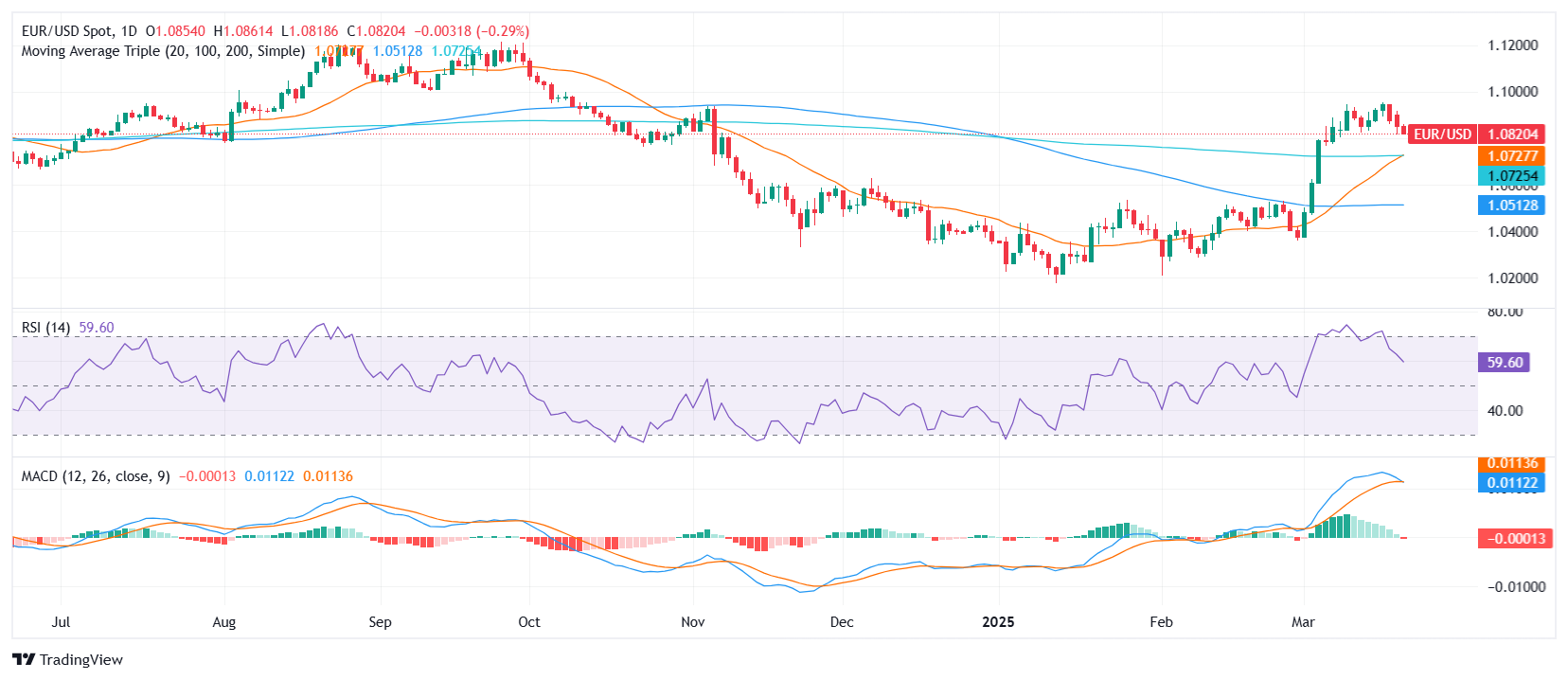
  • EUR/USD was seen trading around the 1.0820 area after the European session, falling for a third consecutive day.
  • Despite shedding over 1% this week, the recent bullish crossover between the 100- and 200-day SMAs may provide a strong base.
  • Momentum indicators turn bearish, with RSI dropping sharply and MACD printing a fresh red bar.

EUR/USD declined on Friday’s session after the European close, moving near the 1.0820 zone as the pair tallied a third straight day in the red. After a strong rally earlier in the month, the pair has lost over 1% this week, with momentum indicators now flashing bearish signals. Still, structural support remains firm as key moving averages align beneath current price levels.

The Relative Strength Index (RSI) has sharply retreated within positive territory and now hovers near neutral, hinting at fading bullish momentum. Meanwhile, the Moving Average Convergence Divergence (MACD) has shifted direction, printing a fresh red bar, which confirms weakening momentum in the short term.

From a broader perspective, a bullish crossover between the 100-day and 200-day Simple Moving Averages has taken shape this week, forming a solid technical floor near the 1.0730 region. This development helps cushion the downside, even if sellers continue to weigh on the pair in the near term.

Looking ahead, immediate support is seen at the 1.0780-1.0730 zone, where the moving average crossover occurred. A break below could expose further losses toward 1.0660. On the upside, resistance now sits at 1.0900, followed by 1.1000 should buyers regain control.

EUR/USD daily chart
Author

Patricio Martín

Patricio is an economist from Argentina passionate about global finance and understanding the daily movements of the markets.


More from Patricio Martín
Share:

Editor's Picks

AUD/USD rises to 0.6950 as USD slips on Fed's Warsh

AUD/USD regains traction and extends the bounce toward 0.6950 in the Asian session on Friday. Fed Chair Warsh's comments reinforce the selling pressure on the US Dollar, allowing the pair to stretch higher. Warsh said that he remains committed to delivering price stability without giving away anything on future interest rate path.

USD/JPY falls in symc with USD, gives up 158.00 after Warsh's speech

USD/JPY has come under fresh selling pressure and gives up 158.00 in the Asian session on Friday amid the emergence of fresh US Dollar selling. Fed Chair Warsh's non-committal commentary on the future tightening path, weighs on the US Dollar and the pair.

Gold looks vacillating above $4,150

Gold alternates gains with losses below the key $4,200 mark per troy ounce on Friday. The yellow metal’s irresolute price action comes in response to a modest pullback in the US Dollar and a tepid recovery in US Treasury yields across the board.

Bitcoin steadies at $82,000: The five forces crushing the Uptober rally

Crypto markets have remained under pressure so far in October, with Bitcoin (BTC) sliding below $80,000 earlier this week before recovering to around $82,000 on Friday, as macroeconomic headwinds and cooling demand weigh on the market.

The Fed just got a second hot inflation number. Here's what the diesel signal is really saying
The Federal Reserve (Fed) faces a renewed inflation challenge after two consecutive reports showed price pressure intensifying across the US economy. September's Consumer Price Index (CPI) confirmed accelerating consumer inflation, while the Producer Price Index (PPI) revealed an even sharper rise in business costs. Behind both reports lies a common factor: energy prices.
Everyone's dumping Gold after hot US inflation. Here's why $4,100 could be a floor, not a cliff
Gold (XAU/USD) is recovering from a sharp sell-off triggered by hotter-than-expected United States (US) inflation data released on Wednesday. The precious metal briefly plunged toward $4,073 as investors increased their bets on further Federal Reserve (Fed) interest rate hikes before recovering as US Treasury yields and the US Dollar (USD) reversed their initial gains.














