|

EUR/USD Price Analysis: Bulls take a breather after last week’s sharp rally

  • EUR/USD was seen trading near the 1.0830 area after the European session, posting mild gains on Monday.
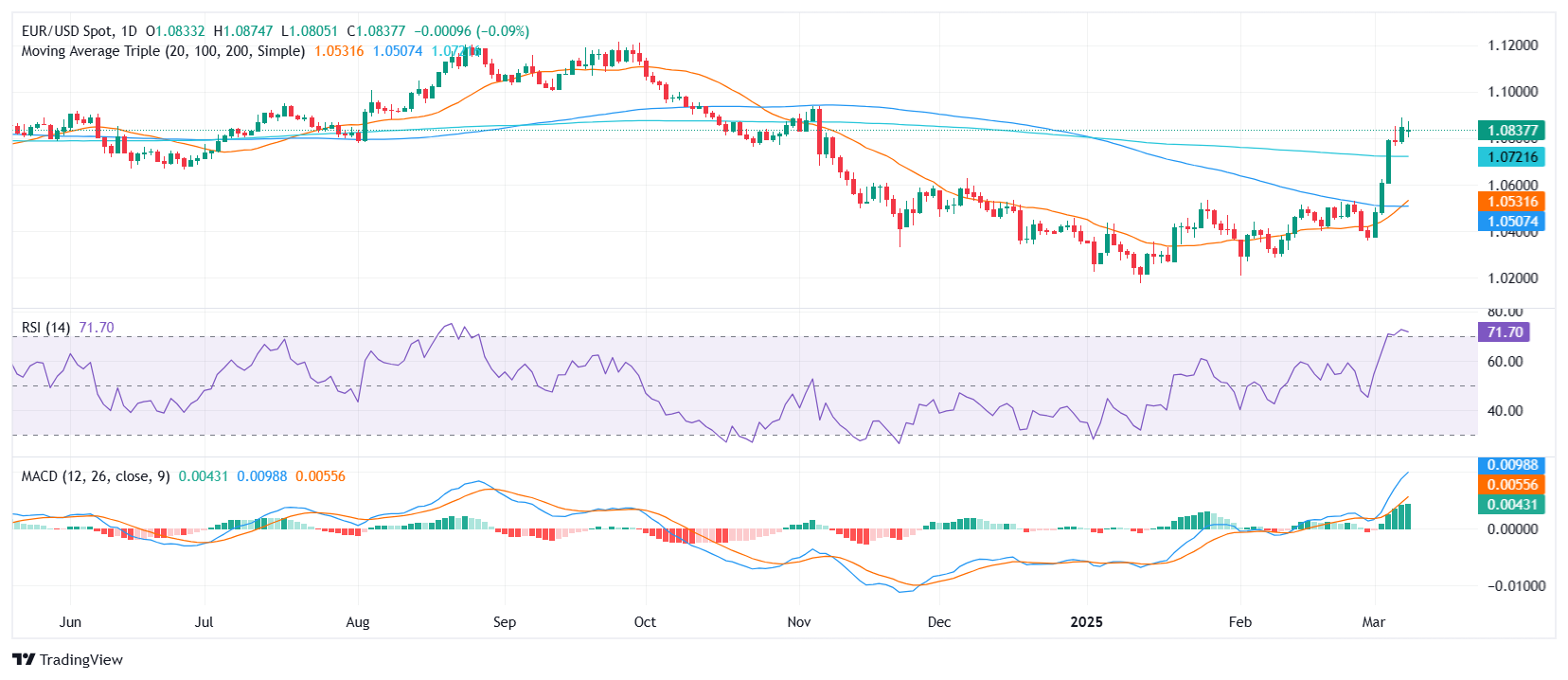
  • Following a strong rally of over 4% last week, the pair enters a consolidation phase, potentially stabilizing above the 200-day SMA near 1.0780.
  • Technical indicators remain in positive territory, though the RSI is slightly declining from overbought conditions, signaling a possible slowdown in momentum.

The EUR/USD pair extended its bullish momentum on Monday, trading near the 1.0830 zone after the European session. Despite the mild gains, the pair appears to be entering a consolidation phase after last week’s sharp surge, during which it added more than 4%. The recent slowdown could indicate that bulls are reassessing their positions, with technical indicators suggesting a potential cooling-off period.

The Relative Strength Index (RSI) remains in overbought territory but has started to decline slightly, hinting at fading upside pressure. Meanwhile, the Moving Average Convergence Divergence (MACD) continues to print rising green bars, reflecting sustained buying interest, though at a moderating pace. Given this setup, further gains may be capped in the short term unless fresh catalysts emerge.

On the support side, the key level to watch is the 200-day Simple Moving Average (SMA) at 1.0780, which may act as a floor for price action. A decisive drop below this level could see the pair correcting toward 1.0750. On the upside, immediate resistance is seen around the 1.0850 zone, with stronger hurdles near 1.0900.

EUR/USD daily chart
Author

Patricio Martín

Patricio is an economist from Argentina passionate about global finance and understanding the daily movements of the markets.


More from Patricio Martín
Share:

Editor's Picks

AUD/USD hangs close to monthly lows, still defends 0.7100 ahead of Fed decision

AUD/USD retains its negative bias for the third straight day, defending 0.7100 while trading close to a monthly low in Wednesday's Asian session on Wednesday. The US Dollar stands firm near a two-week high as the anticipated Fed rate hike and oil-driven inflation fears continue to push US bond yields to a multi-year high. Furthermore, escalating Middle East tensions benefit the safe-haven buck and weigh on the risk-sensitive Aussie.

USD/JPY holds firm above 155.00, awaits Fed policy announcements

USD/JPY climbs to a fresh one-week high above 155.00 in the Asian session on Wednesday amid a bullish US Dollar. Oil-driven inflation fears, along with the anticipated Fed rate hike, continue to support surging US bond yields. Moreover, rising US-Iran tensions underpin the USD's reserve currency status. The pair, however, remains below the mid-155.00s as bulls seem hesitant ahead of the Fed decision later today and the BoJ meeting, starting on Thursday.

Gold clings to recovery gains above $4,300, awaits Fed

Gold struggles to capitalize on its modest intraday move higher and remains below the $4,350 level in European trading on Wednesday. The US Dollar pauses for a breather after touching a two-week high and offers some support to the commodity. Traders, however, seem hesitant to place aggressive directional bets and opt to wait on the sidelines heading into the key Fed event risk.

Bitcoin, Ethereum, and Ripple retreat as Fed rate decision looms
Bitcoin (BTC), Ethereum (ETH) and Ripple (XRP) remain under pressure and consolidate at the time of writing on Wednesday after falling more than 3%, 4% and 9%, respectively, as the Clarity Act failed to advance in the Senate on Tuesday.
Fed decision in focus

Starting with the most important, the Fed decision. Heading into the event, data showed a rather punchy US August jobs report, which, you will likely recall, triggered a hawkish Fed rate repricing in rates markets. However, the recent US August CPI print mattered more.

How Japan became the World's Banker and why that era may be ending

Japan's ultra-low interest rates helped finance trillions of dollars in global investments for more than a decade, making the Japanese Yen one of the world’s cheapest sources of funding. With the Bank of Japan expected to tighten policy again this week, that advantage may be entering a new phase. While most major economies raised interest rates, Japan remained the world's outlier.