|

EUR/USD Price Analysis: Bulls now look at 1.0800 and beyond

  • The upside momentum in EUR/USD picks up pace on Monday.
  • Next on the upside comes the 1.0800 mark.

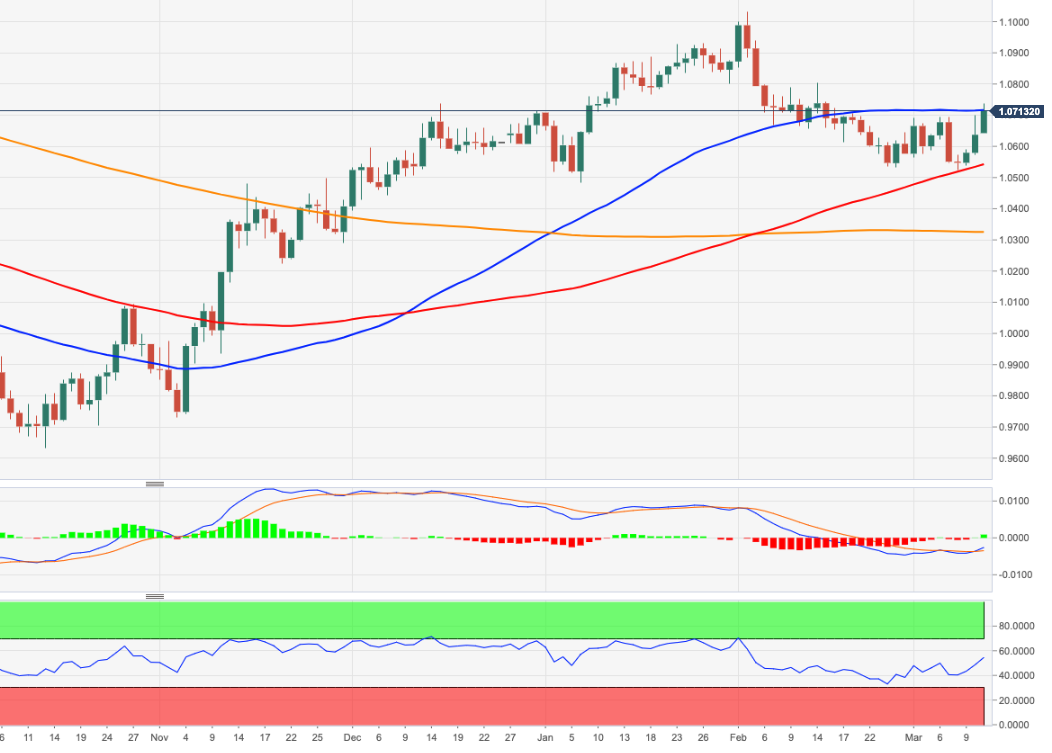
EUR/USD extends the buying interest to fresh multi-week highs north of 1.0700 the figure at the beginning of the week.

The continuation of the uptrend appears favoured for the time being. Against that, a convincing move above Monday’s peak at 1.0737 should open the door the wekly high at 1.0804 (February 14). Further up, there are no resistance levels of note until the 2023 high at 1.1032 (February 2).

Looking at the longer run, the constructive view remains unchanged while above the 200-day SMA, today at 1.0324.

EUR/USD daily chart
EUR/USD

Overview
Today last price1.0721
Today Daily Change87
Today Daily Change %0.79
Today daily open1.0637
 
Trends
Daily SMA201.0634
Daily SMA501.0722
Daily SMA1001.0534
Daily SMA2001.0326
 
Levels
Previous Daily High1.0701
Previous Daily Low1.0574
Previous Weekly High1.0701
Previous Weekly Low1.0524
Previous Monthly High1.1033
Previous Monthly Low1.0533
Daily Fibonacci 38.2%1.0652
Daily Fibonacci 61.8%1.0622
Daily Pivot Point S11.0574
Daily Pivot Point S21.0511
Daily Pivot Point S31.0447
Daily Pivot Point R11.07
Daily Pivot Point R21.0764
Daily Pivot Point R31.0827

Author

Pablo Piovano

Born and bred in Argentina, Pablo has been carrying on with his passion for FX markets and trading since his first college years.

More from Pablo Piovano

Share:

Editor's Picks

AUD/USD drops to two-week low, further below 0.7000 after RBA's less hawkish rate hike

AUD/USD drifts lower for the second straight day on Tuesday, hitting a fresh two-week low during the Asian session after the Reserve Bank of Australia's (RBA) widely expected 25 bps rate hike. The decision was far from unanimous, with three members preferring to hold rates at 4.60%. This tempers expectations of further tightening, which, along with modest US Dollar strength, weighs on the currency pair.


USD/JPY fails near 159.00 amid weak USD, intervention risks

USD/JPY edges lower during Tuesday’s Asian session, reversing part of the previous day's gains to 158.00 as the US Dollar remains depressed amid hopes for Iran diplomacy and ahead of US midterm elections. Meanwhile, intervention risks support the Japanese Yen, though the uncertainty over the timing of the next BoJ rate hike caps gains. This keeps the pair confined within a familiar range and warrants caution before placing directional bets.


Gold slides below $3,900 as Fed hike bets counter softer USD ahead of US elections

Gold slides below the $3,900 mark during the first half of the European session, eyeing its lowest level since October 2025, set last week amid expectations of further tightening by the US Federal Reserve. Data released on Monday showed that US manufacturing sector business activity expanded for the 10th consecutive month in October. The Institute for Supply Management's Manufacturing PMI came in higher than consensus estimates and rose to 55.5 in October from 54.5 in the previous month.

Cardano extends losses as sellers stay in control

Cardano (ADA) extends correction, trading below $0.189 on Tuesday after losing key support zone the previous day. Mixed derivatives data and cautious on-chain metrics continue to weigh on bullish sentiment, while weakening technical indicators suggest further downside risks for ADA.

BoE is set to hike rates this week: Warns against 'unwarranted' aggressive tightening
We see a hike as a done deal this week and another, while not yet our baseline scenario, is possible in February should inflation stay above 4%, commodity prices remain high and activity remain resilient. We remain of the view, however, that aggressive tightening is unwarranted, for four main reasons: There are no clear signs of second-round inflation effects, nor do we think that there will be.
The 2% inflation target came from a throwaway remark. It now moves trillions
The Federal Reserve's 2% inflation goal grew out of an off-the-cuff remark by a New Zealand politician in 1988. Bond investors still price long-term US debt as if 2% holds, so a change in how the Fed measures inflation would move markets.