EUR/USD posts fresh monthly high on soft US Inflation and weak Retail Sales data
- EUR/USD rises to 1.0870 as the US Dollar tumbles due to soft US Inflation and weak Retail Sales data.
- The US inflation data declined in April after remaining stubbornly higher in the first quarter of the year.
- ECB’s Wunsch expects that the likelihood of two rate cuts is very high.


EUR/USD refreshes monthly high near 1.0870 in Wednesday’s New York session. The major currency pair strengthens as the United States Consumer Price Index (CPI) eases in line with estimates (CPI) and the monthly Retail Sales remain stagnant for April.
An expected decline in price pressures in the US economy, along with weak Retail Sales data, is an unfavorable situation for the US Dollar and bond yields. The US Dollar Index (DXY), which tracks the Greenback’s value against six major currencies, tumbles to more than a month low around 104.50.
10-year US Treasury yields have also plunged to 4.36% as weak data is expected to boost expectations for the Federal Reserve (Fed) to begin reducing interest rates from the September meeting. This will also improve the confidence of Fed policymakers, who were concerned that the progress in the disinflation process has stalled as the previous three reports were hotter than expected.
Daily digest market movers: EUR/USD capitalizes on weak US Dollar
- EUR/USD advances to 1.0870 as the market sentiment turns extremely bullish due to a decline in the US consumer inflation and stagnant Retail Sales. S&P 500 futures have posted stellar gains in the early American session, exhibiting a sharp improvement in investors' risk appetite.
- Annual headline CPI softened as expected to 3.4% from 3.5% in March. In the same period, the core inflation, which strips off volatile food and energy prices, grew in line with estimates of 3.6% but decelerated from the prior reading of 3.8%. Monthly headline CPI rose at a slower pace of 0.3% from the consensus and the prior reading of 0.4% and the core CPI meets estimates of 0.3% but declines from the prior reading of 0.4%. The US CPI report showed that the decline in the inflation data came from lower prices of utility gas services and used cars and trucks. Rentals, transportation and medical services price index continue to gain.
- The US Retail Sales, which is a leading indicator of consumer spending and provides cues about the inflation outlook, remained stagnant in April. Investors forecasted a slower growth of 0.4% in sales at retail stores from the prior reading of 0.7%
- Meanwhile, the Euro remains upbeat as investors hope that higher interest rates for longer by the Fed will slow down the pace at which the European Central Bank (ECB) was anticipated to return to policy normalization.
- On Tuesday, ECB policymaker and Banque Nationale de Belgique Governor Pierre Wunsch commented that the first two 25 basis points (bps) reductions in key ECB rates are close to a "no-brainer" but added that high rates for longer by the US Federal Reserve could lead to a slower pace of rate cuts.
- Historically, investors underpin the US Dollar against the Euro if the policy divergence between the Fed and the ECB widens. A weak Euro brings significant business to Eurozone merchants from overseas markets. This could strengthen the economic outlook and result in higher employment and wage growth, which eventually will flare up price pressures again.
- On the economic data front, Eurostat has released a second estimate of preliminary Q1 Gross Domestic Product (GDP) data. The GDP report indicated that quarterly and annualized GDP growth were in line with the consensus and the preliminary reading at 0.3% and 0.4%, respectively. While EUR/USD didn't react to the second estimate as investors' focus remains on the US CPI data.
Technical Analysis: EUR/USD prints fresh monthly high near 1.0870
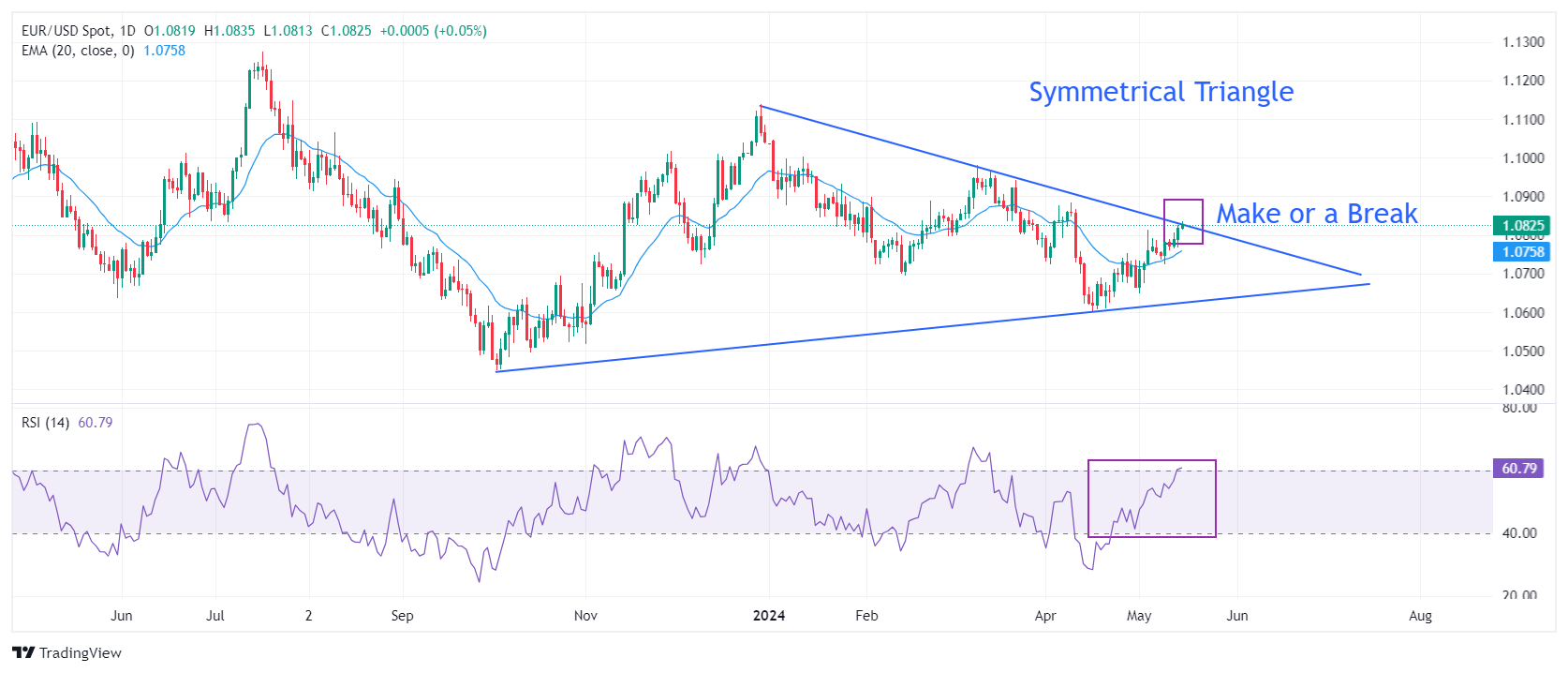
EUR/USD rises above the round-level resistance of 1.0800. The asset has advanced to the downward-sloping border of the Symmetrical Triangle pattern formed on a daily timeframe, which is plotted from December 28 high around 1.1140. The upward-sloping border of the triangle pattern is marked from October 3 low at 1.0448. The Symmetrical Triangle formation exhibits a sharp volatility contraction.
The major currency pair is at a make-or-break near 1.0870. A breakout of the Symmetrical Triangle formation could put the Euro bulls in the driving seat for a longer period. On the contrary, sharp selling pressure could drag them toward the upward-sloping border.
The 14-period Relative Strength Index (RSI) rises to 60.00. A bullish momentum would trigger if the RSI sustains above these levels.
Interest rates FAQs
Interest rates are charged by financial institutions on loans to borrowers and are paid as interest to savers and depositors. They are influenced by base lending rates, which are set by central banks in response to changes in the economy. Central banks normally have a mandate to ensure price stability, which in most cases means targeting a core inflation rate of around 2%. If inflation falls below target the central bank may cut base lending rates, with a view to stimulating lending and boosting the economy. If inflation rises substantially above 2% it normally results in the central bank raising base lending rates in an attempt to lower inflation.
Higher interest rates generally help strengthen a country’s currency as they make it a more attractive place for global investors to park their money.
Higher interest rates overall weigh on the price of Gold because they increase the opportunity cost of holding Gold instead of investing in an interest-bearing asset or placing cash in the bank. If interest rates are high that usually pushes up the price of the US Dollar (USD), and since Gold is priced in Dollars, this has the effect of lowering the price of Gold.
The Fed funds rate is the overnight rate at which US banks lend to each other. It is the oft-quoted headline rate set by the Federal Reserve at its FOMC meetings. It is set as a range, for example 4.75%-5.00%, though the upper limit (in that case 5.00%) is the quoted figure. Market expectations for future Fed funds rate are tracked by the CME FedWatch tool, which shapes how many financial markets behave in anticipation of future Federal Reserve monetary policy decisions.
Author
Sagar Dua
FXStreet
Sagar Dua is associated with the financial markets from his college days. Along with pursuing post-graduation in Commerce in 2014, he started his markets training with chart analysis.