EUR/USD dives deep as US and China lower tariffs substantially
- EUR/USD slides below 1.1100 as the US Dollar rallies after the US and China agreed to lower tariffs by 115% for 90 days.
- The US-China temporary trade truce is expected to tame elevated consumer inflation expectations.
- ECB Schnabel sees no need to lower interest rates further.
EUR/USD is down over 1% near 1.1100 during North American trading hours on Monday. The major currency pair faces an intense selling pressure as the US Dollar (USD) rallies after the United States (US) and China, in a joint statement, announced a higher-than-expected reduction in tariffs for 90 days imposed in April.
The US Dollar Index (DXY), which tracks the Greenback’s value against six major currencies, surges to near 101.60.
In a scheduled briefing during the European trading session on Monday, the US and China have agreed to lower tariffs by 115%. Tariffs on the US and China have dropped to 10% and 30%, respectively. Import duties on China still carry the burden of a 20% fentanyl levy. However, Washington has assured that it could be resolved soon. “Two sides are having constructive conversations on the issue of fentanyl,” US Trade Representative Jamieson Greer said. Additionally, US Treasury Secretary Scott Bessent said, "If China acts, perhaps the fentanyl tariff could come down," Reuters reported.
Ahead of the US-China trade talks in Geneva over the weekend, US President Donald Trump stated on Friday that he could lower tariffs on China to 80% through a post on Truth. Social. "80% Tariff on China seems right! It's up to Scott Bessent," Trump said.
The next trigger for the US Dollar will be commentary from Federal Reserve (Fed) officials on the monetary policy outlook in the wake of de-escalation in the Sino-US trade war. Fed officials are expected to revise their outlook on interest rates as the averted tariff war would diminish elevated consumer inflation expectations.
Last week, Fed Chair Jerome Powell warned in the press conference after the central bank’s decision to keep interest rates unchanged that tariffs announced were “significantly bigger than expected” and we will see “higher inflation, and lower employment” if large increases in tariffs as announced are “sustained”.
Daily digest market movers: EUR/USD plummets on absence of progress in US-EU trade talks
- EUR/USD plunges on Monday as the US Dollar surges after the US and China lowered tariffs. The Euro (EUR) trades lower against other currencies, while investors seek cues on how the temporary US-China trade truce will influence the Eurozone economic outlook.
- Ahead of the Sino-US trade talks, financial market participants anticipated that the trade war between the two largest world economic countries would be unfavorable for the shared continent, assuming that Beijing would move to other markets to sell its products to offset the impact of a trade war with Washington. Given China’s low-cost competitive advantage, its products could be disruptive for the global economy.
- After the US unveiled a 90-day tariff pause with China, a bilateral deal with the UK, and progress in trade talks with Japan, India, and other nations, no announcement regarding trade discussions with the European Union (EU) is also weighing on the Euro. Investors are seeing the scenario as unfavorable for the Eurozone economic outlook, assuming that the confidence of market participants will diminish in the economy if uncertainty prevails.
- Meanwhile, firm expectations that the European Central Bank (ECB) could continue the monetary policy expansion cycle in the wake of easing inflationary pressures are also acting as a tailwind for the Euro. A string of ECB officials has signaled that more interest rate cuts are needed amid trade tensions with the US, while remaining confident that the disinflation trend is intact.
- Contrary to several officials supporting more interest rate cuts, ECB board member Isabel Schnabel has signaled that there is no need to reduce interest rates further. “The appropriate course of action is to keep rates close to where they are today – that is, firmly in neutral territory," Schnabel said in a conference at Stanford University on Friday. Schnabel warned of risks to inflation exceeding the central bank’s 2% target in the medium term amid global economic turmoil.
- On the economic front, the EUR/USD pair will be influenced by the US Consumer Price Index (CPI) data for April, which will be released on Tuesday. The inflation data is expected to show that the headline CPI rose steadily by 2.4% YoY.
Technical Analysis: EUR/USD weakens on consolidation breakdown
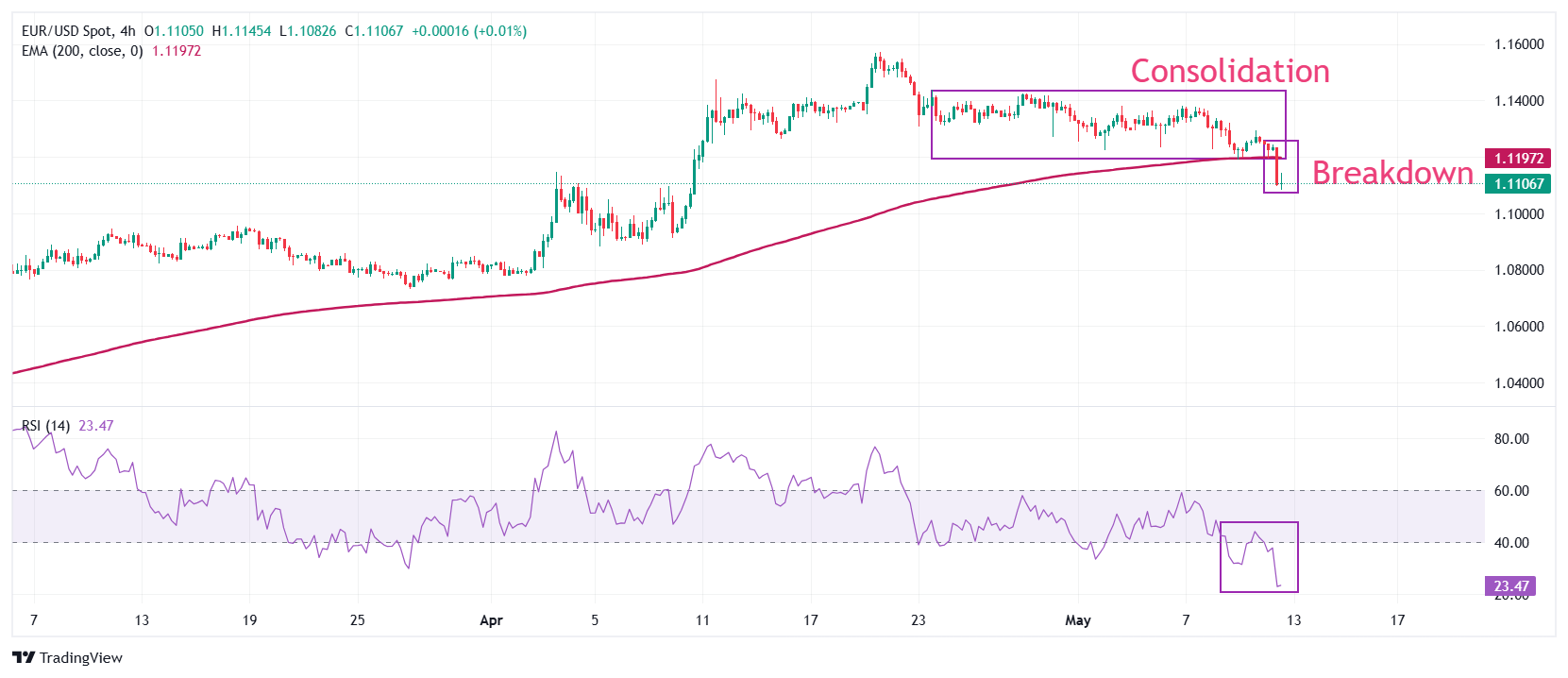
EUR/USD declines on Monday after a breakdown of the 1.1200-1.1440 range formed in the last 20 trading days. The major currency pair extends its downside move below the 200-period Exponential Moving Average (EMA), which is around 1.1200, indicating a bearish trend.
The 14-period Relative Strength Index (RSI) slides below 40.00, suggesting that a fresh bearish momentum has been triggered.
Looking up, the April 28 high of 1.1425 will be the major resistance for the pair. Conversely, the March 27 low of 1.0733 will be a key support for the Euro bulls.
US Dollar FAQs
The US Dollar (USD) is the official currency of the United States of America, and the ‘de facto’ currency of a significant number of other countries where it is found in circulation alongside local notes. It is the most heavily traded currency in the world, accounting for over 88% of all global foreign exchange turnover, or an average of $6.6 trillion in transactions per day, according to data from 2022. Following the second world war, the USD took over from the British Pound as the world’s reserve currency. For most of its history, the US Dollar was backed by Gold, until the Bretton Woods Agreement in 1971 when the Gold Standard went away.
The most important single factor impacting on the value of the US Dollar is monetary policy, which is shaped by the Federal Reserve (Fed). The Fed has two mandates: to achieve price stability (control inflation) and foster full employment. Its primary tool to achieve these two goals is by adjusting interest rates. When prices are rising too quickly and inflation is above the Fed’s 2% target, the Fed will raise rates, which helps the USD value. When inflation falls below 2% or the Unemployment Rate is too high, the Fed may lower interest rates, which weighs on the Greenback.
In extreme situations, the Federal Reserve can also print more Dollars and enact quantitative easing (QE). QE is the process by which the Fed substantially increases the flow of credit in a stuck financial system. It is a non-standard policy measure used when credit has dried up because banks will not lend to each other (out of the fear of counterparty default). It is a last resort when simply lowering interest rates is unlikely to achieve the necessary result. It was the Fed’s weapon of choice to combat the credit crunch that occurred during the Great Financial Crisis in 2008. It involves the Fed printing more Dollars and using them to buy US government bonds predominantly from financial institutions. QE usually leads to a weaker US Dollar.
Quantitative tightening (QT) is the reverse process whereby the Federal Reserve stops buying bonds from financial institutions and does not reinvest the principal from the bonds it holds maturing in new purchases. It is usually positive for the US Dollar.
Author

Sagar Dua
FXStreet
Sagar Dua is associated with the financial markets from his college days. Along with pursuing post-graduation in Commerce in 2014, he started his markets training with chart analysis.

















