|

EUR/USD may free-fall if it loses this support line – Confluence Detector

EUR/USD has been remarkably stable amid the Federal Reserve's rate cut and drama in oil markets. How is it positioned as the week draws to a close? 

The Technical Confluences Indicator is showing that EUR/USD has support at 1.1045, which is the convergence of the Fibonacci 38.2% one-week, the Fibonacci 61.8% one-day, the Simple Moving Average 100-1h, the SMA 200-1h, the Bollinger Band 4h-Middle, and the BB one-day Middle. 

If it falls below this level, the world's most popular currency pair has only weak support. The next noteworthy level is 1.0965, which is the confluence of the BB 1d-Lower, the Pivot Point one-week Support 1, and the PP 1d-S3.

Looking up, fierce resistance awaits at 1.1074. The dense cluster includes the BB 1h-Upper, the PP 1d-R1, the Fibonacci 38.2% one-month, the previous daily high, and the Fibonacci 23.6% one-week. 

Also here, if EUR/USD breaks free to the upside, it has room to run. However, the resistance line is stronger than support. 

An upside move could target 1.1143, which is the meeting point of the Fibonacci 61.8% one-month and the PP 1w-R1. 

Here is how it looks on the tool:
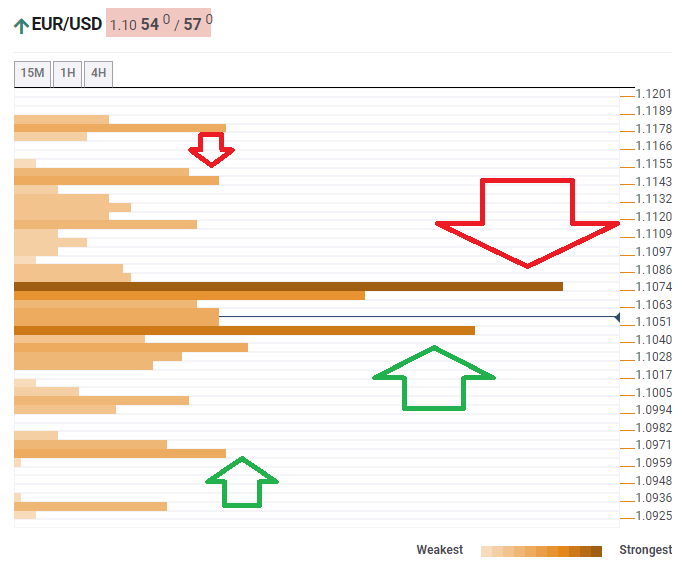
EUR USD technical confluence September 20 2019

Confluence Detector

The Confluence Detector finds exciting opportunities using Technical Confluences. The TC is a tool to locate and point out those price levels where there is a congestion of indicators, moving averages, Fibonacci levels, Pivot Points, etc. Knowing where these congestion points are located is very useful for the trader, and can be used as a basis for different strategies.

This tool assigns a certain amount of “weight” to each indicator, and this “weight” can influence adjacents price levels. These weightings mean that one price level without any indicator or moving average but under the influence of two “strongly weighted” levels accumulate more resistance than their neighbors. In these cases, the tool signals resistance in apparently empty areas.

Learn more about Technical Confluence

Author

Yohay Elam

Yohay Elam

FXStreet

Yohay is in Forex since 2008 when he founded Forex Crunch, a blog crafted in his free time that turned into a fully-fledged currency website later sold to Finixio.


More from Yohay Elam
Share:

Editor's Picks

AUD/USD keeps range near 0.6950 after Australian trade data

AUD/USD consolidates near a two-month low, trading around mid-0.6900s in the Asian session on Thursday amid a bullish US Dollar. The US PCE data tempered October Fed hike bets, though oil-driven inflation fears remain supportive of elevated US bond yields. Meanwhile, Australia's trade surplus shrank sharply in August to AUD495M, having limited impact on the Aussie Dollar and the pair.


USD/JPY advances to weekly top, around 157.75 as bullish USD counters intervention risks

USD/JPY recovers further from a one-and-a-half-week low, touched the previous day, climbing to the top end of its weekly range during the Asian session on Thursday. Despite the softer US PCE data, oil-driven inflation risks keep US bond yields elevated near multi-year highs. Moreover, the US-Iran standoff benefits the safe-haven US Dollar and supports the currency pair. However, BoJ rate hike bets and intervention fears could limit losses for the Japanese Yen, warranting caution for bulls.

Gold trades below $4,150 as elevated US bond yields and Iran risks support USD

Gold drifts lower for the second straight day on Thursday, looking to extend the previous day's pullback from $4,220. Oil-driven inflation risks counter softer US PCE data and support elevated US bond yields, undermining the non-yielding bullion. Moreover, geopolitical uncertainties allow the safe-haven US Dollar to retain its bullish undertone, further weighing on the commodity.

Why CLARITY Act's failure is beneficial for crypto
Bitwise CIO Matt Hougan stated Wednesday that the crypto market has rallied since the US Senate failed to advance the CLARITY Act, arguing that the legislation’s collapse allowed regulators to move faster on industry rules. Hougan noted that Bitcoin (BTC) has gained 8% and Ethereum (ETH) 7% since the vote, while several altcoins posted larger gains.
The Fed's October hike shrinks with the inflation it was built on

Traders have moved the next Federal Reserve hike from October 28 to December 9, and the inflation report that added to the move said more about July than August. The government's annual rewrite, published alongside the August Personal Consumption Expenditures Price Index, cut July's core reading, which leaves out food and energy, from 3.3% to 3%.

The Euro is near a one-year low: Inflation could trigger its rebound, not its fall

EUR/USD has fallen to its lowest level since May 2025, but a fresh inflation shock in the Eurozone could give the Euro (EUR) an unexpected lifeline. The pair hit 1.1312 on Wednesday and trades well below the January peak of 1.2082.