EUR/USD languishes near daily lows above 1.1850 as trade thins out pre-weekend
- EUR/USD is set to finish Friday a little softer, but pretty much band in line with where it started the week.
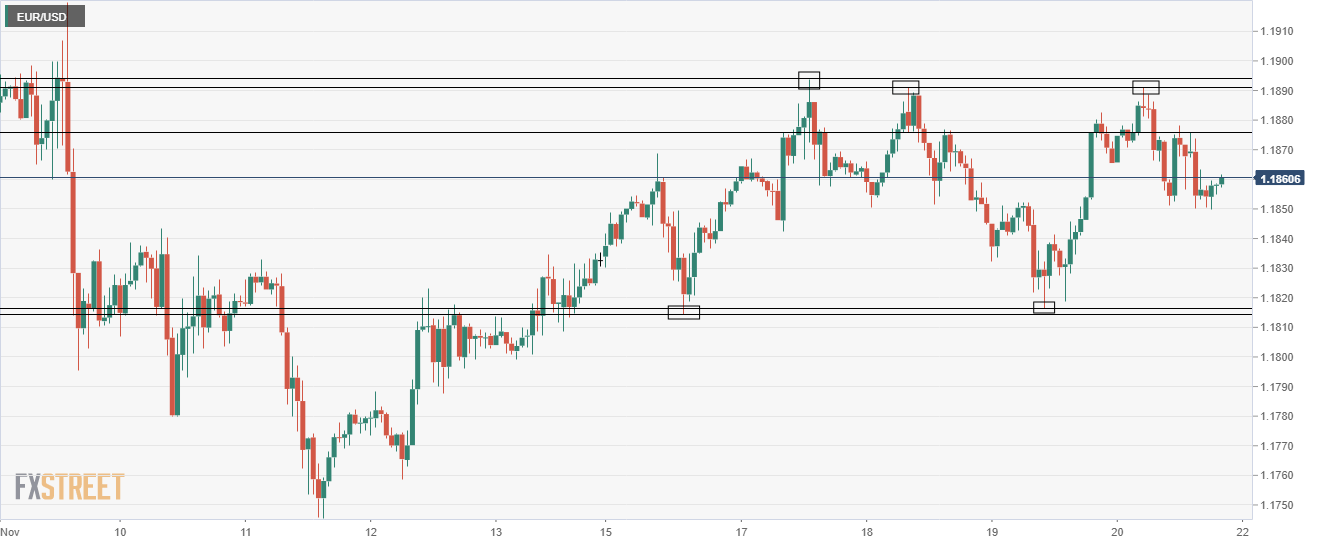
- EUR/USD has respected its 1.1815-1.1890ish range nicely thus far, reflective of a broader lack of direction in the market this week.

EUR/USD is set to finish the week pretty much bang on where it started it, within 10 pips of the 1.1850 mark. On the day, the pair is around 15 pips or 0.1% lower, with the pair having run into significant selling pressure ahead weekly highs close to 1.1890. Recent trade has become characteristically thin as the weekend approaches.
EUR/USD indicative of indecisive markets
EUR/USD has traded very nicely within a 1.1815-1.1890ish range this week; buoyed initially by a risk on start to the week given vaccine optimism (Moderna’s update) and a dovish tone from the FOMC and making highs in the 1.1890s, before reversing lower to set lows in the low 1.1800s on renewed fears regarding the worsening state of the global Covid-19 outbreak. Then the pair rallied again on Thursday as US fiscal stimulus talks between the Democrats got going again, testing the weekly highs again before pulling back to current levels.
Moving forward, the balancing act of pandemic and lockdown concerns (USD bullish) versus vaccine optimism, an increasingly dovish tone to FOMC speak and US political uncertainty (likely all USD bearish factors) is set to continue.
How the US Treasury’s decision not to renew emergency Fed lending programmes from 31 December (and to repatriate $455B in funds to the treasury coffers) will affect markets is unclear; a Fed with less ammunition to support the economy might be a USD negative as it might signal slower US growth ahead. Or would that trigger USD upside on the subsequent stronger demand for havens? Meanwhile, the repatriated funds are likely to be used to fund further fiscal stimulus. So does that actually mean faster growth ahead (likely a risk appetite positive)? Or does it take the pressure of Congress to get a new stimulus bill passed (risk appetite negative)?
Either way, the run into the end of the year will be anything but boring; how the pandemic develops and how the Fed and ECB react, how the early vaccine rollout goes, how the Trump to Biden Administration transition (which hasn’t even started yet) goes will all be crucial determinants of future EUR/USD direction.
With stronger global economic growth expected in 2021 following mass vaccinations and a return to normality, as well as better global trade conditions given the Biden Administration’s less protectionist stance, a number of banks are forecasting a weaker USD ahead. This might keep USD’s upside capped in the short-term, even if the pandemic does get significantly worse than expected this winter.
EUR/USD bang in the middle of its weekly range
EUR/USD is finishing the week right in the middle of its range this week. Thus, the most significant upside resistance comes in the form of weekly highs around 1.1890, while the most significant support comes at the weekly lows around 1.1815. A break in either direction next week (or in the coming weeks) will be indicative of either a continuation of the USD weakness we have already seen this November or a pullback on it.
In terms of notable levels outside of this week’s range; to the upside, the next level of note is just beyond the 1.1900 mark, the 10 September and 9 November highs at 1.1919. To the downside, the 11 November lows at just under 1.1750 will be important to watch.
EUR/USD one hour chart
Author

Joel Frank
Independent Analyst
Joel Frank is an economics graduate from the University of Birmingham and has worked as a full-time financial market analyst since 2018, specialising in the coverage of how developments in the global economy impact financial asset