EUR/USD holds ground as EU spared from tariffs, Trump urges Fed cuts and delays deadline
- EUR/USD steadies near 1.1725 support as EU is spared from new US tariff measures for now.
- Trump urges Fed to cut rates, delays tariff deadline to August 1.
- Risk appetite fades as US mulls tariffs on tech and pharma sectors.

EUR/USD registers minimal gains during the North American session as the US dollar erases some of its earlier gains, following US President Donald Trump's demand that the Federal Reserve cut interest rates, as he delays the July 9 deadline towards August 1. At the time of writing, the pair trades at 1.1724, up 0.14%.
Risk appetite turned sour late in the day, amid uncertainty about trade policies. The US Commerce Secretary, Howard Lutnick, said that he expects another 15-20 letters to go out over the next few days, according to an interview with CNBC. In the meantime, Trump's threats to broaden tariffs to pharmaceuticals, semiconductors, and copper weighed on investors' mood.
Data-wise, the US economic docket revealed that small business confidence edged lower, according to a survey of the National Federation of Independent Business (NFIB).
The shared currency halted Monday’s losses as the White House didn’t target the European Union (EU) with additional tariffs. Recently, Trump acknowledged that talks between the US and Europe are progressing, adding that the EU has been “very nice” with the US.
Meanwhile, the US economic docket remains absent, with traders eyeing the release of June’s Federal Open Market Committee (FOMC) minutes. In the EU, a flurry of officials from the European Central Bank (ECB) will cross the wires, led by Vice President Luis de Guindos, Chief Economist Philip Lane, and Joachim Nagel.
Daily digest market movers: Euro recovers as Trump said August 1 deadline is definitive
- The strength of the Greenback pressures the EUR/USD. The US Dollar Index (DXY), which tracks the buck’s value against a basket of six currencies, finished Tuesday’s session flat at 97.51.
- US President Donald Trump posted that Federal Reserve Chair Jerome Powell should cut rates now, after saying he should resign immediately earlier in the day. He pushes the July 9 deadline to August 1, although he said he would not extend it. Regarding the European Union (EU), he said the EU is treating the US very nicely, that’s why he refrained from sending the tariffs letter.
- Trump added that he could have been harsher on trade and announced that he would impose duties on pharmaceuticals, semiconductors, and copper, which he said would result in tariffs of around 50%.
- The NFIB Small Business Optimism Index edged down to 98.6 in June, slightly below expectations of 98.7 and a decline from May’s reading of 98.8. The decrease was primarily driven by an increase in the number of respondents citing excessive inventories.
- The EU stated that there has been some progress on a framework trade deal with the United States (US), according to EU spokesman Olof Gill. He indicated that Ursula Von der Leyen held a call with Trump on Sunday, saying that “They had a good exchange.”
Euro technical outlook: EUR/USD clings to 1.1700 as the pair consolidates
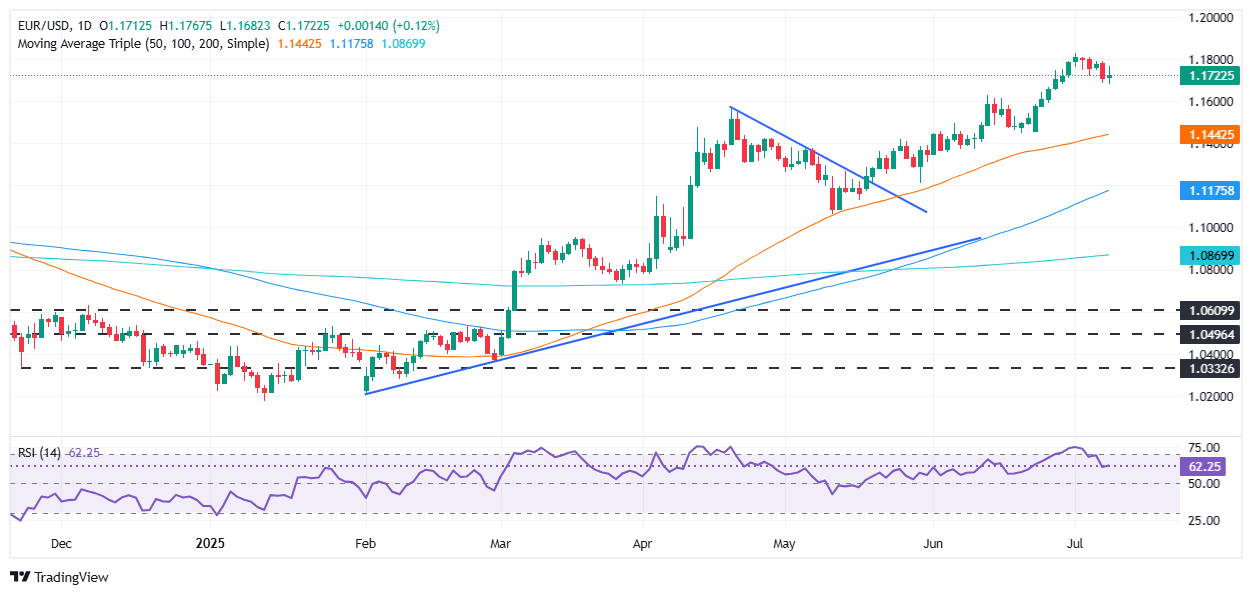
From a technical perspective, the pair is neutral, with well-defined support and resistance levels. The Relative Strength Index (RSI), although bullish, has turned flat, indicating that neither buyers nor sellers are in control.
For a bullish continuation, the EUR/USD must clear the July 7 high of 1.1789 before buyers set their sights on 1.1800. Key resistance lies overhead with the year-to-date (YTD) high of 1.1829.
Conversely, if EUR/USD tumbles below 1.1700, this will expose the 20-day Simple Moving Average (SMA) as the first support level at 1.1649. A breach of the latter will expose the 1.1600 figure, followed by the 50-day SMA at 1.1448.
Euro FAQs
The Euro is the currency for the 19 European Union countries that belong to the Eurozone. It is the second most heavily traded currency in the world behind the US Dollar. In 2022, it accounted for 31% of all foreign exchange transactions, with an average daily turnover of over $2.2 trillion a day. EUR/USD is the most heavily traded currency pair in the world, accounting for an estimated 30% off all transactions, followed by EUR/JPY (4%), EUR/GBP (3%) and EUR/AUD (2%).
The European Central Bank (ECB) in Frankfurt, Germany, is the reserve bank for the Eurozone. The ECB sets interest rates and manages monetary policy. The ECB’s primary mandate is to maintain price stability, which means either controlling inflation or stimulating growth. Its primary tool is the raising or lowering of interest rates. Relatively high interest rates – or the expectation of higher rates – will usually benefit the Euro and vice versa. The ECB Governing Council makes monetary policy decisions at meetings held eight times a year. Decisions are made by heads of the Eurozone national banks and six permanent members, including the President of the ECB, Christine Lagarde.
Eurozone inflation data, measured by the Harmonized Index of Consumer Prices (HICP), is an important econometric for the Euro. If inflation rises more than expected, especially if above the ECB’s 2% target, it obliges the ECB to raise interest rates to bring it back under control. Relatively high interest rates compared to its counterparts will usually benefit the Euro, as it makes the region more attractive as a place for global investors to park their money.
Data releases gauge the health of the economy and can impact on the Euro. Indicators such as GDP, Manufacturing and Services PMIs, employment, and consumer sentiment surveys can all influence the direction of the single currency. A strong economy is good for the Euro. Not only does it attract more foreign investment but it may encourage the ECB to put up interest rates, which will directly strengthen the Euro. Otherwise, if economic data is weak, the Euro is likely to fall. Economic data for the four largest economies in the euro area (Germany, France, Italy and Spain) are especially significant, as they account for 75% of the Eurozone’s economy.
Another significant data release for the Euro is the Trade Balance. This indicator measures the difference between what a country earns from its exports and what it spends on imports over a given period. If a country produces highly sought after exports then its currency will gain in value purely from the extra demand created from foreign buyers seeking to purchase these goods. Therefore, a positive net Trade Balance strengthens a currency and vice versa for a negative balance.
Author

Christian Borjon Valencia
FXStreet
Markets analyst, news editor, and trading instructor with over 14 years of experience across FX, commodities, US equity indices, and global macro markets.