EUR/USD hits 3-year high above 1.1650 as Fed cut bets grow, Dollar dives
- EUR/USD hits 3-year highs as Iran–Israel tensions ease and Fed cut bets grow.
- Powell flags uncertainty on tariff-driven inflation, keeping focus on Fed policy direction.
- Eurozone data is mixed; markets eye ECB speeches and key US data, including Q1 GDP and Durable Goods Orders.

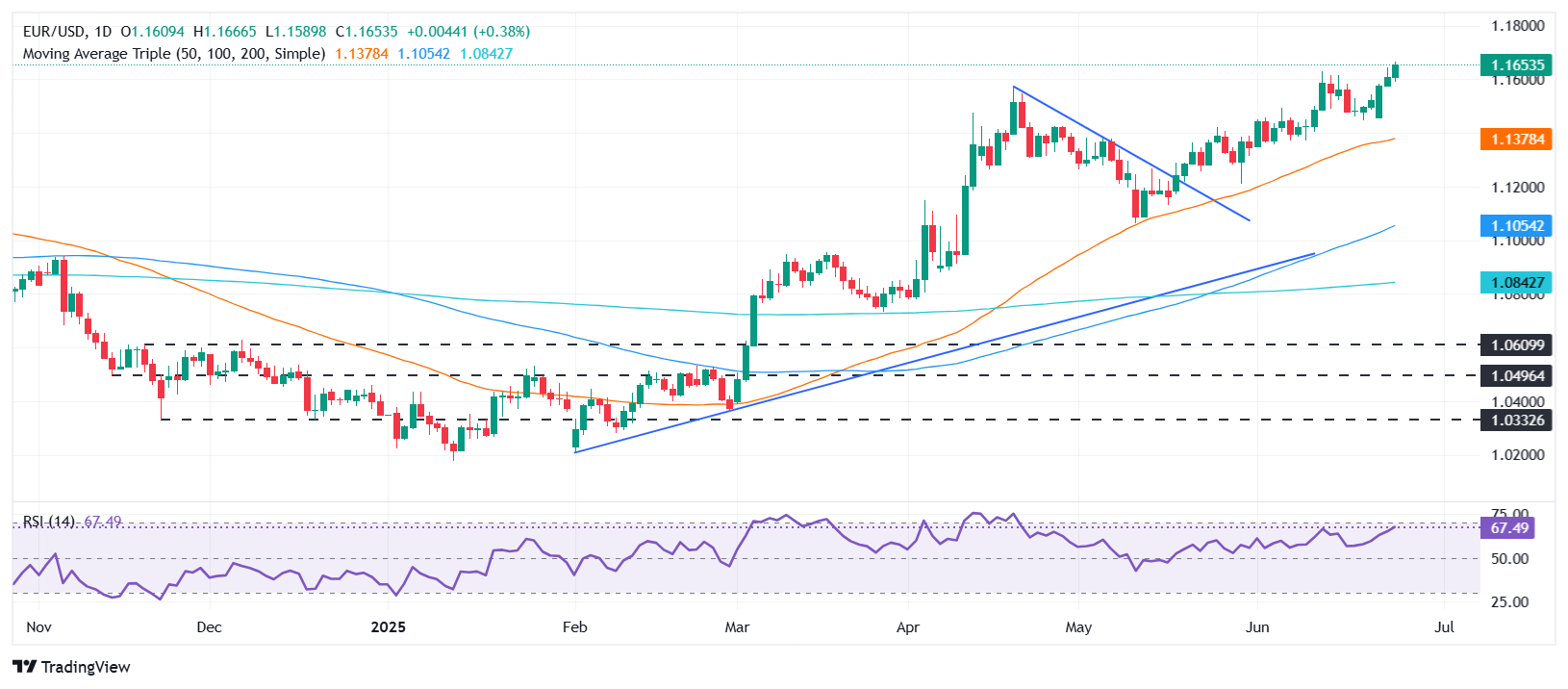
EUR/USD rallied to its highest level since October 2021, above the 1.1650 level on Wednesday, driven by a risk-on mood sparked by the de-escalation of the Iran-Israel conflict and broad weakness in the US Dollar. Investors' growing speculation that the Federal Reserve (Fed) will cut interest rates pushed the Greenback lower, setting it to test yearly lows. At the time of writing, the pair trades at 1.1661, up 0.45%.
Geopolitics and central bank speeches are grabbing the headlines at the beginning of the week. Fed Chair Jerome Powell appeared before the US Senate, reiterating that monetary policy is appropriate and that the central bank is struggling to determine the impact of tariffs on inflation. Powell said, “The question is, who’s going to pay for the tariffs?.” “How much of it does show up in inflation. And honestly, it’s very hard to predict that in advance,” he added.
Regarding geopolitics in the Middle East, US President Donald Trump revealed that the US would hold a meeting with Iran next week. He warned that if Iran’s regime begins to build nuclear weapons, the US would attack Iran again.
In the meantime, the US economic schedule featured housing data, which was worse than expected, alongside another raft of Fed speakers. Across the pond, Consumer Confidence in France was steady, failing to improve as expected. In Spain, the Gross Domestic Product (GDP) for the first quarter was in line with estimates.
Ahead of the economic docket in the Eurozone, the agenda will feature the GfK Consumer Confidence for July and speeches by European Central Bank (ECB) officials, Luis de Guindos and Isabel Schnabel. In the US, the schedule will unveil the final release of growth figures for Q1 2025. Durable Goods Orders, as well as speeches by Cleveland Fed's Beth Hammack, Governor Michael Barr, and Minneapolis Fed's Neel Kashkari, are awaited by investors.
Daily digest market movers: EUR/USD surges on expectations of dovish Fed
- The EUR/USD's main advance on Wednesday is due to overall weakness in the US Dollar. The US Dollar Index (DXY), which tracks the performance of the buck’s value against a basket of rivals, plunges 0.25% to a new two-week low of 97.72. This, alongside expectations that the Fed will cut rates in the near term and month-end flows, could keep the pair underpinned.
- New Home Sales in the US dropped sharply by 13.7% in May, falling to an annualized rate of 623,000 from 722,000 in April, well below the expected 693,000 units. The decline was primarily attributed to elevated 30-year mortgage rates, nearly 7%, due to restrictive interest rates set by the Fed.
- Boston Fed Susan Collins commented that monetary policy is well-positioned and that the US economy is solid overall. She added that the tariffs' impact would be seen over the coming months, which most likely will push prices up and lower growth.
- Eurozone data released on Wednesday showed that French Consumer Confidence held steady at 88 in June, falling short of expectations for a slight uptick to 89. Meanwhile, Spain’s final Q1 GDP reading confirmed earlier estimates, showing a 0.6% expansion on a quarterly basis and 2.8% growth YoY.
- Money markets suggest that traders are pricing in 59 basis points of easing toward the end of the year, according to Prime Market Terminal data.
Euro technical outlook: EUR/USD remains bullish with buyers targeting 1.1700 as next resistance
EUR/USD remains bullish, and after clearing the previously new year-to-date (YTD) high of 1.1641, it refreshed at 1.1664, with further upside seen in the short term. The Relative Strength Index (RSI) indicates that buyers are gaining momentum.
That said, the next resistance for EUR/USD is 1.1700. Once surpassed, the next area of interest would be 1.1800. On the other hand, a daily close below 1.1650 could pave the way for testing 1.1600. A breach of the latter will expose 1.1550, followed by the 1.1500 mark.
Euro FAQs
The Euro is the currency for the 19 European Union countries that belong to the Eurozone. It is the second most heavily traded currency in the world behind the US Dollar. In 2022, it accounted for 31% of all foreign exchange transactions, with an average daily turnover of over $2.2 trillion a day. EUR/USD is the most heavily traded currency pair in the world, accounting for an estimated 30% off all transactions, followed by EUR/JPY (4%), EUR/GBP (3%) and EUR/AUD (2%).
The European Central Bank (ECB) in Frankfurt, Germany, is the reserve bank for the Eurozone. The ECB sets interest rates and manages monetary policy. The ECB’s primary mandate is to maintain price stability, which means either controlling inflation or stimulating growth. Its primary tool is the raising or lowering of interest rates. Relatively high interest rates – or the expectation of higher rates – will usually benefit the Euro and vice versa. The ECB Governing Council makes monetary policy decisions at meetings held eight times a year. Decisions are made by heads of the Eurozone national banks and six permanent members, including the President of the ECB, Christine Lagarde.
Eurozone inflation data, measured by the Harmonized Index of Consumer Prices (HICP), is an important econometric for the Euro. If inflation rises more than expected, especially if above the ECB’s 2% target, it obliges the ECB to raise interest rates to bring it back under control. Relatively high interest rates compared to its counterparts will usually benefit the Euro, as it makes the region more attractive as a place for global investors to park their money.
Data releases gauge the health of the economy and can impact on the Euro. Indicators such as GDP, Manufacturing and Services PMIs, employment, and consumer sentiment surveys can all influence the direction of the single currency. A strong economy is good for the Euro. Not only does it attract more foreign investment but it may encourage the ECB to put up interest rates, which will directly strengthen the Euro. Otherwise, if economic data is weak, the Euro is likely to fall. Economic data for the four largest economies in the euro area (Germany, France, Italy and Spain) are especially significant, as they account for 75% of the Eurozone’s economy.
Another significant data release for the Euro is the Trade Balance. This indicator measures the difference between what a country earns from its exports and what it spends on imports over a given period. If a country produces highly sought after exports then its currency will gain in value purely from the extra demand created from foreign buyers seeking to purchase these goods. Therefore, a positive net Trade Balance strengthens a currency and vice versa for a negative balance.
Author

Christian Borjon Valencia
FXStreet
Markets analyst, news editor, and trading instructor with over 14 years of experience across FX, commodities, US equity indices, and global macro markets.