EUR/USD drops as German inflation cools down in March
- EUR/USD edges lower around 1.0800, focusing on Trump’s reciprocal tariff measures to be released on Wednesday.
- This week, the US Dollar will also be influenced by the US ISM PMI and a slew of employment-related data, ending with the NFP for March on Friday.
- The EU Commission agrees to provide a ‘term sheet’ of concessions for the US.

EUR/USD ticks lower to near 1.0800 in Monday’s North American session after the release of the soft preliminary German Harmonized Index of Consumer Prices (HICP) data. In 12 months to March, the HICP rose at a slower pace of 2.3% compared to estimates of 2.4% and the prior release of 2.6%. Month-on-month HICP grew at a moderate pace of 0.4% against the former reading of 0.5%. On Friday, France and Spain's March preliminary inflation data also showed that price pressures rose at a slower-than-expected pace.
Earlier in the day, six states of Germany had indicated mixed flash Consumer Price Index (CPI) data for March. Year-on-year inflation in Germany states: Saxony and Hesse accelerated, but it slowed in Baden-Wuettemberg and Bavaria. Price pressures grew steadily in Brandenburg and North Rhine-Westphalia. Theoretically, cooling inflationary pressures in the Eurozone should boost market expectations that the European Central Bank (ECB) will cut interest rates again in the April policy meeting. However, investors expect their impact to be limited on the monetary policy outlook as investors anticipate a resurgence in inflation and a slowdown in economic growth in the Eurozone due to United States (US) President Donald Trump’s tariff agenda.
ECB policymaker and Governor of Bank of Italy said in a speech in Rome during European trading hours that the "fight against inflation cannot be considered over" due to increased uncertainty, especially "contradictory US policy announcements", which calls for "caution on further interest rate cuts".
Donald Trump is poised to announce planned reciprocal tariffs on Wednesday. Investors expect Trump to slap significant tariffs on the Eurozone as he has criticized the European Union (EU) for not buying American goods.
In 2024, Ireland and Germany were the fourth and fifth, respectively, largest nations having trade surplus with the US, according to the World Population Review. Trump's higher import duties on the Eurozone would significantly impact its economic growth. During European trading hours, European Central Bank (ECB) President Christine Lagarde stated that any ensuing trade war would be a lose-lose scenario and lower Eurozone growth by at least 0.3%.
Last week, Trump also imposed 25% tariffs on imports of foreign cars and light trucks, which will come into effect on Wednesday. In response, the EU Commission warned of retaliatory measures but later agreed to provide concessions to the US to secure the partial removal of tariffs that have already hit and are expected to increase further on April 2, Bloomberg reported.
Euro PRICE Today
The table below shows the percentage change of Euro (EUR) against listed major currencies today. Euro was the strongest against the Australian Dollar.
| USD | EUR | GBP | JPY | CAD | AUD | NZD | CHF | |
|---|---|---|---|---|---|---|---|---|
| USD | 0.23% | 0.02% | -0.15% | 0.48% | 0.78% | 0.80% | 0.24% | |
| EUR | -0.23% | -0.10% | -0.36% | 0.29% | 0.63% | 0.61% | 0.06% | |
| GBP | -0.02% | 0.10% | -0.27% | 0.44% | 0.73% | 0.74% | 0.20% | |
| JPY | 0.15% | 0.36% | 0.27% | 0.63% | 0.97% | 0.98% | 0.30% | |
| CAD | -0.48% | -0.29% | -0.44% | -0.63% | 0.33% | 0.32% | -0.24% | |
| AUD | -0.78% | -0.63% | -0.73% | -0.97% | -0.33% | 0.00% | -0.56% | |
| NZD | -0.80% | -0.61% | -0.74% | -0.98% | -0.32% | -0.00% | -0.56% | |
| CHF | -0.24% | -0.06% | -0.20% | -0.30% | 0.24% | 0.56% | 0.56% |
The heat map shows percentage changes of major currencies against each other. The base currency is picked from the left column, while the quote currency is picked from the top row. For example, if you pick the Euro from the left column and move along the horizontal line to the US Dollar, the percentage change displayed in the box will represent EUR (base)/USD (quote).
Daily digest market movers: EUR/USD ticks lower as US Dollar gains
- The cautious trend in the EUR/USD pair is also driven by a slight upside in the US Dollar (USD) ahead of Trump's reciprocal tariff announcemnet on Liberation Day. The US Dollar Index (DXY), which tracks the Greenback’s value against six major currencies, rebounds to near 104.20 after posting a fresh 10-day low around 103.75 earlier in the day.
- Financial market participants expect that Trump’s reciprocal tariffs will be unfavorable for economic growth and will reignite inflation across the globe, including the US. According to the Washington Post, the President keeps telling his advisers to increase trade measures, and in recent days, he has brought back the idea of a universal tariff that would be applicable to most imports, no matter which country they come from.
- The Washington Post also showed that US President Trump expressed regret for not imposing broader tariffs in his first term and was confident that levies would be a win for the US. Higher import duties will bring back manufacturing jobs and add trillions in government revenue.
- This week, investors will also focus on a slew of US economic data, such as the ISM Manufacturing and Services Purchasing Managers Index (PMI) and labor market-related indicators, which will influence market speculation for the Federal Reserve’s (Fed) monetary policy outlook.
- According to the CME FedWatch tool, the Fed is expected to keep interest rates at their current levels in the May policy meeting. However, the probability for an interest rate cut in June has increased to 83.5% from 65.6% recorded a week ago.
Technical Analysis: EUR/USD stays above 20-day EMA
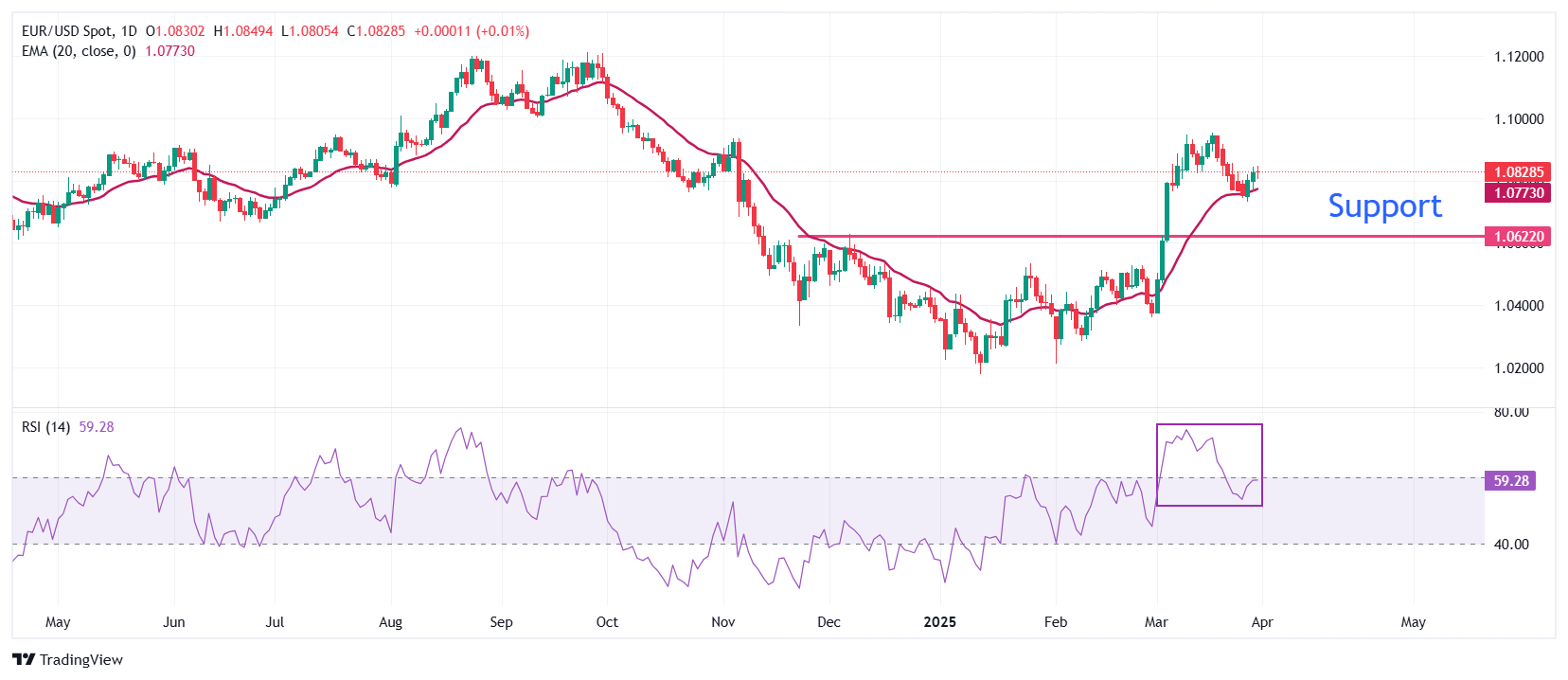
EUR/USD trades indecisively around 1.0800 at the start of the week. The near-term outlook of the pair remains firm as it holds the 20-day Exponential Moving Average (EMA), which trades around 1.0773.
The 14-day Relative Strength Index (RSI) cools down below 60.00, suggesting that the bullish momentum is over, but the upside bias is intact.
Looking down, the December 6 high of 1.0630 will act as the major support zone for the pair. Conversely, the psychological level of 1.1000 will be the key barrier for the Euro bulls.
ECB FAQs
The European Central Bank (ECB) in Frankfurt, Germany, is the reserve bank for the Eurozone. The ECB sets interest rates and manages monetary policy for the region. The ECB primary mandate is to maintain price stability, which means keeping inflation at around 2%. Its primary tool for achieving this is by raising or lowering interest rates. Relatively high interest rates will usually result in a stronger Euro and vice versa. The ECB Governing Council makes monetary policy decisions at meetings held eight times a year. Decisions are made by heads of the Eurozone national banks and six permanent members, including the President of the ECB, Christine Lagarde.
In extreme situations, the European Central Bank can enact a policy tool called Quantitative Easing. QE is the process by which the ECB prints Euros and uses them to buy assets – usually government or corporate bonds – from banks and other financial institutions. QE usually results in a weaker Euro. QE is a last resort when simply lowering interest rates is unlikely to achieve the objective of price stability. The ECB used it during the Great Financial Crisis in 2009-11, in 2015 when inflation remained stubbornly low, as well as during the covid pandemic.
Quantitative tightening (QT) is the reverse of QE. It is undertaken after QE when an economic recovery is underway and inflation starts rising. Whilst in QE the European Central Bank (ECB) purchases government and corporate bonds from financial institutions to provide them with liquidity, in QT the ECB stops buying more bonds, and stops reinvesting the principal maturing on the bonds it already holds. It is usually positive (or bullish) for the Euro.
BRANDED CONTENT
Finding the right broker for trading EUR/USD is crucial, and we've identified the top choices for this major currency pair. Read about their unique features to make an informed decision.
Author

Sagar Dua
FXStreet
Sagar Dua is associated with the financial markets from his college days. Along with pursuing post-graduation in Commerce in 2014, he started his markets training with chart analysis.