EUR/USD rises to 1.0800 as Fed Powell emphasize higher for longer interest rates
- EUR/USD climbs slightly above 1.0800 despite stubborn US PPI deepening uncertainty over Fed rate cuts in September.
- US annual PPI for April meets estimates and monthly figures outperformed consensus.
- Eurozone price index is on track to return to 2% as service inflation eases to 3.7%.

EUR/USD advances slightly above the round-level resistance of 1.0800 in Tuesday’s early American session. The major currency pair strengthens even though the United States (US) Producer Price Index (PPI) data for April remains stubborn. The US Bureau of Labor Statistics (BLS) shows that monthly headline and core PPI grew strongly by 0.5% from expectations of 0.3% and 0.2%, respectively. Annually, headline and core PPI grew in line with estimates of 2.2% and 2.4%, respectively.
Hot PPI figures are expected to dent investors' confidence in the Federal Reserve (Fed) to start reducing interest rates from the September meeting. For more clarity, investors will focus on the US Consumer Price Index (CPI) for April, which will be published on Wednesday.
After the US PPI release, Fed Chair Jerome Powell commented that the report is broadly mixed. When asked about the interest rate outlook, Powell ruled out fears of a rate hike but emphasized maintaining interest rates at their current levels for a longer period to bring inflation down.
Daily digest market movers: EUR/USD holds gains despite stubborn US PPI report
- EUR/USD aims to settle above the crucial resistance of 1.0800. The major currency pair extends its upside as the US Dollar drops despite hotter-than-expected US PPI report, which has raised concerns over firm speculation that the Fed will start reducing interest rates from the September meeting. The US Dollar Index (DXY), which tracks the Greenback’s value against six major currencies, falls to the crucial support of 105.00.
- For more clarity, investors will focus on the April consumer inflation readings. The US consumer inflation data will be the major event of the week. US CPI remained hotter than expected in the first quarter of the year due to tight labor market conditions and robust household spending. Therefore, investors will keenly focus on it as the continuation of the release of hot readings will force traders to pare bets for Fed rate cuts in September. Hot inflation reading will also offset the Fed rate-cut optimism built on easing labor market conditions.
- On the other side of the Atlantic, investors await the preliminary Eurozone Q1 Gross Domestic Product (GDP) data, which will be published on Wednesday. The GDP growth is expected to have expanded at a steady rate. Quarterly and annualized GDP are projected to have grown stably by 0.3% and 0.4%, respectively. Upbeat GDP growth would provide relief to European Central Bank (ECB) policymakers, which are planning to start lowering borrowing rates from the June meeting.
- Price pressures in the Eurozone economy are on course to return to the desired rate of 2% as the service inflation, which remained consistent at 4% in the November-March period, declined sharply to 3.7% in April. Financial markets have anticipated that the ECB will reduce interest rates by 70 basis points (bps) this year.
Technical Analysis: EUR/USD aims to stabilize above 1.0800
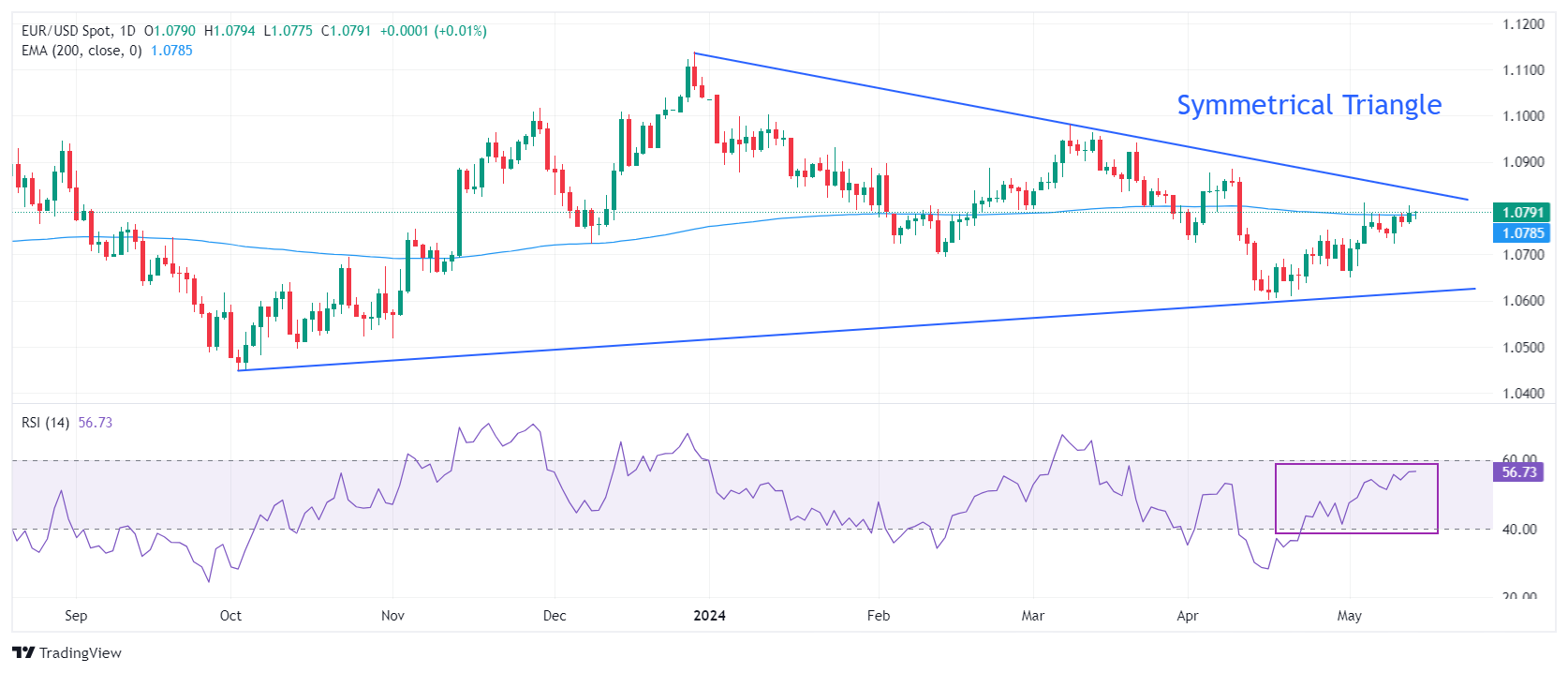
EUR/USD trades close to the round-level resistance of 1.0800. The 200-day Exponential Moving Average (EMA) near 1.0800 is acting as a strong barrier for Euro bulls.
Even though, the major currency pair is on course towards the downward-sloping border of the Symmetrical Triangle pattern formed on a daily timeframe, which is plotted from the December 28 high around 1.1140. The upward-sloping border of the triangle pattern is marked from the October 3 low at 1.0448. The Symmetrical Triangle formation exhibits a sharp volatility contraction.
The 14-period Relative Strength Index (RSI) oscillates inside the 40.00-60.00 range, suggesting indecisiveness among market participants.
Inflation FAQs
Inflation measures the rise in the price of a representative basket of goods and services. Headline inflation is usually expressed as a percentage change on a month-on-month (MoM) and year-on-year (YoY) basis. Core inflation excludes more volatile elements such as food and fuel which can fluctuate because of geopolitical and seasonal factors. Core inflation is the figure economists focus on and is the level targeted by central banks, which are mandated to keep inflation at a manageable level, usually around 2%.
The Consumer Price Index (CPI) measures the change in prices of a basket of goods and services over a period of time. It is usually expressed as a percentage change on a month-on-month (MoM) and year-on-year (YoY) basis. Core CPI is the figure targeted by central banks as it excludes volatile food and fuel inputs. When Core CPI rises above 2% it usually results in higher interest rates and vice versa when it falls below 2%. Since higher interest rates are positive for a currency, higher inflation usually results in a stronger currency. The opposite is true when inflation falls.
Although it may seem counter-intuitive, high inflation in a country pushes up the value of its currency and vice versa for lower inflation. This is because the central bank will normally raise interest rates to combat the higher inflation, which attract more global capital inflows from investors looking for a lucrative place to park their money.
Formerly, Gold was the asset investors turned to in times of high inflation because it preserved its value, and whilst investors will often still buy Gold for its safe-haven properties in times of extreme market turmoil, this is not the case most of the time. This is because when inflation is high, central banks will put up interest rates to combat it. Higher interest rates are negative for Gold because they increase the opportunity-cost of holding Gold vis-a-vis an interest-bearing asset or placing the money in a cash deposit account. On the flipside, lower inflation tends to be positive for Gold as it brings interest rates down, making the bright metal a more viable investment alternative.
Author
Sagar Dua
FXStreet
Sagar Dua is associated with the financial markets from his college days. Along with pursuing post-graduation in Commerce in 2014, he started his markets training with chart analysis.