EUR/USD surrenders intraday gains as US Dollar bounces back
- EUR/USD surrenders its initial gains and turns slightly negative from its opening rate as the US Dollar recovers strongly.
- Market participants worry that potential German coalition government formation will unlikely uplift the economy.
- Weak US private business activity data weighed on the US Dollar.

EUR/USD gives up its entire intraday gains after revisiting the one-month high near 1.0530 and drops to near 1.0460 in Monday’s North American session. The major currency pair surrenders significant gains as the US Dollar (USD) bounces back, with investors looking beyond the weak United States (US) flash S&P Global PMI data for February.
The US Dollar Index (DXY), which tracks the Greenback’s value against six major currencies, rebounds to near 106.40 after posting a fresh 11-week low around 106.10 earlier in the day.
The US S&P Global PMI report showed on Friday that overall private business activity rose at a slower pace. The Composite PMI, which gauges activities in both manufacturing and the services sector, fell to 50.4, the lowest reading since September 2023.
A notable decline in the services sector activities led to a significant slowdown in the comprehensive business activity data. The Services PMI surprisingly declined to 49.7 from 52.9 in January due to political uncertainty, notably in relation to federal spending cuts and potential policy impacts on economic growth and inflation outlooks, according to the PMI report. Contrary to a decline in activities in the services sector, the Manufacturing PMI expanded at a faster-than-expected pace to 51.6.
Weak US PMI data has led to a decent increase in Federal Reserve (Fed) dovish bets. The likelihood that the Fed will cut interest rates in the June meeting has increased to 63.5%, up from almost 50% a week ago.
Meanwhile, fears of global slowdown due to US President Donald Trump’s tariff agenda have supported the US Dollar. Trump has threatened to introduce reciprocal tariffs and levies on lumber and forest products, semiconductors, pharmaceuticals, and automobiles.
Daily digest market movers: EUR/USD falls back amid uncertainty over German coalition formation
- The downside move in the EUR/USD pair is also driven by weakness in the Euro (EUR) in the aftermath of the German federal election, with the absence of a clear majority by a single party that would hinder growth in the already fractured economy.
- Christian Democratic Union of Germany (CDU) leader Friedrich Merz is set to become the German Chancellor after getting majority votes but is expected to face a slew of difficulties, including complicated negotiations to form a coalition government. The most likely scenario seems to be a coalition between the CDU and the Social Democratic Party of Germany (SPD).
- Analysts at ING expect the next German government is unlikely to deliver much more for the economy than a “short-lived positive impact from some tax cuts, small reforms, and a bit more investment.”
- The broader outlook for the Euro remains weak as European Central Bank (ECB) officials continue to support a consistent policy easing cycle. On Saturday, ECB policymaker and Governor of the Bank of France François Villeroy de Galhau said in an interview with Alternatives Economiques that the central bank could cut its deposit rate down to 2% by this summer. His comments came a day after the release of the Eurozone flash HCOB Purchasing Managers Index (PMI) data for February on Friday.
- The preliminary PMI report showed on Friday that the Eurozone Composite PMI remained unchanged at 50.2, slower than estimates of 50.5. Additionally, overall business activity in France contracted at a faster-than-expected pace.
- On the economic front on Monday, German IFO data for February has majorly come in weaker than expected. The IFO Business Climate, which measures current conditions and business expectations, came in at 85.2, as in January, lower than estimates of 85.8. On the contrary, IFO Expectations - which gauges current conditions and business expectations for the next six months - improved to 85.4 from estimates of 85.2 and the former reading of 84.3.
Euro PRICE Today
The table below shows the percentage change of Euro (EUR) against listed major currencies today. Euro was the strongest against the Japanese Yen.
| USD | EUR | GBP | JPY | CAD | AUD | NZD | CHF | |
|---|---|---|---|---|---|---|---|---|
| USD | -0.11% | -0.14% | 0.28% | -0.06% | -0.23% | -0.15% | 0.10% | |
| EUR | 0.11% | -0.12% | 0.25% | -0.13% | -0.13% | -0.23% | 0.05% | |
| GBP | 0.14% | 0.12% | 0.44% | -0.01% | -0.01% | -0.10% | 0.14% | |
| JPY | -0.28% | -0.25% | -0.44% | -0.35% | -0.44% | -0.37% | -0.11% | |
| CAD | 0.06% | 0.13% | 0.01% | 0.35% | -0.22% | -0.09% | 0.16% | |
| AUD | 0.23% | 0.13% | 0.01% | 0.44% | 0.22% | -0.09% | 0.14% | |
| NZD | 0.15% | 0.23% | 0.10% | 0.37% | 0.09% | 0.09% | 0.26% | |
| CHF | -0.10% | -0.05% | -0.14% | 0.11% | -0.16% | -0.14% | -0.26% |
The heat map shows percentage changes of major currencies against each other. The base currency is picked from the left column, while the quote currency is picked from the top row. For example, if you pick the Euro from the left column and move along the horizontal line to the US Dollar, the percentage change displayed in the box will represent EUR (base)/USD (quote).
Technical Analysis: EUR/USD retreats to near 1.0460
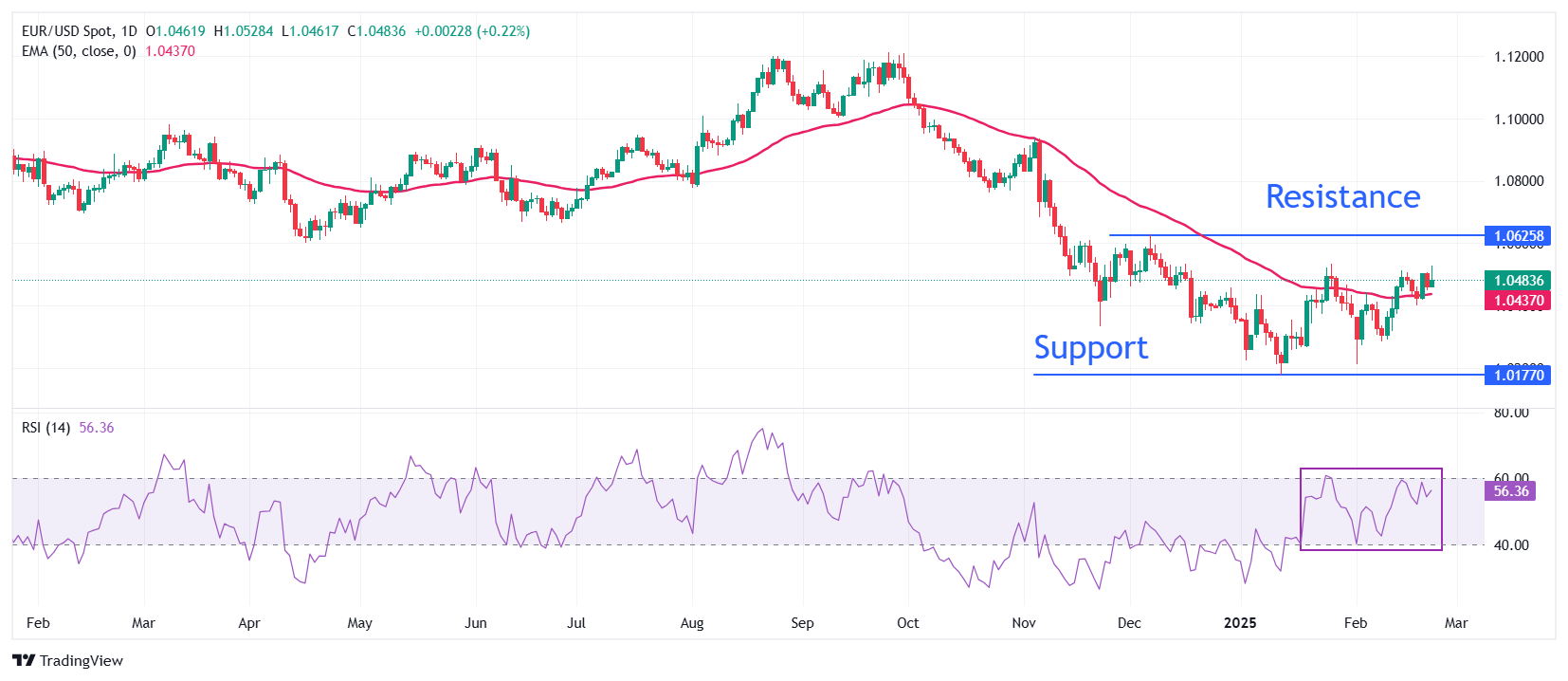
EUR/USD retreats from an intraday high of 1.0530 to near 1.0480 in North American trading hours on Monday. The 50-day Exponential Moving Average (EMA) continues to offer support to the major currency pair at around 1.0437.
The 14-day Relative Strength Index (RSI) wobbles around 60.00. A bullish momentum would activate if the RSI (14) sustains above that level.
Looking down, the February 10 low of 1.0285 will act as the major support zone for the pair. Conversely, the December 6 high of 1.0630 will be the key barrier for the Euro bulls.
Author

Sagar Dua
FXStreet
Sagar Dua is associated with the financial markets from his college days. Along with pursuing post-graduation in Commerce in 2014, he started his markets training with chart analysis.