EUR/USD rises on slightly hot flash German HICP, cooling US core PCE Inflation
- EUR/USD moves higher to near 1.0400 after the release of the flash German HICP for February and the US PCE inflation data for January.
- US President Trump confirmed tariffs on his North American partners and China on Thursday.
- Tariffs on Canada and Mexico, and an additional 10% levy on China to go into effect on March 4, reciprocal tariffs on April 2.

EUR/USD gains slightly to near 1.0410 in the North American trading session on Friday. The major currency pair ticks higher while the US Dollar (USD) trades flat after the release of United States (US) Personal Consumption Expenditures Price Index (PCE) data for January, which slowed in line with estimates. The US Dollar Index (DXY), which tracks the Greenback’s value against six major currencies, clings to Thursday’s strong upward move to near 107.40.
The core PCE inflation, which is the Federal Reserve's (Fed) preferred inflation gauge that excludes volatile food and energy items, decelerated to 2.6%, as expected from 2.8% in December on year. Month-on-month core PCE inflation rose by 0.3%, faster than the 0.2% growth seen in December. An expected slowdown in the US inflation is expected to weigh on market expectations that the Fed will keep interest rates in the current range of 4.25%-4.50% for longer.
Earlier in the day, the US Dollar traded higher, as fresh tariff threats from US President Donald Trump increased the appeal of safe-haven assets.
On Thursday, President Trump communicated from his account on Truth Social that 25% tariffs on Canada and Mexico are “coming into effect on March 4“ as “drugs are still pouring” into the economy from the borders of his North American allies. Trump also threatened to impose an “additional 10% levy on China” on the same date as a large percentage of drugs entering the US is in the form of fentanyl, which is made in and supplied by China. Additionally, Donald Trump said he is poised to introduce reciprocal tariffs on April 2.
Market experts believe that Trump’s tariff agenda will be pro-growth and inflationary for the US economy. Such a scenario would compel Fed officials to maintain a restrictive monetary policy stance.
On Thursday, Philadelphia Fed Bank President Patrick Harker supported maintaining interest rates at their current levels. Harker said that he believes the current level is optimal for bringing inflation back to the 2% target without harming the labor market and economic growth.
Daily digest market movers: EUR/USD rises as Euro outperforms
- EUR/USD moves slightly higher as the Euro (EUR) outperforms its other peers due to slightly hotter-than-expected flash Harmonized Index of Consumer Prices (HICP) data for February. German HICP rose steadily by 2.8%, faster than estimates of 2.7% on the year. Month-on-month HICP grew at a faster pace of 0.6% than expectations of 0.5%. In January, the underlying inflation data deflated by 0.2%.
- Despite a slightly hotter German inflation report for February, the European Central Bank (ECB) is expected to continue easing the monetary policy further in its upcoming meeting on Thursday. According to a February 19-27 Reuters poll, the ECB is certain to cut its Deposit Facility rate by 25 basis points (bps) to 2.5%. This would be the fifth interest rate cut by the central bank in a row. Dovish votes on the poll were based on fears that President Donald Trump’s tariff agenda will damage the Eurozone economic growth.
- On Wednesday, President Trump threatened to impose tariffs on the Eurozone. Trump said the tariffs will be announced “very soon,” and it will be 25% on “cars and other things”. The German economy is expected to be the major victim of a trade war between the Eurozone and the US, being the fourth largest trading partner of the country.
- The Reuters poll also showed that respondents were confident that the ECB would cut interest rates twice more by the middle of the year.
- For more meaningful cues on inflation, investors will focus on the flash Eurozone HICP data for February, which will be released on Monday.
- Meanwhile, German Retail Sales for January have come in higher than expected. The retail sales data, a key measure of consumer spending, rose by 0.2% in the month while it was expected to remain flat. In December, the consumer spending measure contracted by 1.6%. On a yearly basis, Retail Sales rose at a faster pace of 2.9% compared to the 1.8% growth seen in December.
Euro PRICE Today
The table below shows the percentage change of Euro (EUR) against listed major currencies today. Euro was the strongest against the Japanese Yen.
| USD | EUR | GBP | JPY | CAD | AUD | NZD | CHF | |
|---|---|---|---|---|---|---|---|---|
| USD | -0.02% | 0.08% | 0.69% | -0.22% | 0.35% | 0.55% | 0.32% | |
| EUR | 0.02% | 0.10% | 0.72% | -0.19% | 0.36% | 0.57% | 0.35% | |
| GBP | -0.08% | -0.10% | 0.61% | -0.29% | 0.26% | 0.47% | 0.24% | |
| JPY | -0.69% | -0.72% | -0.61% | -0.90% | -0.35% | -0.16% | -0.37% | |
| CAD | 0.22% | 0.19% | 0.29% | 0.90% | 0.55% | 0.77% | 0.54% | |
| AUD | -0.35% | -0.36% | -0.26% | 0.35% | -0.55% | 0.21% | -0.01% | |
| NZD | -0.55% | -0.57% | -0.47% | 0.16% | -0.77% | -0.21% | -0.22% | |
| CHF | -0.32% | -0.35% | -0.24% | 0.37% | -0.54% | 0.00% | 0.22% |
The heat map shows percentage changes of major currencies against each other. The base currency is picked from the left column, while the quote currency is picked from the top row. For example, if you pick the Euro from the left column and move along the horizontal line to the US Dollar, the percentage change displayed in the box will represent EUR (base)/USD (quote).
Technical Analysis: EUR/USD strives to hold ground near 1.0400
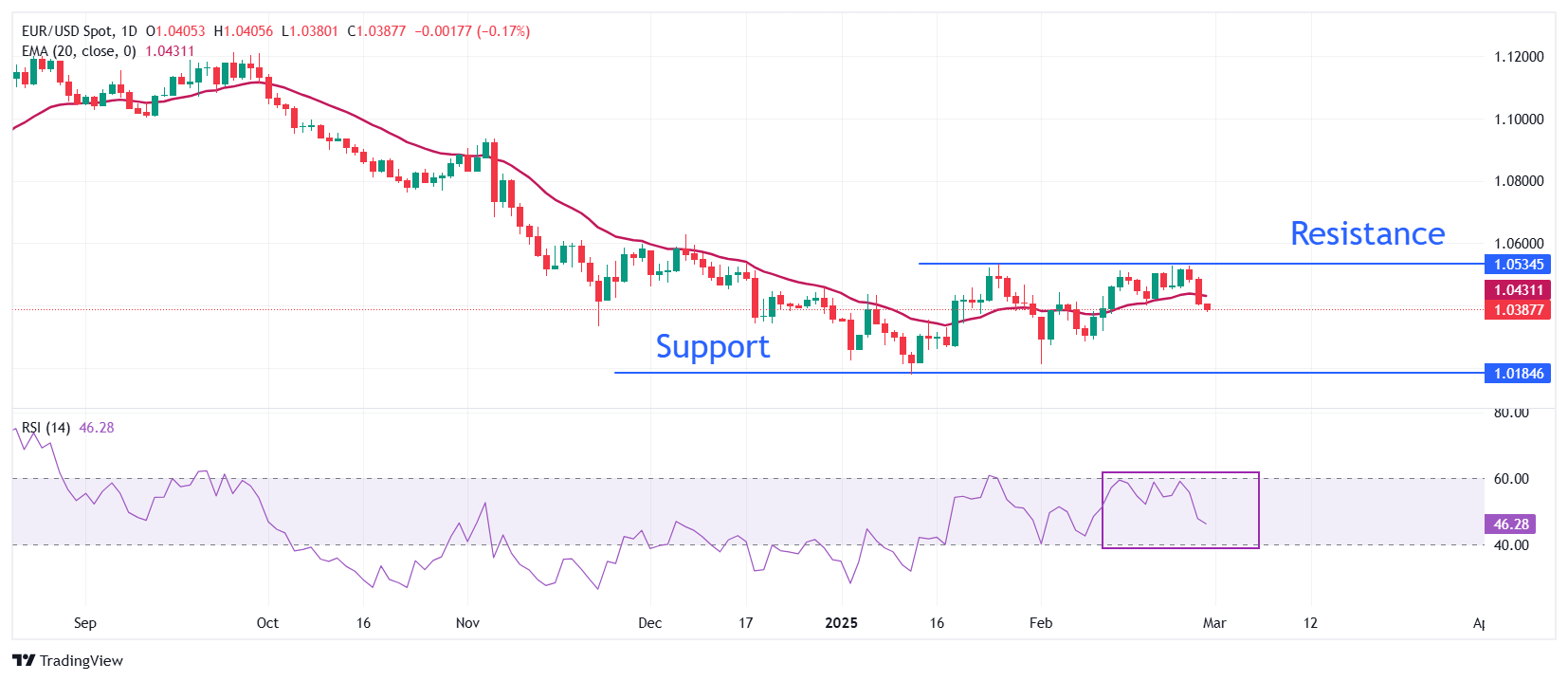
EUR/USD faces strong selling pressure after breaking on Thursday the tight consolidation range of 1.0450-1.0530, in which it has been trading since February 21. The major currency pair extends its downside below the 20-day Exponential Moving Average (EMA), which stands around 1.0430, suggesting that the near-term trend has turned bearish.
The 14-day Relative Strength Index (RSI) declines toward 40.00. A bearish momentum would activate if the RSI falls below that level.
Looking down, the February 10 low of 1.0285 will act as the major support zone for the pair. Conversely, the February 24 high of 1.0530 will be the key barrier for the Euro bulls.
Author

Sagar Dua
FXStreet
Sagar Dua is associated with the financial markets from his college days. Along with pursuing post-graduation in Commerce in 2014, he started his markets training with chart analysis.