EUR/USD ticks lower as Fed signals no rush for rate cuts
- EUR/USD edges down below 1.1300 as the US Dollar strengthens after the Fed said it is in no rush to cut interest rates.
- US President Trump is set to unveil a bilateral trade deal, reportedly with the UK, on Thursday.
- The EU releases countermeasures against US tariffs to offset their costs.

EUR/USD ticks lower below 1.1300 during European trading hours on Thursday. The major currency pair edges down as the US Dollar (USD) trades slightly higher on signals from the Federal Reserve (Fed) that there is no rush to lower interest rates, which came on Wednesday just after the central bank left interest rates unchanged in the range of 4.25%-4.50% for the third time in a row. The US Dollar Index (DXY), which gauges the Greenback’s value against six major currencies, ticks higher to near 100.00.
Fed Chair Jerome Powell stated that “uncertainty about the economic outlook has increased further" due to the fallout of tariffs announced by US President Donald Trump, which have skewed “risks to both inflation and unemployment on the upside”. Therefore, Powell advised that the right thing for the Fed now is to “await more clarity”.
According to the CME FedWatch tool, traders are confident that the Fed will also keep borrowing rates steady in the June policy meeting, but see around a 66% chance of interest rates being lower than current levels in July.
Meanwhile, investors await the announcement of the first bilateral trade deal by the White House under the leadership of US President Trump. On Wednesday, Trump declared through a post on Truth.Social that his team has closed a deal with one of his trading allies, which will be public on Thursday. According to a report from The New York Times (NYT), the trading partner will be the United Kingdom (UK). This contradicts what Trump signaled last week on the NewsNation television network that India, South Korea, and Japan would be the first countries to close trade deals.
However, financial market participants are mainly focusing on trade discussions between the US and China, which are scheduled for Saturday in Switzerland. US Treasury Secretary Scott Bessent and Trade Representative Jamieson Greer confirmed that they will meet their Chinese counterparts, aiming to de-escalate the trade war.
Daily digest market movers: EUR/USD ticks lower, EU unveils countermeasures for US tariffs
- EUR/USD is slightly down as the US Dollar moves higher. Though investors have underpinned the USD against the Euro (EUR), the latter is outperforming a majority of peers.
- However, its upside is expected to remain limited as the European Central Bank (ECB) is expected to continue the monetary expansion cycle further. Traders are increasingly confident that the ECB will reduce interest rates again in the June meeting.
- ECB officials have shown concerns over the Eurozone economic outlook, while remaining confident that inflation will sustainably return to the central bank’s target of 2% by the year-end.
- Meanwhile, the European Union (EU) commission has launched a public consultation paper that contains possible countermeasures as response to United States (US) tariffs. The paper shows countermeasures on up to €95 billion of US imports if trade talks fail to deliver a satisfactory result for the bloc, which is a little short of €100 billion reported by Bloomberg on Tuesday.
- European Trade Commissioner Maros Sefcovic already told on Wednesday that the commission would announce countermeasures to offset the cost stemmed by US tariffs to the continent, "Tomorrow we will announce next preparatory steps, both in the area of possible rebalancing measures, and also in the areas important for the further discussions," Sefcovic said, Reuters reported. However, he clarified that the foremost priority of the continent is trade negotiations with the US, but not at any cost.
Technical Analysis: EUR/USD wobbles around 20-day EMA
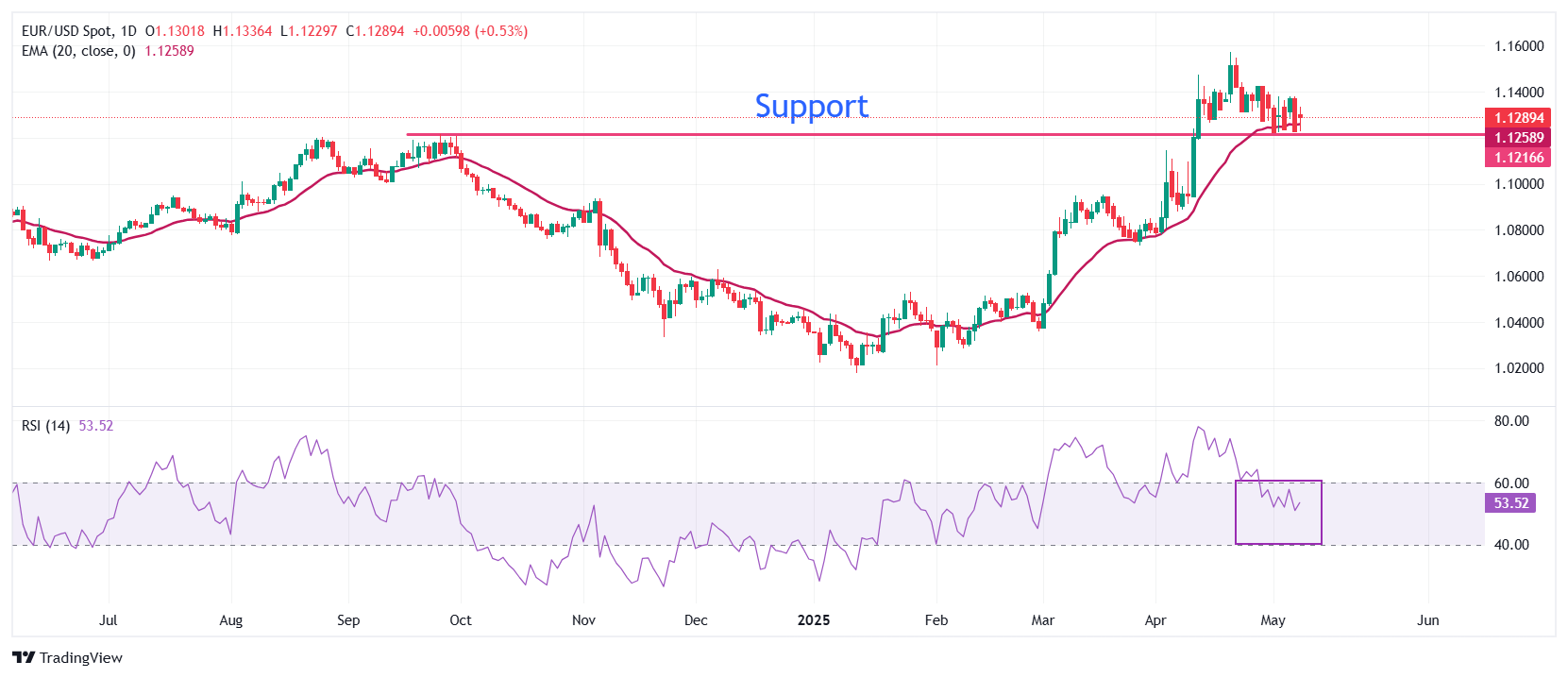
EUR/USD ticks lower below 1.1300 on Thursday. The pair continues to hold the 20-day Exponential Moving Average (EMA) around 1.1260.
The 14-day Relative Strength Index (RSI) falls inside the 40.00-60.00 range, indicating that the bullish momentum is concluded for now. However, the upside bias still prevails.
Looking up, the psychological level of 1.1500 will be the major resistance for the pair. Conversely, the September 25 high of 1.1214 will be a key support for the Euro bulls.
Fed FAQs
Monetary policy in the US is shaped by the Federal Reserve (Fed). The Fed has two mandates: to achieve price stability and foster full employment. Its primary tool to achieve these goals is by adjusting interest rates. When prices are rising too quickly and inflation is above the Fed’s 2% target, it raises interest rates, increasing borrowing costs throughout the economy. This results in a stronger US Dollar (USD) as it makes the US a more attractive place for international investors to park their money. When inflation falls below 2% or the Unemployment Rate is too high, the Fed may lower interest rates to encourage borrowing, which weighs on the Greenback.
The Federal Reserve (Fed) holds eight policy meetings a year, where the Federal Open Market Committee (FOMC) assesses economic conditions and makes monetary policy decisions. The FOMC is attended by twelve Fed officials – the seven members of the Board of Governors, the president of the Federal Reserve Bank of New York, and four of the remaining eleven regional Reserve Bank presidents, who serve one-year terms on a rotating basis.
In extreme situations, the Federal Reserve may resort to a policy named Quantitative Easing (QE). QE is the process by which the Fed substantially increases the flow of credit in a stuck financial system. It is a non-standard policy measure used during crises or when inflation is extremely low. It was the Fed’s weapon of choice during the Great Financial Crisis in 2008. It involves the Fed printing more Dollars and using them to buy high grade bonds from financial institutions. QE usually weakens the US Dollar.
Quantitative tightening (QT) is the reverse process of QE, whereby the Federal Reserve stops buying bonds from financial institutions and does not reinvest the principal from the bonds it holds maturing, to purchase new bonds. It is usually positive for the value of the US Dollar.
BRANDED CONTENT
Finding the right broker for trading EUR/USD is crucial, and we've identified the top choices for this major currency pair. Read about their unique features to make an informed decision.
Author

Sagar Dua
FXStreet
Sagar Dua is associated with the financial markets from his college days. Along with pursuing post-graduation in Commerce in 2014, he started his markets training with chart analysis.