EUR/USD crawls higher as investors shift their focus to US inflation
- The Euro bounces up and trims previous losses as investors digest the 30% levies on products from the EU announced by Trump.
- Investors shift their focus to US inflation figures, hopeful of a US-EU trade deal.
- EUR/USD maintains its broader bearish trend intact with 1.1700 resistance capping bulls.

The EUR/USD pair bounced up from lows in the early European session on Monday and is moving higher for the first time in the past four trading days. The pair, however, maintains its broader bearish trend intact as the 30% levies on all European Union (EU) products announced by US President Donald Trump over the weekend keep risk appetite subdued.
The Euro (EUR) bounced up from fresh three-week lows at the 1.1655 earlier on Monday, but it remains capped between the 1.1700 round level ahead of the US Session opening. Looking at the trend since the beginning of the month, the pair has been trading within a bearish channel since peaking at a nearly four-year high at 1.1830 on July 1.
Markets have opened with a mild risk-off tone on the back of Trump's new round of tariffs, but the reaction so far has been more contained than that of April 2 Liberation Day. Traders seem to have assumed this new threat as a negotiating scheme rather than a final statement.
EU officials maintain their positive approach regarding the ongoing trade talks with Washington and remain hopeful of reaching a deal before the August deadline. The European Union has delayed any retaliatory tariffs, and EU Trade Commissioner, Maros Sefkovic, reiterated that an agreement with the US is imminent, which has provided some support to the Euro.
The economic calendar is practically void on Monday with news from the Eurogroup meeting and European Central Bank's (ECB) Cipollone speech, due in the European afternoon, likely to guide the Euro. In the US, the focus will be on Tuesday's Consumer Price Index (CPI) data from June, which might give further clues on the Federal Reserve's (Fed) easing calendar.
Daily digest market movers: The Euro picks up on hopes of a trade deal with the US
- The Euro is reversing previous losses as hopes of a deal between the EU and the US remain alive. EU officials said that the Union will extend the suspension of countermeasures, prioritizing negotiations, and Trade Commissioner Sefkovic assured that "we are approaching a good outcome for both sides" before announcing that he will be speaking with US counterparts later on Monday.
- On Friday, ECB's board member Fabio Panetta observed that downside risks to inflation have strengthened and affirmed that the central bank should keep easing its monetary policy, increasing bearish pressure on the common currency.
- Also on Friday, Chicago Fed President Austan Goolsbee warned that Trump's new tariff threats muddle the inflation outlook and make it more difficult for policymakers to support the rate cuts he is calling for.
- These comments did not stop the US President from continuing to pressure the Fed Chairman. Trump affirmed during the weekend that it would be a "great thing" if Powell stepped down, this time supported by the US Government's economic adviser, Kevin Hassett, who suggested that the president might be authorized to oust Powell due to the overrun costs of the bank's headquarters.
EUR/USD picks up from lows, but 1.1700 is limiting rallies for now
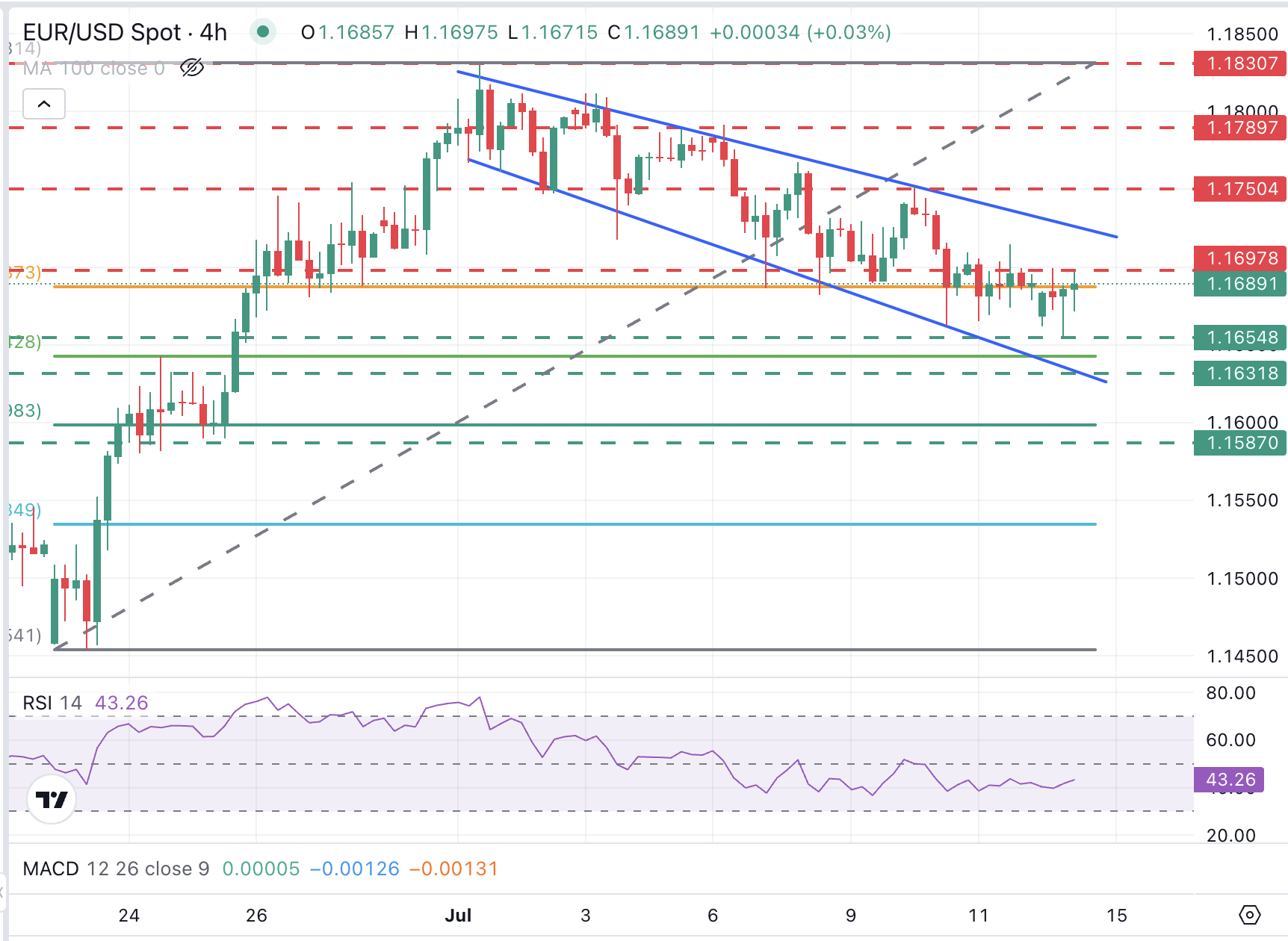
EUR/USD continues trading within the descending channel from July 1highs. Upside attempts remain limited amid a moderate risk-off market, and technical indicators remain well within bearish territory. The Relative Strength Index is low but still above oversold levels, which suggests that further depreciation is on the cards.
Bears failed to confirm below the 1.1660 support area (July 10 and 12 low), but upside attempts remain limited below 1.1700 so far. A bearish continuation below the mentioned 1.1660 might find support at the 50% Fibonacci retracement of the late June bullish run, at 1.1640, ahead of the bottom of the bearish channel from July 1 highs, at 1.1630.
On the upside, above the 1.1700 intraday high, bulls are likely to be challenged at the trendline resistance, now at 1.1730, and the July 10 high at 1.1740.
Economic Indicator
Consumer Price Index (YoY)
Inflationary or deflationary tendencies are measured by periodically summing the prices of a basket of representative goods and services and presenting the data as The Consumer Price Index (CPI). CPI data is compiled on a monthly basis and released by the US Department of Labor Statistics. The YoY reading compares the prices of goods in the reference month to the same month a year earlier.The CPI is a key indicator to measure inflation and changes in purchasing trends. Generally speaking, a high reading is seen as bullish for the US Dollar (USD), while a low reading is seen as bearish.
Read more.Next release: Tue Jul 15, 2025 12:30
Frequency: Monthly
Consensus: 2.7%
Previous: 2.4%
Source: US Bureau of Labor Statistics
The US Federal Reserve (Fed) has a dual mandate of maintaining price stability and maximum employment. According to such mandate, inflation should be at around 2% YoY and has become the weakest pillar of the central bank’s directive ever since the world suffered a pandemic, which extends to these days. Price pressures keep rising amid supply-chain issues and bottlenecks, with the Consumer Price Index (CPI) hanging at multi-decade highs. The Fed has already taken measures to tame inflation and is expected to maintain an aggressive stance in the foreseeable future.
Economic Indicator
Consumer Price Index ex Food & Energy (YoY)
Inflationary or deflationary tendencies are measured by periodically summing the prices of a basket of representative goods and services and presenting the data as the Consumer Price Index (CPI). CPI data is compiled on a monthly basis and released by the US Department of Labor Statistics. The YoY reading compares the prices of goods in the reference month to the same month a year earlier. The CPI Ex Food & Energy excludes the so-called more volatile food and energy components to give a more accurate measurement of price pressures. Generally speaking, a high reading is bullish for the US Dollar (USD), while a low reading is seen as bearish.
Read more.Next release: Tue Jul 15, 2025 12:30
Frequency: Monthly
Consensus: 3%
Previous: 2.8%
Source: US Bureau of Labor Statistics
The US Federal Reserve has a dual mandate of maintaining price stability and maximum employment. According to such mandate, inflation should be at around 2% YoY and has become the weakest pillar of the central bank’s directive ever since the world suffered a pandemic, which extends to these days. Price pressures keep rising amid supply-chain issues and bottlenecks, with the Consumer Price Index (CPI) hanging at multi-decade highs. The Fed has already taken measures to tame inflation and is expected to maintain an aggressive stance in the foreseeable future.
Author

Guillermo Alcala
FXStreet
Graduated in Communication Sciences at the Universidad del Pais Vasco and Universiteit van Amsterdam, Guillermo has been working as financial news editor and copywriter in diverse Forex-related firms, like FXStreet and Kantox.