EUR/USD hesitates with US ADP employment data, Manufacturing PMI in tap
- The Euro pares gains and returns below 1.1750 despite a moderate uptick in Eurozone inflation.
- Consumer prices accelerated to 2.2% in the Eurozone in September, from 2% in August.
- In the US, the focus turns ffrom the government shutdown to August's pauyolls, manufacturing activity data

EUR/USD has been capped 1.1780 earlier during Wednesday's European session and is trading at 1.1735 at the time of writing, practically flat on the day. The Eurozone preliminary Harmonized Index of Consumer Prices (HICP) met expectations, and investors' focus shifts away from the US Government closure to August's US ADP Employment and the ISM Manufacturing PMI report.
Eurozone inflation data confirmed that price pressures accelerated to a 2.2% yearly rate in September from 2% in August, although the core inflation remained growing at a steady 2.3%. Monthly inflation eased to 0.1%, from 0.3% in the previous month, while the core HICP remained steady at 0.1%. All in all, figures in line with the market expectations that have failed to provide any further support to the Euro.
In the US, a last-minute vote in the US Senate failed to pass the Republicans' funding bill, leading to the government's closure. The economic impact should not be significant unless the situation extends in time. However, it might delay the release of the US Nonfarm Payrolls report on Friday, which is a key data point for the Federal Reserve's monetary policy decision due in late October.
US JOLTS Job Openings data was mixed on Tuesday, showing a slight increase in job vacancies but less hiring. Later today, the ADP Employment Change report is expected to show that private payrolls increased by 50K in September, a poor reading compared with last year's averages and further evidence that employment creation has stalled.
Euro Price Today
The table below shows the percentage change of Euro (EUR) against listed major currencies today. Euro was the strongest against the Swiss Franc.
| USD | EUR | GBP | JPY | CAD | AUD | NZD | CHF | |
|---|---|---|---|---|---|---|---|---|
| USD | -0.03% | -0.32% | -0.59% | 0.06% | -0.08% | -0.38% | 0.18% | |
| EUR | 0.03% | -0.27% | -0.55% | 0.08% | -0.04% | -0.33% | 0.20% | |
| GBP | 0.32% | 0.27% | -0.26% | 0.36% | 0.24% | -0.05% | 0.48% | |
| JPY | 0.59% | 0.55% | 0.26% | 0.66% | 0.49% | 0.44% | 0.86% | |
| CAD | -0.06% | -0.08% | -0.36% | -0.66% | -0.14% | -0.42% | 0.12% | |
| AUD | 0.08% | 0.04% | -0.24% | -0.49% | 0.14% | -0.29% | 0.24% | |
| NZD | 0.38% | 0.33% | 0.05% | -0.44% | 0.42% | 0.29% | 0.54% | |
| CHF | -0.18% | -0.20% | -0.48% | -0.86% | -0.12% | -0.24% | -0.54% |
The heat map shows percentage changes of major currencies against each other. The base currency is picked from the left column, while the quote currency is picked from the top row. For example, if you pick the Euro from the left column and move along the horizontal line to the US Dollar, the percentage change displayed in the box will represent EUR (base)/USD (quote).
Daily digest market movers: The US Dollar struggles with the government closed
- The Euro is giving away gains as the US Dollar picks up from the multi-week lows hit after the US government confirmed the worst expectations and shut down earlier on Wednesday. Investors seem to be receptive to the USD, ahead of the US session opening, although the Greenback could need a strong positive surprise at the , the ADP Employment Change report to perform a significant recovery, which is unlikely to be the case.
- Data released by Destatis on Tuesday revealed that the German Consumer Price Index (CPI) accelerated to a 2.4% year-on-year pace in September, from 2.2% in August, beating expectations of a softer increase to 2.3%. Likewise, the HICP grew at a 2.4% pace, from 2.1% in the previous month and above the 2.2% market consensus.
- In the US, JOLTS Job Openings increased to 7.22 million in August from 7.20 million in July, beating expectations of 7.2 million openings, although the hiring rate eased to 3.2% from 3.3% in July, which adds to evidence of a deteriorating labour market and dampened investors' optimism about the headline reading.
- Later on Wednesday, Automatic Data Processing (ADP) will release its September payrolls report, which is expected to show a net change of 50K new jobs, down from the 54K seen in August and well below the levels beyond 100K seen last year and at the beginning of this one.
- The US ISM Manufacturing PMI is expected to show a moderate improvement to 49.0 in August from 48.7 in July, still at levels consistent with a contracting business activity. The Dollar needs positive surprises, preferably in both areas, to extend the frrail recovery attempts seen earlier on the day.
Technical Analysis: EUR/USD resistances at 1.1760 and 1.1790 are holding bulls
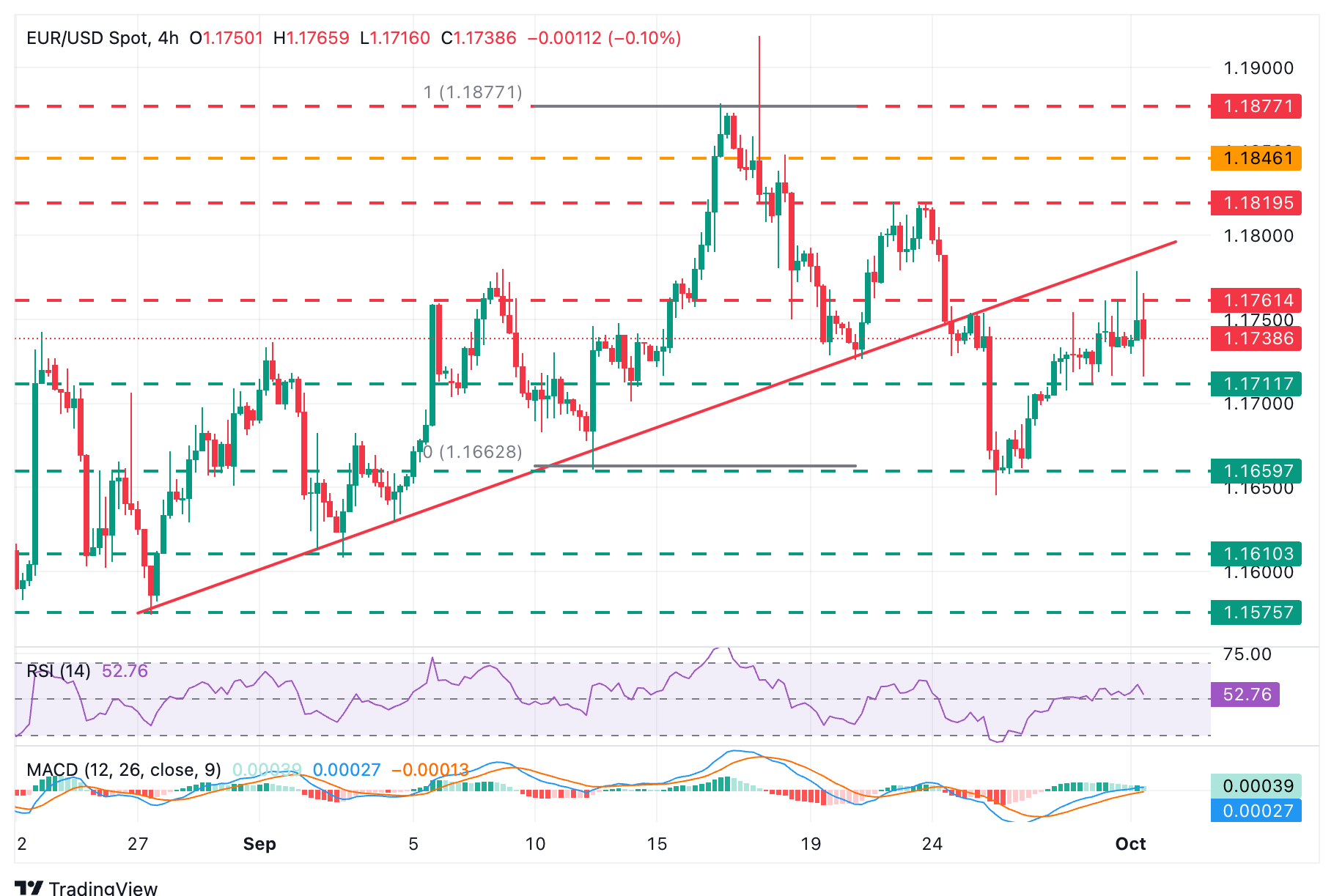
EUR/USD maintains the immediate bullish trend in play, although momentum is faltering. The 4-hour chart Relative Strength Index (RSI) has turned down to levels right above 50, currently at 52, and the Moving Average Convergence Divergence (MACD) is flattening. The US Dollar Index, on the other hand, remains subdued near lows, which keeps the pair's downside attempts limited for now.
Bulls have been rejected at the 1.1780 area earlier today, a few pips below the reverse broken trendline, which now lies right above 1.1790. A successful break of that level would cancel the bearish trend from mid-September highs and shift the focus towards the September 23 and 24 highs, near 1.1820.
To the downside, immediate support is at the 1.1710-1.1715 area, where the pair was contained on Tuesday. Further down, last week's lows at the 1.1645-1.1655 area and the September 2 and 3 lows, near 1.1610, come into focus.
Economic Indicator
ADP Employment Change
The ADP Employment Change is a gauge of employment in the private sector released by the largest payroll processor in the US, Automatic Data Processing Inc. It measures the change in the number of people privately employed in the US. Generally speaking, a rise in the indicator has positive implications for consumer spending and is stimulative of economic growth. So a high reading is traditionally seen as bullish for the US Dollar (USD), while a low reading is seen as bearish.
Read more.Next release: Wed Oct 01, 2025 12:15
Frequency: Monthly
Consensus: 50K
Previous: 54K
Source: ADP Research Institute
Traders often consider employment figures from ADP, America’s largest payrolls provider, report as the harbinger of the Bureau of Labor Statistics release on Nonfarm Payrolls (usually published two days later), because of the correlation between the two. The overlaying of both series is quite high, but on individual months, the discrepancy can be substantial. Another reason FX traders follow this report is the same as with the NFP – a persistent vigorous growth in employment figures increases inflationary pressures, and with it, the likelihood that the Fed will raise interest rates. Actual figures beating consensus tend to be USD bullish.
Economic Indicator
ISM Manufacturing PMI
The Institute for Supply Management (ISM) Manufacturing Purchasing Managers Index (PMI), released on a monthly basis, is a leading indicator gauging business activity in the US manufacturing sector. The indicator is obtained from a survey of manufacturing supply executives based on information they have collected within their respective organizations. Survey responses reflect the change, if any, in the current month compared to the previous month. A reading above 50 indicates that the manufacturing economy is generally expanding, a bullish sign for the US Dollar (USD). A reading below 50 signals that factory activity is generally declining, which is seen as bearish for USD.
Read more.Next release: Wed Oct 01, 2025 14:00
Frequency: Monthly
Consensus: 49
Previous: 48.7
Source: Institute for Supply Management
The Institute for Supply Management’s (ISM) Manufacturing Purchasing Managers Index (PMI) provides a reliable outlook on the state of the US manufacturing sector. A reading above 50 suggests that the business activity expanded during the survey period and vice versa. PMIs are considered to be leading indicators and could signal a shift in the economic cycle. Stronger-than-expected prints usually have a positive impact on the USD. In addition to the headline PMI, the Employment Index and the Prices Paid Index numbers are watched closely as they shine a light on the labour market and inflation.
Author

Guillermo Alcala
FXStreet
Graduated in Communication Sciences at the Universidad del Pais Vasco and Universiteit van Amsterdam, Guillermo has been working as financial news editor and copywriter in diverse Forex-related firms, like FXStreet and Kantox.














