EUR/USD declines on China factors, ECB meeting on the horizon
- EUR/USD falls as the US Dollar (USD) strengthens on safe-haven flows.
- China is saber-rattling in the South China Sea around Taiwan.
- Traders sell the Euro ahead of the expected cut at the ECB policy meeting on Thursday.

EUR/USD exchanges hands just above 1.0900 on Monday, falling on the day as the US Dollar (USD) attracts safe-haven flows on the back of increasing geopolitical risks stemming from Taiwan, where the Chinese People's Liberation Army (PLA) is conducting drills. This prompted a spokesperson from the US Department of State to say on Monday that they were “seriously concerned” with the PLA’s activities in the Strait of Taiwan.
Further weakness could be resulting from the release of lower-than-expected China trade data which revealed a slowdown in Chinese Exports in September. The data is a negative indication for the outlook for the Chinese economy and may be further stimulating a flight to the safe-haven US Dollar.
EUR/USD comes under pressure ahead of ECB meeting
EUR/USD could also come under increasing pressure as traders sell the Euro (EUR) ahead of the European Central Bank (ECB) meeting on Thursday. Most analysts now expect the bank to announce a further 25 basis point (bps) (0.25%) rate cut at the policy meeting, making it the second cut in a row. This, in turn, is likely to weaken the Euro since falling interest rates attract lower foreign capital inflows.
In September, Eurozone headline inflation declined to 1.8%, falling below the ECB’s 2.0% target for the first time in over three years. This, combined with a slowdown in economic activity, is increasing bets of another rate cut on Thursday. Such a move would signal a significant “gear change up” in terms of the pace and timing of the ECB’s easing cycle.
Trading floors in the US, meanwhile, will likely be mostly empty due to employees being away for the Columbus Day public holiday on Monday. Although some equity trading will still go on, the US bond market will be closed.
Investors expect a 25 bps rate cut from the Federal Reserve (Fed) in November after US Producer Price Index (PPI) inflation data on Friday, which showed headline PPI slowed to 0.0% on a monthly basis in September – missing expectations of 0.1% and the prior month’s 0.2% reading. Core PPI inflation, which excludes volatile food and energy prices, slowed to 0.2% from 0.3% in August. Annual readings, however, resulted mixed, as PPI decelerated while core PPI rose by 2.8%, above the prior month’s 2.6%. Although mixed annual performance, the monthly readings weighed, as did the preliminary US Michigan Consumer Sentiment Index for October, which fell below September’s reading and analysts’ estimates.
The CME FedWatch Tool is showing the markets are now pricing in around a 90% chance of a 25 bps Fed rate cut – up from 83% before the PPI data.
Technical Analysis: EUR/USD bottoms out at 100-day SMA
EUR/USD broke below a key trendline, declined to the level of the 100-day Simple Moving Average (SMA) and bottomed out.
EUR/USD Daily Chart
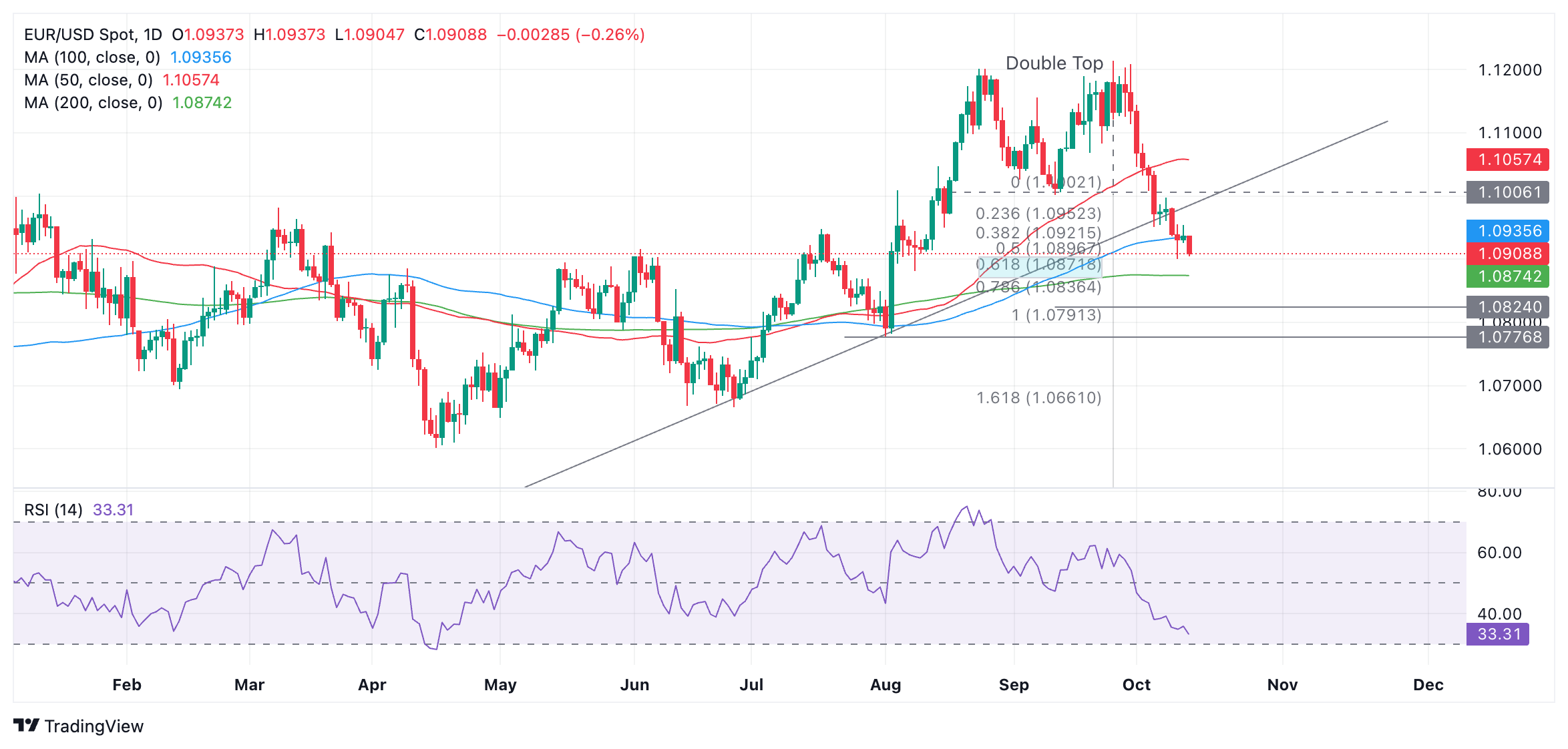
The pair probably formed a Double Top bearish reversal pattern at the August and September highs. If so, the pattern would have been confirmed after the break below the neckline at the September 11 low of 1.1002.
The pattern’s initial downside target lies at 1.0872, the 61.8% Fibonacci extension of the height of the pattern extrapolated lower (blue shaded rectangle on the chart). A further target lies at 1.0874, the 200-day SMA, and 1.0824, the target generated by the trendline break.
Momentum, as measured by the Relative Strength Index (RSI), is mirroring price as it tracks lower, which is a relatively bearish sign.
Economic Indicator
ECB Main Refinancing Operations Rate
One of the three key interest rates set by the European Central Bank (ECB), the main refinancing operations rate is the interest rate the ECB charges to banks for one-week long loans. It is announced by the European Central Bank at its eight scheduled annual meetings. If the ECB expects inflation to rise, it will increase its interest rates to bring it back down to its 2% target. This tends to be bullish for the Euro (EUR), since it attracts more foreign capital inflows. Likewise, if the ECB sees inflation falling it may cut the main refinancing operations rate to encourage banks to borrow and lend more, in the hope of driving economic growth. This tends to weaken the Euro as it reduces its attractiveness as a place for investors to park capital.
Read more.Next release: Thu Oct 17, 2024 12:15
Frequency: Irregular
Consensus: 3.4%
Previous: 3.65%
Source: European Central Bank
Author

Joaquin Monfort
FXStreet
Joaquin Monfort is a financial writer and analyst with over 10 years experience writing about financial markets and alt data. He holds a degree in Anthropology from London University and a Diploma in Technical analysis.