EUR/USD starts positively in a busy US data-packed week
- EUR/USD trades close to a one-week high near 1.1730 as the US Dollar underperforms on firm Fed dovish bets.
- Investors await a slew of US labor market-related data this week.
- German inflation grew at a faster-than-expected pace in August.
EUR/USD trades higher to near a one-week high around 1.1730 during the European trading session on Monday. The major currency pair gains as the US Dollar (USD) underperforms its peers amid firm expectations that the Federal Reserve (Fed) will resume its monetary easing cycle in the policy meeting in September.
At the time of writing, the US Dollar Index (DXY), which tracks the Greenback’s value against six major currencies, trades close to the August low around 97.55.
According to the CME FedWatch tool, there is an 87.6% chance that the Fed will cut interest rates by 25 basis points (bps) in the policy meeting in September.
Fed dovish expectations have intensified due to growing concerns over the labor market outlook on the back of tariffs imposed by United States (US) President Donald Trump. Also, Federal Open Market Committee (FOMC) members, including Chair Jerome Powell, have expressed concerns over increasing labor market risks.
For fresh cues on the current US labor market status, investors await a string of job-related data, such as JOLTS Job Openings data for July, and ADP Employment Change and the Nonfarm Payrolls (NFP) data for August, which will be released this week.
On Monday, US markets will be closed in observance of Labor Day.
US Dollar Price Today
The table below shows the percentage change of US Dollar (USD) against listed major currencies today. US Dollar was the weakest against the British Pound.
| USD | EUR | GBP | JPY | CAD | AUD | NZD | CHF | |
|---|---|---|---|---|---|---|---|---|
| USD | -0.22% | -0.24% | 0.10% | 0.05% | -0.11% | -0.23% | 0.00% | |
| EUR | 0.22% | -0.02% | 0.28% | 0.28% | 0.12% | -0.00% | 0.23% | |
| GBP | 0.24% | 0.02% | 0.18% | 0.29% | 0.13% | 0.01% | 0.30% | |
| JPY | -0.10% | -0.28% | -0.18% | 0.02% | -0.20% | -0.30% | -0.06% | |
| CAD | -0.05% | -0.28% | -0.29% | -0.02% | -0.15% | -0.28% | 0.00% | |
| AUD | 0.11% | -0.12% | -0.13% | 0.20% | 0.15% | -0.12% | 0.16% | |
| NZD | 0.23% | 0.00% | -0.01% | 0.30% | 0.28% | 0.12% | 0.28% | |
| CHF | -0.00% | -0.23% | -0.30% | 0.06% | -0.01% | -0.16% | -0.28% |
The heat map shows percentage changes of major currencies against each other. The base currency is picked from the left column, while the quote currency is picked from the top row. For example, if you pick the US Dollar from the left column and move along the horizontal line to the Japanese Yen, the percentage change displayed in the box will represent USD (base)/JPY (quote).
Daily digest market movers: Euro gains as Germany's hot inflation undermines ECB dovish bets
- An upbeat performance by the Euro (EUR) has also contributed to an upside move in the EUR/USD pair. The Euro gains as higher-than-expected growth in the preliminary German Harmonized Index of Consumer Prices (HICP) data for August has undermined expectations that the European Central Bank (ECB) will lower interest rates in the near term.
- The data showed on Friday that the HICP grew at an annualized pace of 2.1%, faster than estimates of 2% and the prior reading of 1.8%. On a monthly basis, the inflation data rose by 0.1%, while it was expected to remain flat. However, inflation in other economies of the Eurozone grew at a moderate pace.
- For more cues on inflation in the shared continent, investors will focus on the preliminary Eurozone HICP data for August, which will be released on Tuesday. Economists expect the headline HICP to have grown steadily by 2% on year, with core figures rising moderately by 2.2%.
- In Monday's session, final HCOB Manufacturing Purchasing Managers’ Index (PMI) data for August showed that thefactory activity grew at a faster pace to 50.7, compared to the preliminary figure of 50.5.
- On the political front, French President Emmanuel Macron has announced that he will serve his term until 2027, regardless of a confidence vote on his proposed €44 billion budget package on September 8. "The mandate which has been given to me by the French people, and by no-one else, is a mandate that will be carried out through to the end of its term," Macron said on Friday.
- However, bond yields have soared on the backdrop of French politial risks. 30-year French bond yields have surged to 4.46%, the highest level seen since 2011. A significant jump in borrowing costs for the French economy has refreshed risks seen at times of sub-prime crises among investors. In response, ECB President Christine Lagarde that clarified that the French banking system is in a "better place than the 2008 crisis".
- In the US, investors have become concerned over the credibility of the administration following claims from appeals courts that US President Donald Trump’s tariffs are “illegal”, and he has wrongfully invoked the emergency law to support the same. A panel of judges stated on Friday that Trump has exceeded his authority to fulfill his tariff agenda.
- Additionally, the ongoing legal battle between Fed Governor Lisa Cook and her termination by President Trump over mortgage allegations has also threatened the safe-haven appeal of the US Dollar.
- This week, the US Dollar will also be influenced by the ISM Manufacturing and Services PMI data for August.
Technical Analysis: EUR/USD aims for a breakout above 1.1740
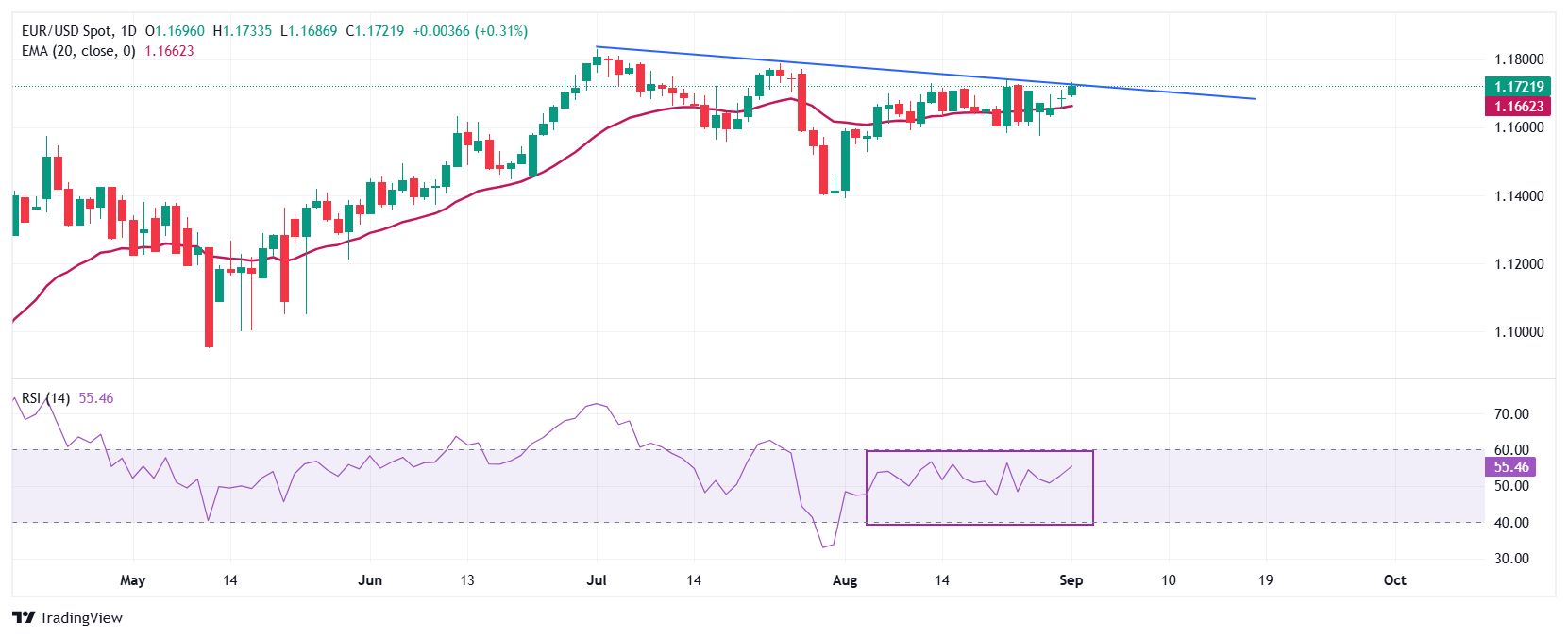
EUR/USD trades close to 1.1730, nearing a downward-sloping trendline plotted from July’s high at 1.1830. The near-term trend of the pair is bullish as it holds above the 20-day Exponential Moving Average (EMA), which trades near 1.1662.
The 14-day Relative Strength Index (RSI) oscillates inside the 40.00-60.00 range, suggesting a sideways trend.
If the pair breaks above the August 22 high near 1.1740, a fresh upside move would become inevitable, targeting the July high at 1.1830 and the round-level resistance of 1.1900.
On the flip side, a downside move below the August 22 low of 1.1583 will expose it to the August 5 low of 1.1528, followed by the August 1 low of 1.1392.
US Dollar FAQs
The US Dollar (USD) is the official currency of the United States of America, and the ‘de facto’ currency of a significant number of other countries where it is found in circulation alongside local notes. It is the most heavily traded currency in the world, accounting for over 88% of all global foreign exchange turnover, or an average of $6.6 trillion in transactions per day, according to data from 2022. Following the second world war, the USD took over from the British Pound as the world’s reserve currency. For most of its history, the US Dollar was backed by Gold, until the Bretton Woods Agreement in 1971 when the Gold Standard went away.
The most important single factor impacting on the value of the US Dollar is monetary policy, which is shaped by the Federal Reserve (Fed). The Fed has two mandates: to achieve price stability (control inflation) and foster full employment. Its primary tool to achieve these two goals is by adjusting interest rates. When prices are rising too quickly and inflation is above the Fed’s 2% target, the Fed will raise rates, which helps the USD value. When inflation falls below 2% or the Unemployment Rate is too high, the Fed may lower interest rates, which weighs on the Greenback.
In extreme situations, the Federal Reserve can also print more Dollars and enact quantitative easing (QE). QE is the process by which the Fed substantially increases the flow of credit in a stuck financial system. It is a non-standard policy measure used when credit has dried up because banks will not lend to each other (out of the fear of counterparty default). It is a last resort when simply lowering interest rates is unlikely to achieve the necessary result. It was the Fed’s weapon of choice to combat the credit crunch that occurred during the Great Financial Crisis in 2008. It involves the Fed printing more Dollars and using them to buy US government bonds predominantly from financial institutions. QE usually leads to a weaker US Dollar.
Quantitative tightening (QT) is the reverse process whereby the Federal Reserve stops buying bonds from financial institutions and does not reinvest the principal from the bonds it holds maturing in new purchases. It is usually positive for the US Dollar.
Author

Sagar Dua
FXStreet
Sagar Dua is associated with the financial markets from his college days. Along with pursuing post-graduation in Commerce in 2014, he started his markets training with chart analysis.