EUR/USD trades cautiously ahead of Trump's tariffs announcement
- EUR/USD finds cushion near 1.0780 after the release of the weak US ISM Manufacturing PMI and JOLTS Job Openings data.
- The Eurozone inflation grows at a faster pace in March on month but cools down on a yearly basis.
- Market participants are mixed over whether Trump’s tariffs would lead to a recession in the US.


EUR/USD recovers some intraday losses and rises to near 1.0800 during the North American trading session on Tuesday. The major currency pair rebounds slightly after the release of the United States (US) ISM Manufacturing Purchasing Managers Index (PMI) data for March and the JOLTS Job Openings data for February, which came in weaker-than-expected.
The ISM Manufacturing PMI report showed that activities contracted at a faster-than-expected pace. The economic data fell to 49.0 from February's reading of 50.3. Economists expected the Manufacturing PMI to have contracted to 49.5. Meanwhile, US JOLTS Job Openings data landed at 7.57 million jobs in February, slightly lower than the expectations of 7.63 million and the prior release of 7.76 million.
However, the shared currency pair is expected to trade cautiously ahead of the release of reciprocal tariffs by US President Donald Trump on Wednesday. Market participants anticipate Trump’s tariffs to deliver economic shocks globally, including in the US, as domestic importers will bear the burden of higher prices.
The White House aides have drafted a proposal to impose tariffs of around 20% on most imports to the US, according to the Washington Post.
Investors expect that Trump’s economic policies could also lead to a recession in the US. Market participants' confidence in recession risks escalated after a slew of US officials, including President Donald Trump, didn’t rule out the possibility of economic damage when asked whether new policies could lead to a recession.
Meanwhile, investment banking firm Goldman Sachs has also revised its chances for a potential recession to 35%, up from their prior expectations of 20%. The upward revision for recession risks was based on a sharp “deterioration in household and business confidence”.
International Monetary Fund (IMF) Managing Director Kristalina Georgieva also signaled in an interview with Reuters NEXT Newsmaker on Monday that Trump’s push for imposing reciprocal tariffs has created greater uncertainty and dented confidence, but ruled out fears of a recession. Georgieva said that the IMF is not seeing a" dramatic impact" from the tariffs slapped and threatened so far by Trump.
Daily digest market movers: EUR/USD faces pressure after Eurozone inflation data
- EUR/USD drops after the release of the preliminary Eurozone Harmonized Index of Consumer Prices (HICP) for March and the Eurozone Unemployment Rate for February.
- In 12 months to March, the Eurozone HICP rose by 2.2%, as expected, slower than the 2.3% increase seen in February. In the same period, the core HICP grew moderately by 2.4% compared to expectations of 2.5% and the former release of 2.6%. On a monthly basis, the headline and core HICP – which excludes volatile items such as food, energy, alcohol, and tobacco – rose by 0.6% and 1%, respectively. The Unemployment Rate decelerated to 6.1% in February from the prior release and the estimates of 6.2%. Soft Eurozone inflation data is expected to force European Central Bank (ECB) officials to cut interest rates again on April 17.
- Going forward, the major trigger for the Euro (EUR) will be the detailed reciprocal tariff plan by US President Trump, which will show a fresh suite of import duties on the Eurozone. Market participants expect Trump to announce a significant number of tariff measures on the Eurozone as the President has blamed the European Union (EU) for adopting unfair trade practices against the US. Fresh tariffs by Donald Trump would be inflationary and weaker for growth in the shared continent.
- The announcement of a 25% levy on imports of foreign cars and light trucks into the US, which will become effective on Wednesday, has already forced financial market participants to revise down their growth forecasts for Germany, given that 13% of the country’s total auto exports are taken by the US.
- The European Commission (EC) has prepared countermeasures in advance to respond to Trump’s expected new suite of tariffs, as reported by EC President Ursula von der Leyen during European trading hours on Tuesday. “We do not necessarily want to retaliate, but if it is necessary, we have a strong plan to do so, and we will use it,” von der Leyen said, adding that we have the power to “push back against US tariffs”.
- On Monday, ECB President Christine Lagarde said in an interview with France Inter radio that she sees April 2, touted as “Liberation Day” by Trump, as a moment when we must together decide to take “better control of our destiny” and a step towards independence.
Technical Analysis: EUR/USD ticks lower to near 20-day EMA
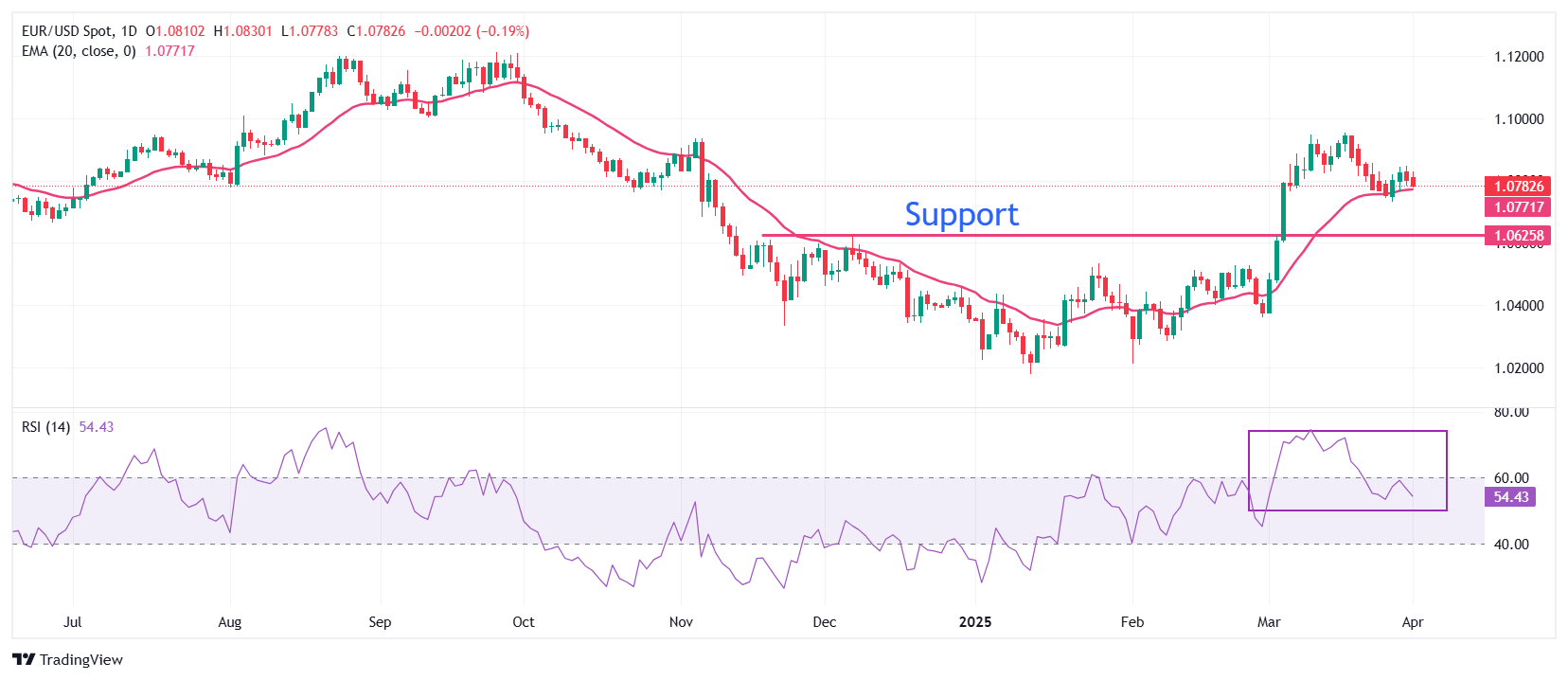
EUR/USD falls to near 1.0800 against the US Dollar on Tuesday. However, the near-term outlook of the pair remains firm as it holds the 20-day Exponential Moving Average (EMA), which trades around 1.0776.
The 14-day Relative Strength Index (RSI) cools down below 60.00, suggesting that the bullish momentum is over, but the upside bias is intact.
Looking down, the December 6 high of 1.0630 will act as the major support zone for the pair. Conversely, the psychological level of 1.1000 will be the key barrier for the Euro bulls.
Author
Sagar Dua
FXStreet
Sagar Dua is associated with the financial markets from his college days. Along with pursuing post-graduation in Commerce in 2014, he started his markets training with chart analysis.