EUR/USD tumbles as upbeat US prints, evaporate Fed cuts hopes
- US Dollar gains on solid labor and retail figures, while Trump denies Powell firing rumors, calming market nerves.
- US jobless claims and retail sales beat forecasts, boosting the Greenback.
- Fed officials are cautious on cuts, citing inflation and tariff-driven uncertainty.
- Euro is pressured as ECB inflation stays near target, contrasting with hot US CPI.


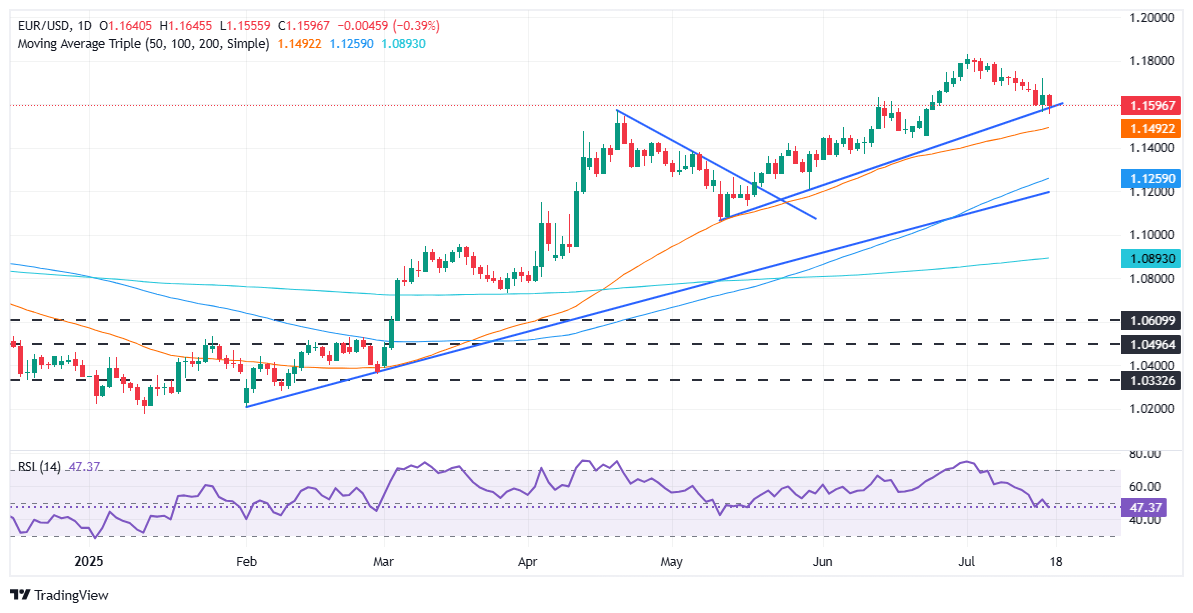
EUR/USD tumbles during the North American session, down 0.38% following the release of economic data from the United States (US), which triggered a reaction by investors, who trimmed their bets that the Federal Reserve (Fed) will cut interest rates. At the time of writing, the pair traded at 1.1598, having reached a high of 1.1642.
Risk appetite improved after US President Donald Trump denied rumors that he planned to sack Federal Reserve Chair Jerome Powell. News flows had remained light, though economic data from the US continues to justify the Fed’s current stance, which most officials had revealed as appropriate, as the labor market is solid, Retail Sales improved, and Tuesday’s Consumer Price Index (CPI) report for June showed that inflation is on its way to 3%.
Before Wall Street opened, Initial Jobless Claims for the previous week came below estimates. At the same time, Retail Sales for June crushed May’s data and economists' forecasts, although the data suggest that increases in goods and services prices may be responsible for the upbeat report.
Fed speeches had been grabbing the headlines, with Governor Adriana Kugler, San Francisco Fed Mary Daly, and recently. Atlanta’s Fed President Raphael Bostic. He said that the economic outlook remains highly uncertain, adding that tariff adjustments are the cause blocking the path to further rate cuts.
Across the pond, the Eurozone (EZ) inflation report showed that prices ticked up, but they remain closer to the 2% goal by the European Central Bank (ECB), in contrast to US inflation.
Ahead this week, the European economic docket will feature Germany’s Producer Price Index (PPI) figures as the primary catalyst for the Euro, with estimates suggesting that the disinflation process continued to evolve. In the US, the University of Michigan Consumer Sentiment is awaited, along with speeches from the Fed.
Daily digest market movers: EUR/USD struggles at 1.1600 on strong US data
- US economic data showed Initial Jobless Claims for the week ending July 12 fell from 228K to 221K, below the 235K projected by analysts, with the labor market showing strength amid fears of an ongoing slowdown.
- Retail Sales in June exceeded forecasts of 0.1% MoM, rose by 0.6% MoM, and crushed May’s 0.9% plunge, as some of the increase reflects higher prices due to tariffs. Inflation on the consumer side was revealed earlier in the week, with prices rising.
- Fed Governor Adriana Kugler struck a hawkish tone, noting that inflation remains above the central bank’s 2% target and that the labor market continues to show resilience. She also warned that CPI inflation is beginning to broaden into core goods, signaling more persistent price pressures.
- Meanwhile, San Francisco Fed President Mary Daly maintained that the US economy is in a solid position. She acknowledged that June’s CPI data reflected some early effects of tariffs but suggested their overall impact on inflation may be limited. Despite elevated inflation and restrictive policy settings, Daly reiterated her support for two rate cuts in 2025.
- Since last week, several ECB policymakers have voiced their views on the monetary policy outlook. Mario Centeno joined De Guindos, Vujčić, and Villeroy in signaling support for a pause or potential rate cut. Fabio Panetta also backed easing, citing increasing downside risks to growth.
- In contrast, Isabel Schnabel argued that current rates are appropriately positioned, advocating for a hold—an opinion echoed by Robert Holzmann, who emphasized the need to wait for more data before making any adjustments.
EUR/USD technical outlook: Consolidates within the 20 and 50-day SMA, below 1.1600
EUR/USD is neutral-biased, with traders unable to decisively break above 1.1600 on the upside or below 1.1550 on the downside. The Relative Strength Index (RSI) shows that sellers are gathering momentum.
That said, if EUR/USD drops below 1.1550, the next support would be 1.1500, followed by the 50-day SMA at 1.1490, and the 100-day SMA at 1.1266. Conversely, a rise above the 20-day Simple Moving Average (SMA) at 1.1681 would clear the path to challenge 1.1700, followed by the July 20 daily high at 1.1749, ahead of 1.1800 and the record high of 1.1829.
ECB FAQs
The European Central Bank (ECB) in Frankfurt, Germany, is the reserve bank for the Eurozone. The ECB sets interest rates and manages monetary policy for the region. The ECB primary mandate is to maintain price stability, which means keeping inflation at around 2%. Its primary tool for achieving this is by raising or lowering interest rates. Relatively high interest rates will usually result in a stronger Euro and vice versa. The ECB Governing Council makes monetary policy decisions at meetings held eight times a year. Decisions are made by heads of the Eurozone national banks and six permanent members, including the President of the ECB, Christine Lagarde.
In extreme situations, the European Central Bank can enact a policy tool called Quantitative Easing. QE is the process by which the ECB prints Euros and uses them to buy assets – usually government or corporate bonds – from banks and other financial institutions. QE usually results in a weaker Euro. QE is a last resort when simply lowering interest rates is unlikely to achieve the objective of price stability. The ECB used it during the Great Financial Crisis in 2009-11, in 2015 when inflation remained stubbornly low, as well as during the covid pandemic.
Quantitative tightening (QT) is the reverse of QE. It is undertaken after QE when an economic recovery is underway and inflation starts rising. Whilst in QE the European Central Bank (ECB) purchases government and corporate bonds from financial institutions to provide them with liquidity, in QT the ECB stops buying more bonds, and stops reinvesting the principal maturing on the bonds it already holds. It is usually positive (or bullish) for the Euro.
Author
Christian Borjon Valencia
FXStreet
Christian Borjon began his career as a retail trader in 2010, mainly focused on technical analysis and strategies around it. He started as a swing trader, as he used to work in another industry unrelated to the financial markets.