EUR/USD tumbles as Trump threatens to impose reciprocal tariffs on April 2
- EUR/USD falls sharply to near 1.0420 as US President Trump reiterates threats to impose 25% tariffs on cars and other imports from the Eurozone.
- The US Dollar steadies as Trump tariff threats have improved its safe-haven appeal.
- Investors await the US PCE inflation data for January and preliminary HICP data of major Eurozone nations for February, scheduled on Friday.

EUR/USD slumps to near 1.0420 in North American trading hours on Thursday. The major currency pair faces sharp selling pressure as the US Dollar (USD) strengthens on United States (US) President Donald Trump's threats to impose reciprocal tariffs and additional 10% levies on China on Thursday. The US Dollar Index (DXY), which tracks the Greenback's value against six major currencies jumps above 107.00. "April 2 reciprocal tariff date remains in full force," Trump said. He has also confirmed that 25% tariffs on Canada and Mexico are coming on March 4.
On Wednesday, President Donald Trump said that tariffs on its North American allies could "go into effect on April 2" instead of March 4. President Trump also announced in a press conference on Wednesdat that 25% tariffs on “cars and other things” on the Eurozone “very soon.”
In response to Trump’s tariff threats, a European Commission (EC) spokesperson said, "The EU will react firmly and immediately against unjustified barriers to free and fair trade, including when tariffs are used to challenge legal and non-discriminatory policies.”
A tariff war between the US and the Eurozone would make the Eurozone economy vulnerable to growth, which is already fractured due to weak demand. Such a scenario would weigh on the Euro (EUR).
Meanwhile, uncertainty over the outcome of negotiations to form a German coalition government has also kept the Euro (EUR) on the backfoot. Victorious Frederich Merz’s conservative Christian Democratic Union of Germany (CDU) will most likely form the government with outgoing Chancellor Olaf Scholz’s Social Democratic Party of Germany (SPD).
On Wednesday, Bundesbank President Joachim Nagel said in an interview with Reuters on the sidelines of a meeting of G20 finance chiefs that the new German government should address “structural faults” in the economy quickly to improve “Germany’s competitiveness”.
US Dollar PRICE Today
The table below shows the percentage change of US Dollar (USD) against listed major currencies today. US Dollar was the strongest against the Swiss Franc.
| USD | EUR | GBP | JPY | CAD | AUD | NZD | CHF | |
|---|---|---|---|---|---|---|---|---|
| USD | 0.45% | 0.26% | 0.48% | 0.44% | 0.43% | 0.56% | 0.60% | |
| EUR | -0.45% | -0.18% | 0.05% | 0.00% | -0.00% | 0.11% | 0.15% | |
| GBP | -0.26% | 0.18% | 0.25% | 0.18% | 0.17% | 0.29% | 0.34% | |
| JPY | -0.48% | -0.05% | -0.25% | -0.06% | -0.07% | 0.02% | 0.09% | |
| CAD | -0.44% | -0.00% | -0.18% | 0.06% | -0.00% | 0.11% | 0.16% | |
| AUD | -0.43% | 0.00% | -0.17% | 0.07% | 0.00% | 0.11% | 0.16% | |
| NZD | -0.56% | -0.11% | -0.29% | -0.02% | -0.11% | -0.11% | 0.04% | |
| CHF | -0.60% | -0.15% | -0.34% | -0.09% | -0.16% | -0.16% | -0.04% |
The heat map shows percentage changes of major currencies against each other. The base currency is picked from the left column, while the quote currency is picked from the top row. For example, if you pick the US Dollar from the left column and move along the horizontal line to the Japanese Yen, the percentage change displayed in the box will represent USD (base)/JPY (quote).
Daily digest market movers: EUR/USD falls sharply as US Dollar strengthens
- EUR/USD weakens as the US Dollar (USD) strengthens on tariff threats from President Donald Trump and upbeat US Durable Goods Orders for January. New orders for durable goods rose at a robust pace of 3.1%, faster than estimates of 2%. In December, the economic data declined by 2.2%.
- Meanwhile, US Initial Jobless Claims for the week ending February 21 have come in significantly higher than expected. Individuals claiming jobless benefits for the first time were 242K, higher than estimates of 221K.
- Going forward, investors will focus on the US Personal Consumption Expenditures Price Index (PCE) data for January, which will be released on Friday. The inflation data would influence market speculation for the Federal Reserve's (Fed) monetary policy outlook. Currently, market participants have become increasingly confident that the Fed could reduce interest rates in the June policy meeting after keeping in the current range of 4.25%-4.50% in the March and May meetings. According to the CME FedWatch tool, there is a 68% chance that the Fed can reduce interest rates in the June policy meeting.
- Traders raised bets supporting the Fed resuming the policy-easing cycle in June due to a decline in the US service sector activity in February, according to the flash S&P Global Purchasing Managers Index (PMI) report. Also, a sharp decline in the Consumer Confidence data in February has raised concerns over the Fed maintaining a restrictive monetary policy stance for longer.
- On the Eurozone front, investors await the flash inflation data of Germany and its six states, France and Italy, for February, which will be released on Friday. The inflation data will influence market expectations for the European Central Bank’s (ECB) monetary policy outlook.
Technical Analysis: EUR/USD struggles to hold 50-day EMA
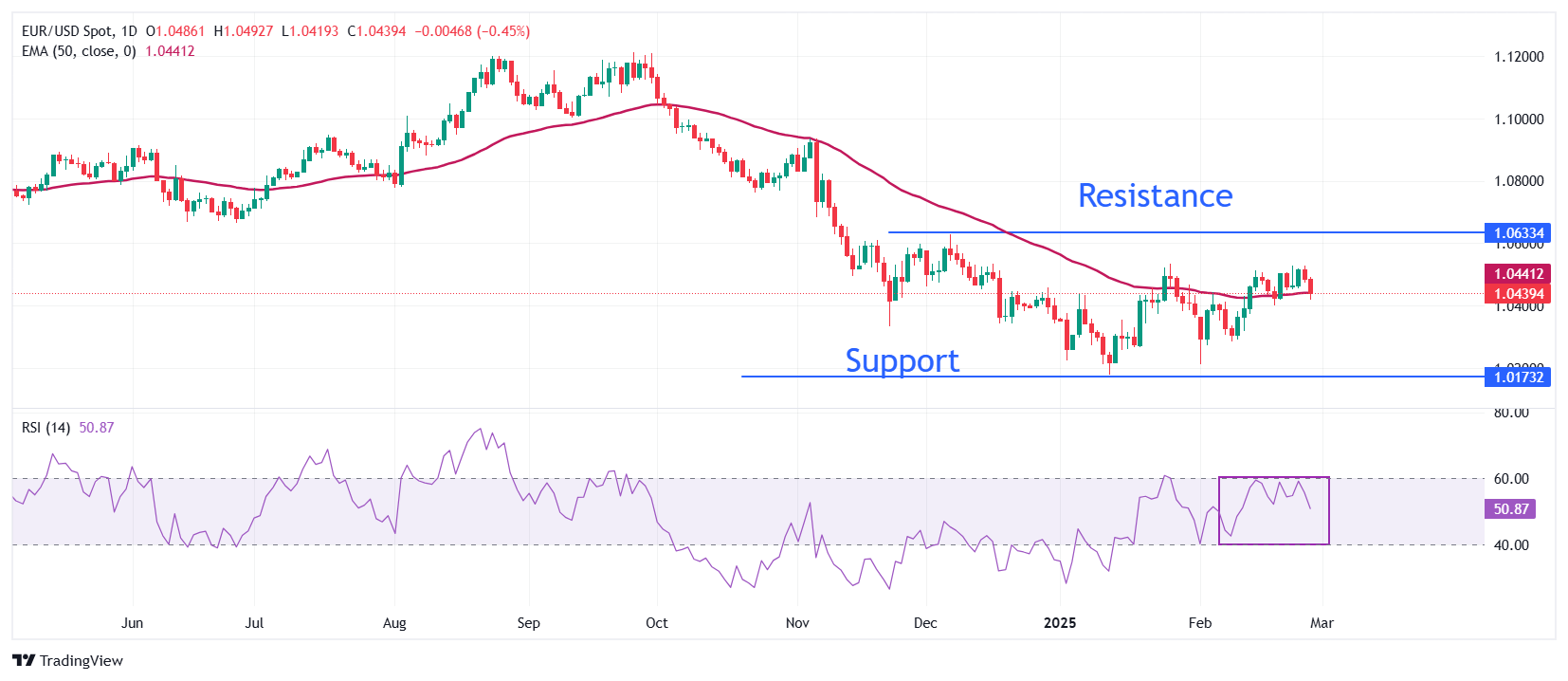
EUR/USD falls vertically to near 1.0420 after failing to hold above 1.0500 on Thursday. The major currency pair struggles to hold the 50-day Exponential Moving Average (EMA), which trades around 1.0440.
The 14-day Relative Strength Index (RSI) wobbles below the 60.00 level, suggesting that the upside remains capped.
Looking down, the February 10 low of 1.0285 will act as the major support zone for the pair. Conversely, the December 6 high of 1.0630 will be the key barrier for the Euro bulls.
Author

Sagar Dua
FXStreet
Sagar Dua is associated with the financial markets from his college days. Along with pursuing post-graduation in Commerce in 2014, he started his markets training with chart analysis.