EUR/USD drifts lower heading into the long-awaited US NFP release
- The Euro remains pinned at two-week lows near 1.1500 against a firmer US Dollar.
- Hawkishly tilted Fed Minutes have put a December interest rate cut into question.
- US Nonfarm Payrolls report is expected to show a 55,000 net gain in employment in September.

EUR/USD extends losses for the fifth consecutive day and trades at 1.1515 at the time of writing on Thursday after a sharp reversal from levels near 1.1600 on Wednesday. The US Dollar's (USD) positive reaction to a hawkishly tilted Federal Reserve (Fed) Minutes and traders' cautiousness ahead of the long-awaited US Nonfarm Payrolls (NFP) report for September have boosted the Greenback across the board.
The Minutes of October's Federal Market Open Committee (FOMC) meeting revealed on Wednesday that many Fed officials were against cutting interest rates, concerned that it might compromise the fight against inflation and deteriorate public trust in the central bank. These comments have cast further doubt about the possibility of back-to-back rate cuts in December.
The chances of a quarter-point interest rate cut at the December 10 meeting decline below 30%, according to the CME Group's FedWatch tool, from 50% on Wednesday, and above 90% one month ago. The US Dollar has firmed up in the meantime.
In the Eurozone, Construction Output data showed that the sector accelerated its decline in September. Later on the day, November's preliminary Consumer Confidence reading released by the European Commission might give some further guidance to the Euro (EUR). In the US, the focus will be on September's Nonfarm Payrolls report and the Philadelphia Fed Manufacturing Survey.
Euro Price Today
The table below shows the percentage change of Euro (EUR) against listed major currencies today. Euro was the strongest against the Japanese Yen.
| USD | EUR | GBP | JPY | CAD | AUD | NZD | CHF | |
|---|---|---|---|---|---|---|---|---|
| USD | 0.12% | -0.08% | 0.46% | 0.06% | -0.12% | -0.27% | 0.19% | |
| EUR | -0.12% | -0.19% | 0.33% | -0.05% | -0.23% | -0.38% | 0.08% | |
| GBP | 0.08% | 0.19% | 0.51% | 0.14% | -0.04% | -0.19% | 0.27% | |
| JPY | -0.46% | -0.33% | -0.51% | -0.39% | -0.55% | -0.74% | -0.26% | |
| CAD | -0.06% | 0.05% | -0.14% | 0.39% | -0.17% | -0.34% | 0.11% | |
| AUD | 0.12% | 0.23% | 0.04% | 0.55% | 0.17% | -0.15% | 0.31% | |
| NZD | 0.27% | 0.38% | 0.19% | 0.74% | 0.34% | 0.15% | 0.46% | |
| CHF | -0.19% | -0.08% | -0.27% | 0.26% | -0.11% | -0.31% | -0.46% |
The heat map shows percentage changes of major currencies against each other. The base currency is picked from the left column, while the quote currency is picked from the top row. For example, if you pick the Euro from the left column and move along the horizontal line to the US Dollar, the percentage change displayed in the box will represent EUR (base)/USD (quote).
Daily digest market movers: The Dollar rallies on as Fed easing hopes recede
- The Minutes of the last Fed meeting reflected a divided committee in October, with some policymakers showing their preference to leave interest rates unchanged and others rejecting an interest rate cut outright. This, along with the lack of official data after a 43-day government shutdown, has prompted investors to cut back hopes of a rate cut by the central bank in December, which is underpinning the US Dollar.
- In Japan, Finance Minister Satsuki Katayama affirmed that she did not talk about foreign exchange in the meeting with Bank of Japan (BoJ) Governor Kazuo Ueda, which has been interpreted by the markets as a sign that the authorities are not planning to step in so far, and boosted the US Dollar to near year-to-date highs against the Japanese Yen (JPY).
- The Euro has failed to draw any significant support from improved market sentiment after chipmaker Nvidia reported better-than-expected quarterly earnings, which eased concerns about overvaluations of AI-related companies and triggered a relief rally in Asia.
- Later on Thursday, the delayed September US NFP report is expected to show a net increase of 50,000 new jobs, following a 22,000 rise in August. Average Hourly Earnings are seen growing at a 0.3% monthly rate and 3.7% from September last year, in both cases at the same pace as in August. The Unemployment Rate is expected to remain steady at 4.3%
- At the same time, the Philadelphia Fed Manufacturing Survey is expected to show that business conditions deteriorated for the second consecutive month in November, although to a lesser extent than in October. The index is seen at -3.1 following a -12.8 reading in the previous month.
- Eurozone data released earlier on the day revealed that the region's Construction Output contracted at a 0.5% rate in September, following a downwardly revised 0.2% fall in August. Year-on-year, the sector's output declined 0.3%, partially reversing a 1% growth in the previous month
- Later on Thursday, the Conference Board's preliminary Consumer Confidence Index is expected to have improved for the fourth consecutive month, to a level of -14.0 in November, from a level of -14.2 in October.
Technical Analysis: EUR/USD remains on the defensive, with 1.1500 in sight
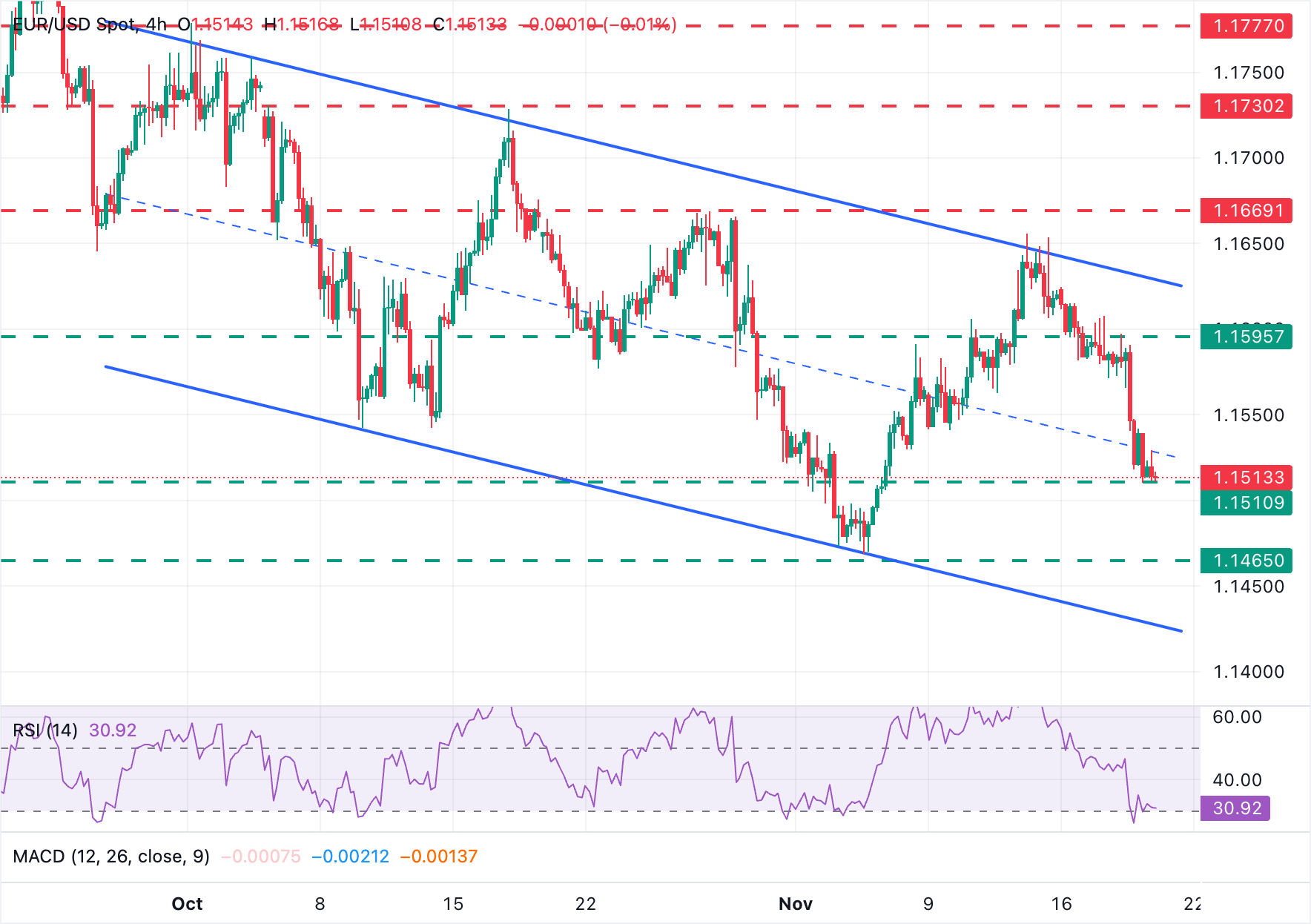
The EUR/USD is on a short-term bearish trend after being rejected near 1.1650 last week, with bears testing the 1.1500 support area. The 4-hour Relative Strength Index (RSI) momentum indicator has reached oversold levels, which suggests the possibility of some consolidation. A significant recovery seems off the cards unless the fundamental context changes radically.
At the time of writing, EUR/USD has found some support right above the 1.1500 psychological level. Further down, the pair might seek support at the November 5 lows, near 1.1470, ahead of the bottom of a bearish channel on the 4-hour chart coming from late-September, now around 1.1430.
To the upside, November 18 and 19 highs in the area of 1.1600 are likely to challenge bulls ahead of the top of the bearish channel, which now lies around 1.1630. An unlikely bullish move past that area would bring the October 28 and 29 highs, near 1.1670, into focus.
Economic Indicator
Nonfarm Payrolls
The Nonfarm Payrolls release presents the number of new jobs created in the US during the previous month in all non-agricultural businesses; it is released by the US Bureau of Labor Statistics (BLS). The monthly changes in payrolls can be extremely volatile. The number is also subject to strong reviews, which can also trigger volatility in the Forex board. Generally speaking, a high reading is seen as bullish for the US Dollar (USD), while a low reading is seen as bearish, although previous months' reviews and the Unemployment Rate are as relevant as the headline figure. The market's reaction, therefore, depends on how the market assesses all the data contained in the BLS report as a whole.
Read more.Next release: Thu Nov 20, 2025 13:30
Frequency: Monthly
Consensus: 50K
Previous: 22K
Source: US Bureau of Labor Statistics
America’s monthly jobs report is considered the most important economic indicator for forex traders. Released on the first Friday following the reported month, the change in the number of positions is closely correlated with the overall performance of the economy and is monitored by policymakers. Full employment is one of the Federal Reserve’s mandates and it considers developments in the labor market when setting its policies, thus impacting currencies. Despite several leading indicators shaping estimates, Nonfarm Payrolls tend to surprise markets and trigger substantial volatility. Actual figures beating the consensus tend to be USD bullish.
Economic Indicator
Unemployment Rate
The Unemployment Rate, released by the US Bureau of Labor Statistics (BLS), is the percentage of the total civilian labor force that is not in paid employment but is actively seeking employment. The rate is usually higher in recessionary economies compared to economies that are growing. Generally, a decrease in the Unemployment Rate is seen as bullish for the US Dollar (USD), while an increase is seen as bearish. That said, the number by itself usually can't determine the direction of the next market move, as this will also depend on the headline Nonfarm Payroll reading, and the other data in the BLS report.
Read more.Author

Guillermo Alcala
FXStreet
Graduated in Communication Sciences at the Universidad del Pais Vasco and Universiteit van Amsterdam, Guillermo has been working as financial news editor and copywriter in diverse Forex-related firms, like FXStreet and Kantox.

















