|

EUR/USD dips below 1.0900 as Fed’s minutes show split views amongst Fed officials

  • Fed officials emphasize commitment to achieving the 2% inflation objective, with many seeing the need for further tightening.
  • A split emerges among policymakers, with some advocating for unchanged rates, highlighting the economy’s resilience and potential risks.
  • EUR/USD reacts with a drop, hovering around the 1.0880s, marking its lowest point since mid-August.

EUR/USD dropped below 1.0900 for the second straight day, as the latest Federal Reserve (Fed) monetary policy minutes began to show policymakers are split between overtightening while others prioritize the fight against inflation. The EUR/USD trades volatile, between the daily low of 1.0870s and the 1.0900 figure.

Federal Reserve minutes reveal a divided board on rate decisions, with inflation concerns at the forefront

The minutes showed that all the Fed officials remain “resolute in their commitment to bring inflation down to the …2% objective,” with most participants estimating that upside risks on inflation would require additional tightening.

Nevertheless, the Fed board began to show a split stance regarding monetary policy as a “couple” of participants wanted rates to be left unchanged, with one of the members, Atlanta’s Fed President Raphael Bostic, having remained vocal about holding rates unchanged.

The minutes showed that even though the economy’s remained resilient, downside risks to economic activity are lingering, and upside risks to the unemployment rate.

Federal Reserve officials agreed that future rate decisions would depend on the “totality” of incoming data while taking a more cautious approach in the coming months.

EUR/USD Reaction

The EUR/USD dropped below the 1.0900 figure, extending its losses below the 1.0880 area, a level last seen on August 14, slightly below the S1 pivot, which acted as support, as the EUR/USD sits at around the 1.0880s area.
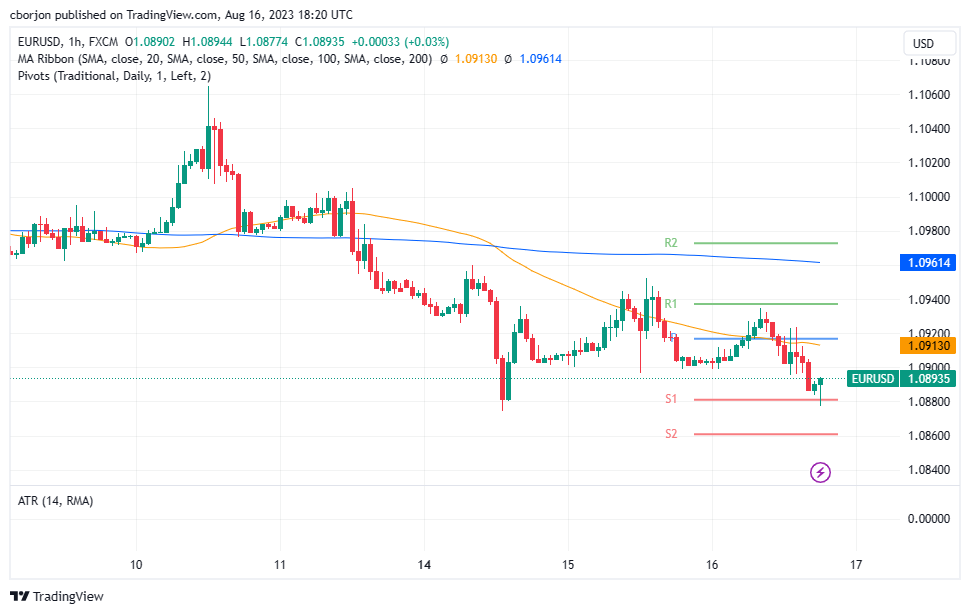
EUR/USD Hourly chart

EUR/USD Technical Levels

EUR/USD

Overview
Today last price1.0883
Today Daily Change-0.0024
Today Daily Change %-0.22
Today daily open1.0907
 
Trends
Daily SMA201.101
Daily SMA501.097
Daily SMA1001.0931
Daily SMA2001.0781
 
Levels
Previous Daily High1.0952
Previous Daily Low1.0897
Previous Weekly High1.1065
Previous Weekly Low1.0929
Previous Monthly High1.1276
Previous Monthly Low1.0834
Daily Fibonacci 38.2%1.0931
Daily Fibonacci 61.8%1.0918
Daily Pivot Point S11.0885
Daily Pivot Point S21.0864
Daily Pivot Point S31.083
Daily Pivot Point R11.094
Daily Pivot Point R21.0974
Daily Pivot Point R31.0996
 

Author

Christian Borjon Valencia

Markets analyst, news editor, and trading instructor with over 14 years of experience across FX, commodities, US equity indices, and global macro markets.


More from Christian Borjon Valencia
Share:

Editor's Picks

GBP/USD clings to daily gains near 1.3350

GBP/USD holds just in positive territory around 1.3350 on Friday as the Greenback keeps a vacillating price action. With Fed rate hike expectations easing and US markets closed for the Independence Day holiday, Cable remains on track to post solid weekly gains.

EUR/USD remains sidelined around 1.1440

EUR/USD holds on to its recent gains and consolidates around 1.1440 at the end of the week as the US Dollar lacks clear direction. In the meantime, trading conditions remain subdued, with volatility constrained by the closure of US markets for the Independence Day holiday.

Gold flirts with two-week highs, targets $4,200

Gold extends its recovery for a third straight day, advancing toward the $4,200 mark per troy ounce on Friday. The precious metal looks set to snap a four-week losing streak as softer-than-expected June US NFP data prompt investors to scale back expectations of further Fed tightening.

Crypto Today: Bitcoin, Ethereum, XRP advance amid renewed capital inflows

Bitcoin maintains its upward momentum, holding above the $61,000 mark at the time of writing on Friday. Major altcoins such as Ethereum and Ripple are also posting gains, signaling a modest uptick in market sentiment and renewed risk appetite among investors.

The Iran war failed to trigger a recession. Can the US economy keep defying expectations?

Nearly four months after the start of the Iran war, the US economy remains remarkably resilient. While the conflict initially triggered a severe disruption to global energy markets and a sharp rise in Oil prices, recent diplomatic progress between Washington and Tehran has eased concerns about a prolonged supply shock.

Kevin Warsh offers no policy clues: Why markets still got their answer

Financial markets came to Sintra looking for clues about the Federal Reserve's (Fed) next move. They largely left with confirmation that Fed Chair Kevin Warsh intends to make those clues much harder to find.