EUR/USD extends recovery as US Dollar slumps, Eurozone/US Inflation in focus
- EUR/USD rebounds after slipping below 1.0800 as the US Dollar corrects sharply.
- The ECB is widely anticipated to deliver a rate-cut move in June’s policy meeting.
- The US core PCE price index is estimated to have grown steadily in April.

EUR/USD bounces back after slipping below the crucial support of 1.0800 in Thursday’s New York session. The major currency pair recovers as the US Dollar (USD) extends its correction after the revised Q1 real Gross Domestic Product (GDP) report showed that the United States (US) grew at a slower rate of 1.3% from advance estimates of 1.6%. The US Dollar Index (DXY), which tracks the Greenback’s value against six major currencies, falls to 104.70 after posting a fresh two-week high slightly above 105.00.
Earlier, investors were gung-ho for the US Dollar as they expected that the Federal Reserve (Fed) would not be leaning towards interest rate cuts anytime soon. Fed policymakers have made it clear that they want to see inflation slow for months to gain confidence that price pressures will sustainably return to the desired rate of 2%.
Fed officials see more rate hikes as less likely but have kept the possibility on the table if progress in the disinflation process stalls. For fresh cues on the interest rate outlook, investors shift focus to the United States core Personal Consumption Expenditure Price Index (PCE) data for April, which will published on Friday and significantly influence speculation for Fed rate cuts in September. Annual and monthly core PCE inflation readings are estimated to have grown steadily by 2.8% and 0.3%, respectively.
Daily digest market movers: EUR/USD recovers further as correction in US Dollar deepens
- EUR/USD rebounds sharply from below the round-level support of 1.0800. The shared currency pair revives intraday losses despite investors being certain that the European Central Bank (ECB) looks set to start reducing interest rates from the June meeting, while the Fed has not committed to the timing of rate cuts.
- Noting that the Eurozone’s core inflation has already declined to 2.7% and the progress in the service disinflation process has resumed after stalling in the November-March period, ECB policymakers are comfortable with expectations of the central bank pivoting to policy normalization from June.
- As the June rate cut appears to be a done deal, speculation about the ECB’s rate-cut path beyond June will project the next move in the Euro. Currently, financial markets expect that the ECB will cut one more time this year. However, a Reuters poll of 82 economists from May 21 to 28 has suggested that the ECB will make two more rate cuts this year.
- At the start of the year, investors forecasted that the ECB would cut interest rates six times this year. However, the expectations for the number of rate cuts reduced as ECB policymakers warned that an aggressive policy easing approach could revamp price pressures again. Also, the uncertainty over wage growth momentum has prompted the odds of following a gradual rate-cut approach.
- On the economic front, investors will focus on the preliminary Eurozone inflation data for May, which will be published on Friday. The inflation data will provide cues about how far and fast the ECB will lower key borrowing rates. Economists expect that the annual Harmonized Index of Consumer Prices (HICP) rose at a stronger pace of 2.5% from the prior reading of 2.4%. The annual core HICP is estimated to have accelerated to 2.8% from 2.7% in April.
- Meanwhile, the Eurozone Unemployment Rate for May falls to 6.4% from the estimates and the prior reading of 6.5%.
Technical Analysis: EUR/USD recovers after testing the triangle breakout region near 1.0800
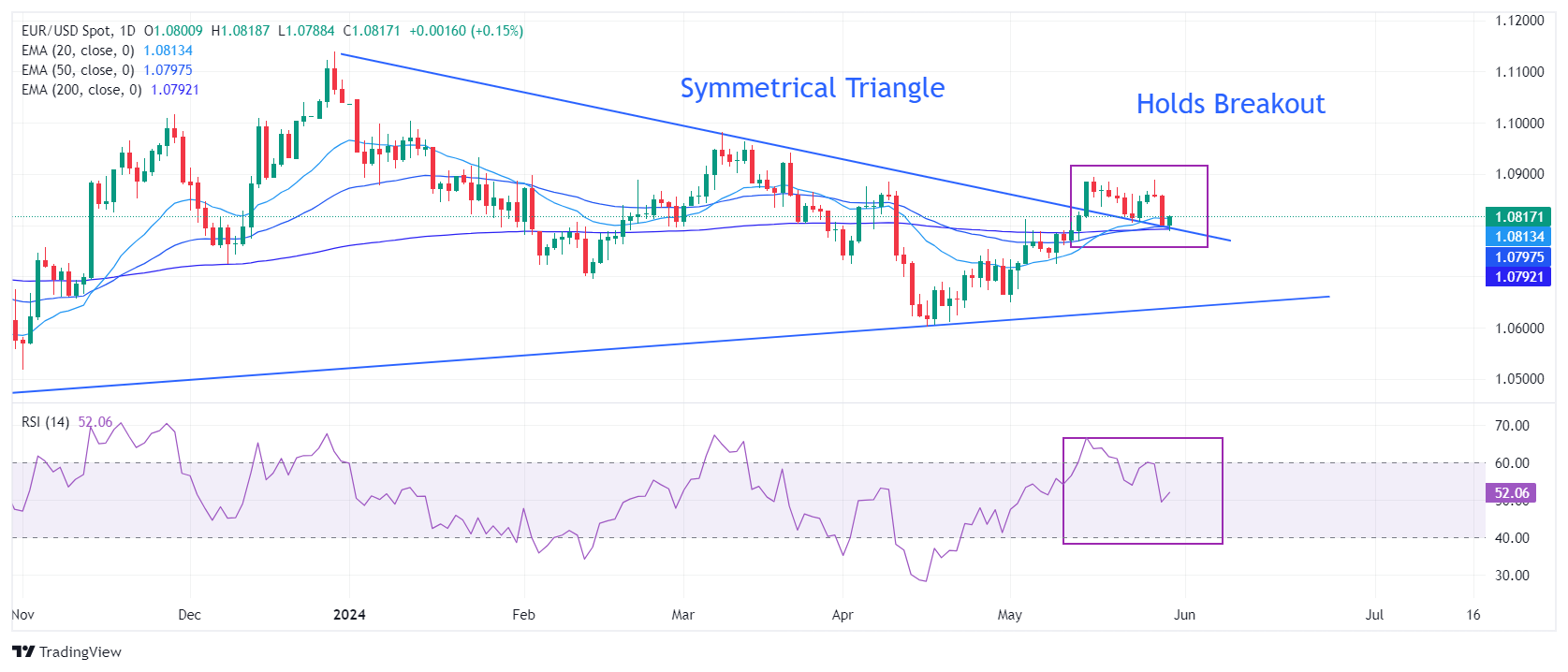
EUR/USD recovers after discovering buying interest near the breakout of the Symmetrical Triangle chart pattern formed on a daily timeframe, which is slightly below 1.0800. The near-term outlook of the shared currency pair is uncertain as it struggles to sustain above all short-to-long-term Exponential Moving Averages (EMAs).
The 14-period Relative Strength Index (RSI) has slipped into the 40.00-60.00 range, suggesting that the momentum, which was leaned toward the upside has faded for now.
The major currency pair would strengthen if it recaptures a two-month high around 1.0900. A decisive break above this level would drive the asset towards the March 21 high, around 1.0950, and the psychological resistance of 1.1000. However, a downside move below the 200-day EMA at 1.0800 could push it further down.
Economic Indicator
Gross Domestic Product Annualized
The real Gross Domestic Product (GDP) Annualized, released quarterly by the US Bureau of Economic Analysis, measures the value of the final goods and services produced in the United States in a given period of time. Changes in GDP are the most popular indicator of the nation’s overall economic health. The data is expressed at an annualized rate, which means that the rate has been adjusted to reflect the amount GDP would have changed over a year’s time, had it continued to grow at that specific rate. Generally speaking, a high reading is seen as bullish for the US Dollar (USD), while a low reading is seen as bearish.
Read more.Last release: Thu May 30, 2024 12:30 (Prel)
Frequency: Quarterly
Actual: 1.3%
Consensus: 1.3%
Previous: 1.6%
Source: US Bureau of Economic Analysis
The US Bureau of Economic Analysis (BEA) releases the Gross Domestic Product (GDP) growth on an annualized basis for each quarter. After publishing the first estimate, the BEA revises the data two more times, with the third release representing the final reading. Usually, the first estimate is the main market mover and a positive surprise is seen as a USD-positive development while a disappointing print is likely to weigh on the greenback. Market participants usually dismiss the second and third releases as they are generally not significant enough to meaningfully alter the growth picture.
Author

Sagar Dua
FXStreet
Sagar Dua is associated with the financial markets from his college days. Along with pursuing post-graduation in Commerce in 2014, he started his markets training with chart analysis.

















