|

EUR/USD dips amid strong US data as market awaits Fed minutes

  • EUR/USD trades at around the 1.0900 lows, reacting to upbeat US ISM Manufacturing PMI and JOLTS job openings data.
  • Market anticipates potential policy easing in Fed's December FOMC minutes; six rate cuts priced in by futures data.
  • Germany's stable unemployment rate at 5.9% contrasts with busy EU and US economic calendars, including upcoming PMIs and jobs data.

The EUR/USD remained on the defensive since the first trading day of 2024, falling 0.27% on the day after economic data from the United States (US) suggests the economy remains robust, though the labor market cooled down. At the time of writing, the major is trading at 1.0910 after posting a daily high of 1.0965.

Euro struggles as US data signals robust economy

The US economic agenda revealed upbeat data. The Institute for Supply Management (ISM) announced December’s Manufacturing PMI improved to 47.4, above forecasts and November’s readings, but it remained in recessionary territory for 14 straight months. At the same time, the US Bureau of Labor Statistics (BLS), revealed the JOLTS report, which showed a slight increase to 8.79 million, below the anticipated 8.85 million.

Aside from this, traders are awaiting the release of December’s Federal Open Market Committee (FOMC) minutes. In that meeting, Fed officials opened the door to ease monetary policy in 2024, with the majority projecting three 25 basis points rate cuts toward the end of the year. Nevertheless, according to futures data from the Chicago Board of Trade (CBOT), market participants had priced in six rate cuts.

Meanwhile, Federal Reserve’s (Fed) speakers had begun to cross newswires, led by the Richmond Fed President Thomas Barkin. He said that although the US central bank is making real progress on curbing stickier inflation, and the economy remains robust, the risks of missing a soft landing remain.

Across the pond, the Eurozone’s (EU) economic docket featured Germany’s employment data, which showed the unemployment rate stood pat at 5.9%, as estimated by economists polled by Reuters.

Ahead of the week, the EU’s calendar will feature S&P Services and Composite PMIs on Thursday. In the US, Flash PMIs would be updated, and jobs data could rock the boat, with ADP and Initial Jobless Claims pending to be released.

EUR/USD Price Analysis: Technical outlook

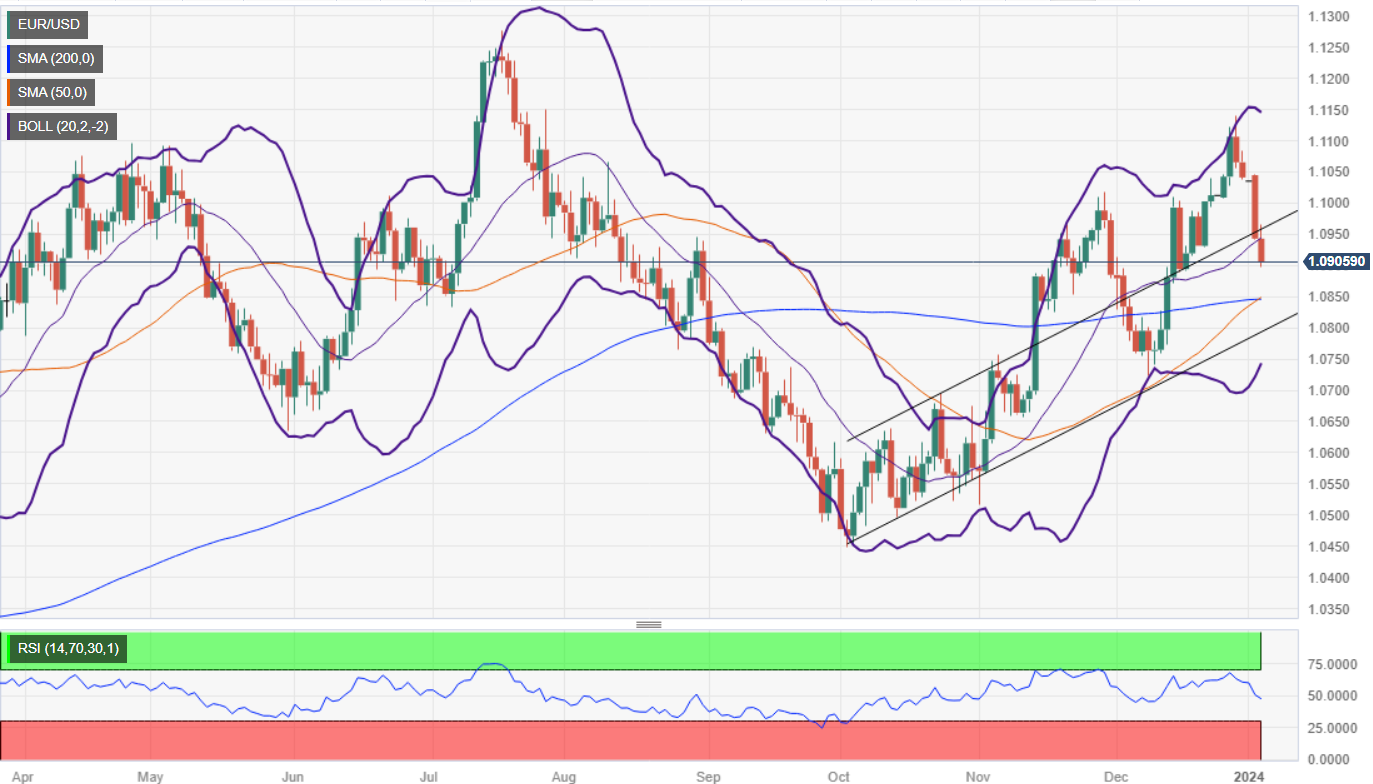
The EUR/USD daily chart depicts the formation of a golden cross, which could pave the way for further gains, but a three-dark crows chart pattern could keep the pair downward pressured. Nevertheless, sellers failure to push prices below 1.0900, and buyers could lift the exchange rate to test a 32-month-old downslope trendline that passes around 1.1025/40.
EUR/USD

Overview
Today last price1.0904
Today Daily Change-0.0039
Today Daily Change %-0.36
Today daily open1.0943
 
Trends
Daily SMA201.0937
Daily SMA501.0842
Daily SMA1001.076
Daily SMA2001.0846
 
Levels
Previous Daily High1.1046
Previous Daily Low1.0941
Previous Weekly High1.114
Previous Weekly Low1.1009
Previous Monthly High1.114
Previous Monthly Low1.0724
Daily Fibonacci 38.2%1.0981
Daily Fibonacci 61.8%1.1006
Daily Pivot Point S11.0907
Daily Pivot Point S21.0872
Daily Pivot Point S31.0802
Daily Pivot Point R11.1012
Daily Pivot Point R21.1082
Daily Pivot Point R31.1117

Author

Christian Borjon Valencia

Markets analyst, news editor, and trading instructor with over 14 years of experience across FX, commodities, US equity indices, and global macro markets.


More from Christian Borjon Valencia
Share:

Editor's Picks

AUD/USD consolidates above 0.7000; remains close to monthly top

AUD/USD holds steady above 0.7000 during the Asian session on Friday, trading just below the previous day's monthly low amid diverging forces. A hawkish RBA continues to support the Aussie, while the recent decline in US bond yields keeps the US Dollar depressed near a three-week low. However, oil-driven inflation fears reinforce Fed hike bets, which, along with geopolitical risks, could benefit the safe-haven buck and cap the currency pair.

USD/JPY bounces off one-month low; climbs to 157.00 amid reviving USD demand

USD/JPY rebounds from the 156.00 neighborhood, or a one-month low touched during Friday’s Asian session, with bulls looking to extend momentum beyond 157.00 amid the emergence of some US Dollar buying. Meanwhile, Japan's National CPI rose to a nine-month peak and reaffirmed BoJ rate-hike bets, which could support the Japanese Yen and cap gains for the currency pair.

Gold holds above $4,000/three-month low as Fed hike bets and firm USD cap upside

Gold struggles to capitalize on its modest recovery from levels below the $4,000 psychological mark, or a three-month low set earlier this Friday, and retains a bearish tone through the first half of the European session. Federal Reserve officials recently signaled there is no urgency to raise interest rates. Traders, however, are still pricing in around an 80% chance that the US central bank will raise borrowing costs again at its December policy meeting.

Bitcoin, Ethereum, and Ripple rebound as major support levels cap recent sell-off

Bitcoin, Ethereum and Ripple rebound modestly on Friday after correcting and testing their key support zone the previous day. BTC holds the 50-day EMA, ETH finds support around the 100-day EMA, while XRP holds the horizontal floor near $1.300. The price action of these top three cryptocurrencies suggests a recovery if this critical support zone holds; a decisive close below these levels suggests a deeper correction.

The week ahead – UK budget, Shell, BP and HSBC and NatWest results
Financial markets have undergone another turbulent week with concerns about public sector debt levels, the impact of energy policy and higher oil and gas prices, and what events in France might mean for the UK economy going forward.
What November 3 means for the Fed's rate path and the US Dollar

The USD faces a decisive period ahead of the November 3 midterm elections. While markets anticipate another interest rate increase from the Fed in December, the battle for control of Congress could reshape fiscal policy expectations and, indirectly, the path of US monetary policy in 2027.