EUR/USD rally rattled by NFP print, US Dollar bites back
- Euro failed to capitalize on upbeat GDP and retail sales; ECB rate cut seen as nearing its limit.
- The US economy added 139K jobs in May, the second-highest in 2025, with the jobless rate steady at 4.2%.
- Hot labor data boosted US Dollar and Treasury yields, dampening Fed rate cut hopes.

EUR/USD trip down extends its losses on Friday after hitting a six-week high near 1.1500 as Nonfarm Payroll figures in the United States (US) came in stronger than expected despite cooling off. The print prompted investors to price in a less dovish Federal Reserve (Fed), while the Euro (EUR) failed to gain traction on upbeat economic data, revealed earlier. The pair trades at 1.1386, down 0.51%.
US jobs data, as revealed by the Bureau of Labor Statistics (BLS), depicted the robustness of the labor market and the economy, with the print being the second highest in 2025, trailing the 147K registered in April. Consequently, the Unemployment Rate remained unchanged.
As expected, the US Dollar advanced, propelled by the jump in US Treasury bond yields and an optimistic mood among investors, who bought US equities amid the conflict between US President Donald Trump and Elon Musk.
The EUR/USD failed to gain traction despite Gross Domestic Product (GDP) figures rising above estimates and surpassing the previous quarter's print. For a whole year, GDP improved from 1.2% to 1.5%, while Retail Sales also advanced in April.
During the week, the European Central Bank (ECB) decided to cut rates to 2% as inflation fell below the central bank’s target but signaled that it would pause its easing cycle. Robert Holzmann voted for keeping rates unchanged, and ECB President Lagarde hinted that the easing cycle is nearing its end.
Next week, the Eurozone (EU) economic docket will feature the ECB Survey of Monetary Analysis and Industrial Production. In the US schedule will feature US inflation figures on the consumer and the producer side, alongside with the University of Michigan (UoM) Consumer Sentiment preliminary release.
Euro PRICE This week
The table below shows the percentage change of Euro (EUR) against listed major currencies this week. Euro was the strongest against the Japanese Yen.
| USD | EUR | GBP | JPY | CAD | AUD | NZD | CHF | |
|---|---|---|---|---|---|---|---|---|
| USD | -0.42% | -0.47% | 0.70% | -0.32% | -0.93% | -0.94% | -0.12% | |
| EUR | 0.42% | -0.06% | 1.12% | 0.09% | -0.51% | -0.56% | 0.29% | |
| GBP | 0.47% | 0.06% | 1.20% | 0.15% | -0.45% | -0.50% | 0.35% | |
| JPY | -0.70% | -1.12% | -1.20% | -1.01% | -1.61% | -1.65% | -0.90% | |
| CAD | 0.32% | -0.09% | -0.15% | 1.01% | -0.61% | -0.65% | 0.19% | |
| AUD | 0.93% | 0.51% | 0.45% | 1.61% | 0.61% | 0.02% | 0.92% | |
| NZD | 0.94% | 0.56% | 0.50% | 1.65% | 0.65% | -0.02% | 0.85% | |
| CHF | 0.12% | -0.29% | -0.35% | 0.90% | -0.19% | -0.92% | -0.85% |
The heat map shows percentage changes of major currencies against each other. The base currency is picked from the left column, while the quote currency is picked from the top row. For example, if you pick the Euro from the left column and move along the horizontal line to the US Dollar, the percentage change displayed in the box will represent EUR (base)/USD (quote).
Daily digest market movers: EUR/USD downtrend stalls on strong US data
- EUR/USD uptrend remains intact, but it would be premature to assume it will remain so, given the uncertainty on US and Eurozone economic data releases.
- US Nonfarm Payrolls rose by 139K in May, beating expectations of 130K but falling short of April’s downwardly revised 147K. While signs of a cooling labor market are evident, overall conditions remain strong even as the economy slows.
- The Unemployment Rate held steady at 4.2%, prompting a repricing of rate expectations, with markets now anticipating fewer than two Fed cuts by the end of 2025.
- ECB officials reportedly expect rate cuts to be paused at the July meeting, according to Bloomberg. “Some officials see reductions in borrowing costs as maybe already finished, while others still back another move — probably in September, according to the people.”
- Financial market players do not expect that the ECB would reduce its Deposit Facility Rate by 25 basis points (bps) at the July monetary policy meeting.
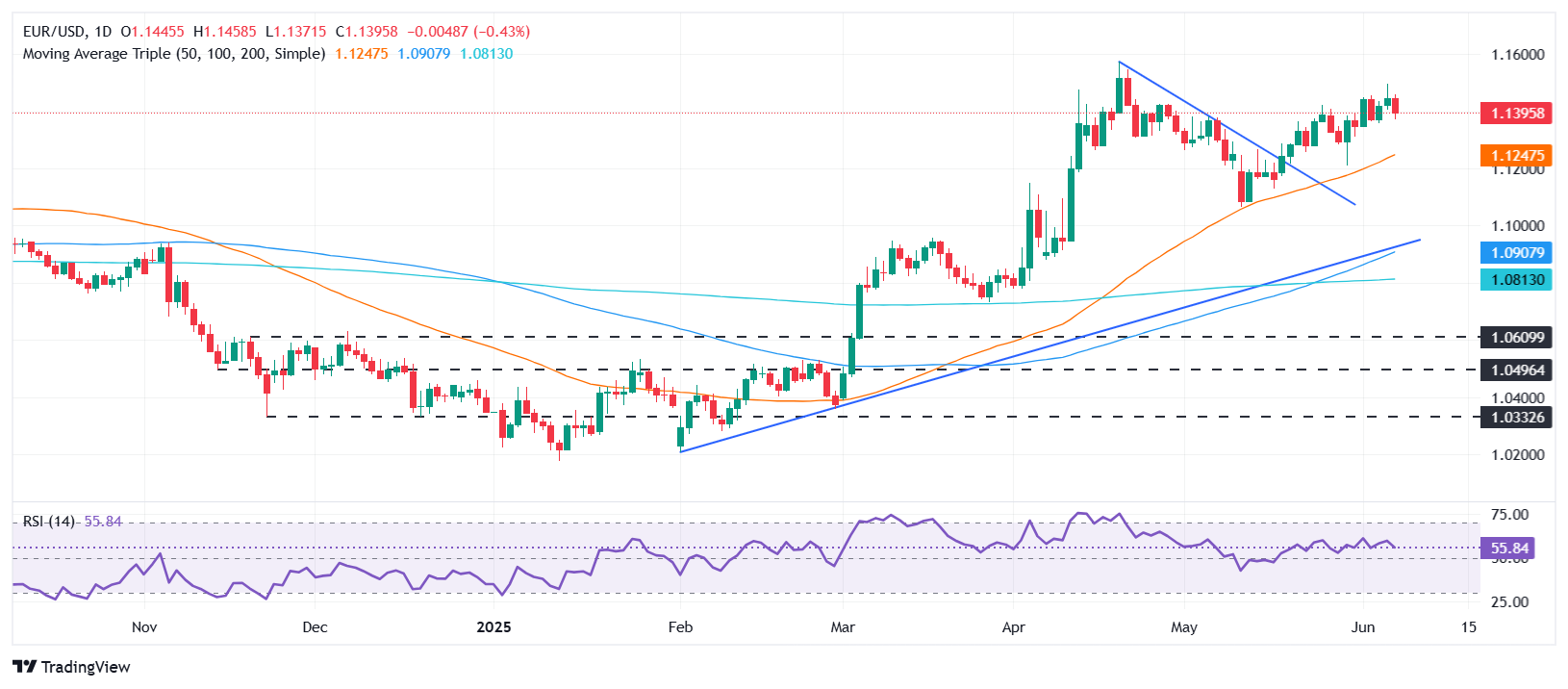
Euro technical outlook: EUR/USD dives beneath 1.1400
EUR/USD is upwardly biased despite retreating to two-day lows of 1.1371, as buyers failed to break the 1.1500 mark, which could have exacerbated a move to 1.1600. Momentum fades as the Relative Strength Index (RSI) remains bullish but aims toward its neutral line. However, as long as the Euro remains near the 1.1380-1.1400 range, buyers are in charge.
The next resistance would be 1.1500. A breach of the latter would expose April’s peak at 1.1572, followed by 1.1600.
Conversely, if EUR/USD falls below the June 2 daily low of 1.1344, a move to 1.1300 is on the cards. A breach of the latter would expose the 20-day Simple Moving Average (SMA) at 1.1284, followed by the 50-day SMA at 1.1218 and 1.1200.
ECB FAQs
The European Central Bank (ECB) in Frankfurt, Germany, is the reserve bank for the Eurozone. The ECB sets interest rates and manages monetary policy for the region. The ECB primary mandate is to maintain price stability, which means keeping inflation at around 2%. Its primary tool for achieving this is by raising or lowering interest rates. Relatively high interest rates will usually result in a stronger Euro and vice versa. The ECB Governing Council makes monetary policy decisions at meetings held eight times a year. Decisions are made by heads of the Eurozone national banks and six permanent members, including the President of the ECB, Christine Lagarde.
In extreme situations, the European Central Bank can enact a policy tool called Quantitative Easing. QE is the process by which the ECB prints Euros and uses them to buy assets – usually government or corporate bonds – from banks and other financial institutions. QE usually results in a weaker Euro. QE is a last resort when simply lowering interest rates is unlikely to achieve the objective of price stability. The ECB used it during the Great Financial Crisis in 2009-11, in 2015 when inflation remained stubbornly low, as well as during the covid pandemic.
Quantitative tightening (QT) is the reverse of QE. It is undertaken after QE when an economic recovery is underway and inflation starts rising. Whilst in QE the European Central Bank (ECB) purchases government and corporate bonds from financial institutions to provide them with liquidity, in QT the ECB stops buying more bonds, and stops reinvesting the principal maturing on the bonds it already holds. It is usually positive (or bullish) for the Euro.
Author

Christian Borjon Valencia
FXStreet
Markets analyst, news editor, and trading instructor with over 14 years of experience across FX, commodities, US equity indices, and global macro markets.