EUR/USD declines as Trump's tax cut bill seems inflationary for economy
- EUR/USD faces pressure above 1.0500 as the US Dollar gains amid a strong recovery in US bond yields.
- Republicans-controlled House of Representatives passed a $4.5 trillion tax cut plan on Tuesday.
- Investors await the preliminary German HICP for February and the US PCE inflation data for January, scheduled for Friday.

EUR/USD continues to face selling pressure above the psychological level of 1.0500 in Wednesday’s North American session. The major currency pair falls due to a strong recovery in the US Dollar (USD). The US Dollar Index (DXY), which tracks the Greenback’s value against six major currencies, recovers sharply to near 106.50 after a weak opening around the 11-week low of 106.10 earlier in the day.
Meanwhile, the shared currency ticks higher against other peers as investors shift focus to the European Central Bank’s (ECB) policy meeting, which will be held next week. The ECB is almost certain to cut the Deposit Facility rate by 25 basis points (bps) to 2.5%. Therefore, investors will pay close attention to the ECB’s monetary policy guidance. A slew of ECB officials has been guiding that the central bank should continue reducing interest rates based on expectations that inflation will sustainably return to the 2% target.
Soft Eurozone Q4 Negotiated Wage Rate data, a key measure of wage growth, has also boosted ECB dovish bets. On Tuesday, the ECB reported that the wage growth measure rose at a slower pace of 4.12% compared to the 5.43% increase seen in the third quarter of the previous year.
However, ECB board member Isabel Schnabel seems to criticize dovish bets as she believes that Eurozone's economic weakness is “not due to overly high borrowing costs” but to “structural factors”. Her commentary indicated that she doesn’t support further policy easing. “It's no longer clear the current 2.75% rate is still holding back the eurozone economy,” Schnabel said.
Going forward, investors will focus on the German flash Harmonized Index of Consumer Prices (HICP) data for February, which will be published on Friday.
Euro PRICE Today
The table below shows the percentage change of Euro (EUR) against listed major currencies today. Euro was the strongest against the Australian Dollar.
| USD | EUR | GBP | JPY | CAD | AUD | NZD | CHF | |
|---|---|---|---|---|---|---|---|---|
| USD | 0.24% | 0.08% | 0.36% | 0.25% | 0.64% | 0.52% | 0.13% | |
| EUR | -0.24% | -0.16% | 0.06% | 0.00% | 0.39% | 0.28% | -0.12% | |
| GBP | -0.08% | 0.16% | 0.19% | 0.17% | 0.57% | 0.45% | 0.06% | |
| JPY | -0.36% | -0.06% | -0.19% | -0.03% | 0.36% | 0.23% | -0.15% | |
| CAD | -0.25% | -0.00% | -0.17% | 0.03% | 0.40% | 0.28% | -0.11% | |
| AUD | -0.64% | -0.39% | -0.57% | -0.36% | -0.40% | -0.11% | -0.49% | |
| NZD | -0.52% | -0.28% | -0.45% | -0.23% | -0.28% | 0.11% | -0.39% | |
| CHF | -0.13% | 0.12% | -0.06% | 0.15% | 0.11% | 0.49% | 0.39% |
The heat map shows percentage changes of major currencies against each other. The base currency is picked from the left column, while the quote currency is picked from the top row. For example, if you pick the Euro from the left column and move along the horizontal line to the US Dollar, the percentage change displayed in the box will represent EUR (base)/USD (quote).
Daily digest market movers: EUR/USD declines as Trump’s tax cut bill gets green signal
- EUR/USD is down as investors have underpinned the US Dollar against the Euro (EUR). The US Dollar capitalizes on a strong recovery in US bond yields, which had been sliding for almost a month. The 10-year US Treasury yields jump to near 4.33% after posting a fresh 13-week low at around 4.28% earlier in the day.
- A green light to United States (US) President Donald Trump’s $4.5 trillion tax cut plan by the House of Representatives forced traders to dump government bonds, assuming that lower taxes on individuals would accelerate their purchasing power. Such a scenario would prompt inflationary pressures and force the Federal Reserve (Fed) to keep interest rates in the current range of 4.25%-4.50% for longer.
- For fresh cues on the current status of inflation, investors await the US Personal Consumption Expenditures Price Index (PCE) data for January, which will be released on Friday. The core PCE inflation data – the Fed’s preferred inflation gauge as it excludes volatile food and energy items – is estimated to have decelerated to 2.6% year-over-year from 2.8% in December. Soft underlying inflation data would weigh on market expectations that the Fed will remain in the “waiting” mode for longer.
Technical Analysis: EUR/USD struggles above 1.0500
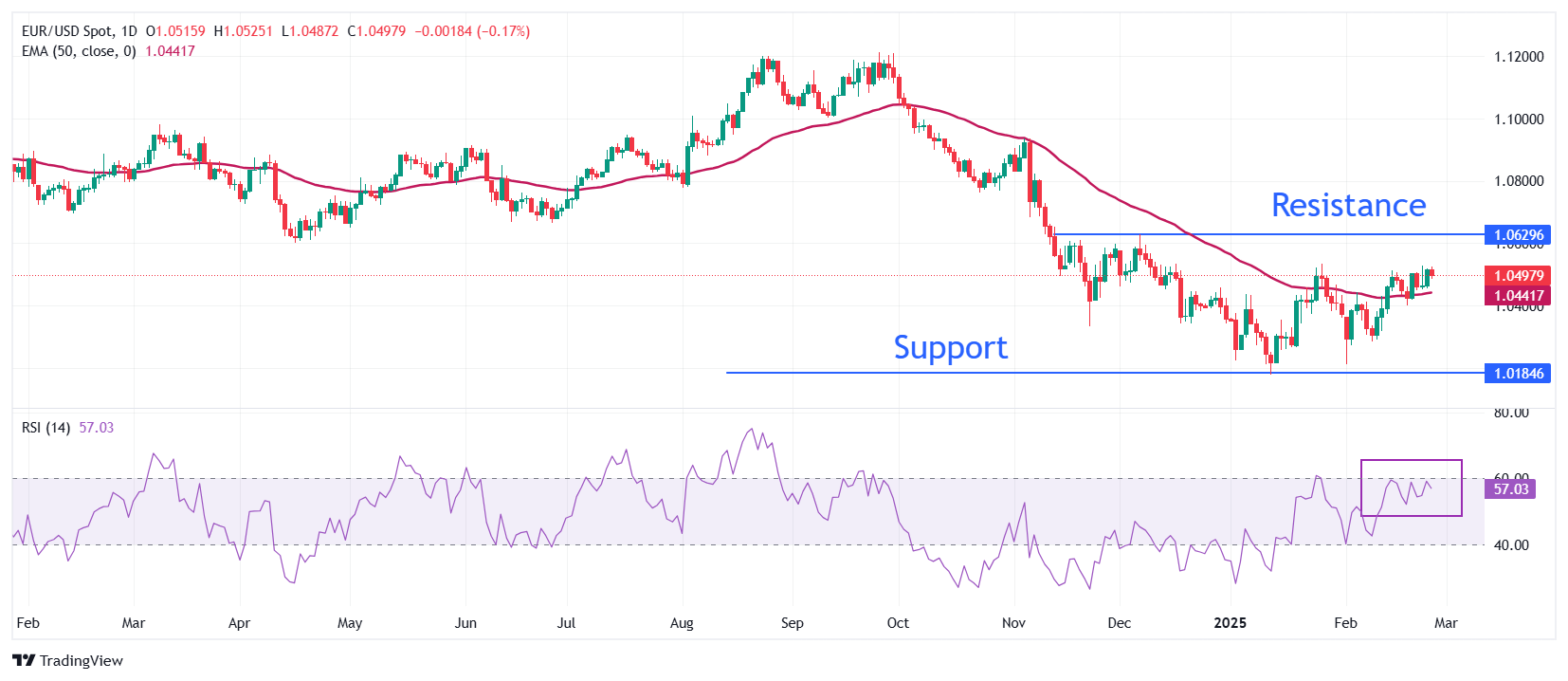
EUR/USD stays in a tight range at around 1.0500. The 50-day Exponential Moving Average (EMA) continues to support the major currency pair around 1.0440.
The 14-day Relative Strength Index (RSI) wobbles just below 60.00. A bullish momentum would activate if the RSI (14) manages to sustain above that level.
Looking down, the February 10 low of 1.0285 will act as the major support zone for the pair. Conversely, the December 6 high of 1.0630 will be the key barrier for the Euro bulls.
Inflation FAQs
Inflation measures the rise in the price of a representative basket of goods and services. Headline inflation is usually expressed as a percentage change on a month-on-month (MoM) and year-on-year (YoY) basis. Core inflation excludes more volatile elements such as food and fuel which can fluctuate because of geopolitical and seasonal factors. Core inflation is the figure economists focus on and is the level targeted by central banks, which are mandated to keep inflation at a manageable level, usually around 2%.
The Consumer Price Index (CPI) measures the change in prices of a basket of goods and services over a period of time. It is usually expressed as a percentage change on a month-on-month (MoM) and year-on-year (YoY) basis. Core CPI is the figure targeted by central banks as it excludes volatile food and fuel inputs. When Core CPI rises above 2% it usually results in higher interest rates and vice versa when it falls below 2%. Since higher interest rates are positive for a currency, higher inflation usually results in a stronger currency. The opposite is true when inflation falls.
Although it may seem counter-intuitive, high inflation in a country pushes up the value of its currency and vice versa for lower inflation. This is because the central bank will normally raise interest rates to combat the higher inflation, which attract more global capital inflows from investors looking for a lucrative place to park their money.
Formerly, Gold was the asset investors turned to in times of high inflation because it preserved its value, and whilst investors will often still buy Gold for its safe-haven properties in times of extreme market turmoil, this is not the case most of the time. This is because when inflation is high, central banks will put up interest rates to combat it. Higher interest rates are negative for Gold because they increase the opportunity-cost of holding Gold vis-a-vis an interest-bearing asset or placing the money in a cash deposit account. On the flipside, lower inflation tends to be positive for Gold as it brings interest rates down, making the bright metal a more viable investment alternative.
Author

Sagar Dua
FXStreet
Sagar Dua is associated with the financial markets from his college days. Along with pursuing post-graduation in Commerce in 2014, he started his markets training with chart analysis.