EUR/USD corrects as US Dollar bounces back after upbeat US NFP data
- EUR/USD retraces to near 1.0970 as the US Dollar recovers after upbeat US NFP data for March.
- US NFP data came in at 228K, beating estimates of 135K.
- Investors expect the ECB to cut interest rates again in April.

EUR/USD corrects below 1.1000 during North American trading hours on Friday after posting a fresh six-month high at 1.1145 the previous day. The major currency pair retraces as upbeat United States (US) Nonfarm Payrolls (NFP) data for March has supported the US Dollar (USD).
The NFP report showed that the economy added 228K fresh workers, significantly higher than estimates of 135K and the former reading of 117K, downwardly revised from 151K. The Unemployment Rate accelerated to 4.2% against estimates and the prior release of 4.1%. Average Hourly Earnings, a key measure of wage growth, rose moderately by 3.8% year-on-year compared to expectations of 3.9% and the former reading of 4%.
Theoretically, a significant addition of employment adds to market expectations that the Federal Reserve will maintain a restrictive monetary policy stance. However, the impact is expected to remain limited as investors are more concerned about potential upside risks to inflation. The reciprocal tariffs announced by US President Donald Trump have stoked fears of high inflation and weak economic growth in the US economy.
According to the CME FedWatch tool, traders have become increasingly confident that the central bank could cut interest rates in the June policy meeting after Trump's tariff announcement. The Fed's probability of keeping interest rates in their current range of 4.25%-4.50% has also diminished to 65.8% from 81.5% recorded a week ago.
To get fresh cues on Trump’s tariffs’ impact on the economy, investors will pay close attention to Fed Chair Jerome Powell’s speech, which is scheduled at 15:25 GMT. Investors would like to know how Trump's tariffs will shape the monetary policy this year.
Daily digest market movers: EUR/USD falls back as US Dollar rebounds
- EUR/USD is down sharply on Friday, but is expected to stay broadly firm as reciprocal tariffs announced by President Donald Trump are expected to weigh heavily on the outlook of the US economy.
- The imposition of harsh-than-expected reciprocal tariffs by Donald Trump has led to market experts becoming pessimists on global economic growth, including in the US.
- Market participants expect that the implementation of full-scale tariffs will result in a resurgence in inflationary pressures and weigh on US economic growth. Such a scenario will lead to stagflation in the economy.
- On Wednesday, a 10% baseline levy on all imports into the US was announced, which will become effective on Saturday. Additionally, Trump slapped different tariffs for each country, ranging from 10% to 49%.
- Meanwhile, the Euro (EUR) declines as investors expect Trump’s tariffs would weaken the Eurozone economic growth. Investors worry about a potential trade war between the Eurozone and the US over Trump’s sweeping reciprocal tariffs. European Commission (EC) President Ursula von der Leyen stated that the consequences will be “dire for millions of people around the globe”. Von der Leyen warned that the Eurozone is prepared to retaliate with countermeasures if negotiations with Washington fail.
- Additionally, firm expectations that the European Central Bank (ECB) will cut interest rates in April have also put some pressure on the Euro. ECB officials expect that Trump’s tariffs-driven inflation won’t be persistent in nature. Hence, it is not a major obstacle to further easing the monetary policy.
Technical Analysis: EUR/USD struggles to hold above 1.1000
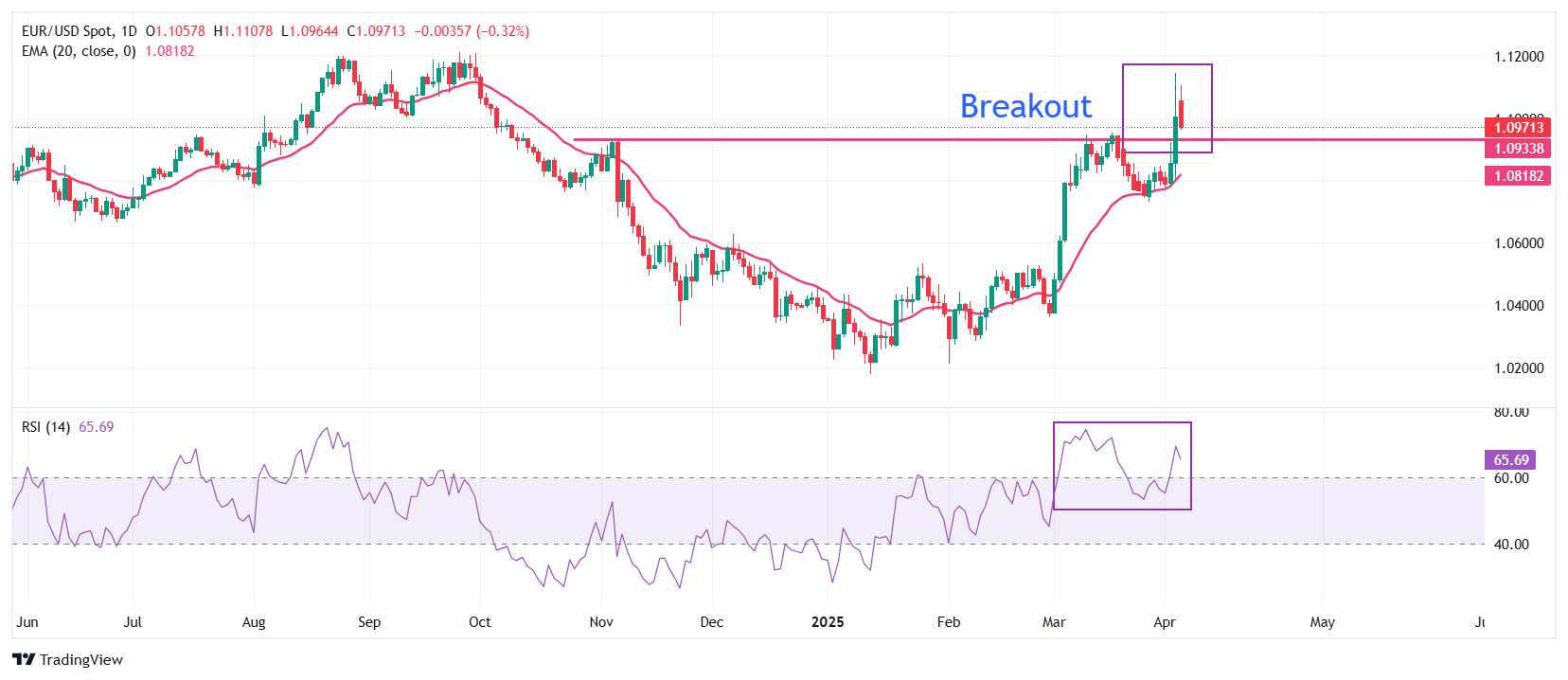
EUR/USD gives up some of the prior day’s gains and declines to near 1.0970 during North American trading hours on Friday. The major currency pair rallied to 1.1147 on Thursday after a decisive breakout above the prior resistance of 1.0955, which is March’s highest level. The near-term outlook of the major currency pair remains bullish as the 20-day Exponential Moving Average (EMA) resumes its upward journey, trading around 1.0820.
The 14-day Relative Strength Index (RSI) holds above 60.00, indicating an active bullish momentum.
Looking down, the prior resistance at 1.0955 and the March 31 high of 1.0850 will act as major support zones for the pair. Conversely, the September 25 high of 1.1214 will be the key barrier for the Euro bulls.
Tariffs FAQs
Tariffs are customs duties levied on certain merchandise imports or a category of products. Tariffs are designed to help local producers and manufacturers be more competitive in the market by providing a price advantage over similar goods that can be imported. Tariffs are widely used as tools of protectionism, along with trade barriers and import quotas.
Although tariffs and taxes both generate government revenue to fund public goods and services, they have several distinctions. Tariffs are prepaid at the port of entry, while taxes are paid at the time of purchase. Taxes are imposed on individual taxpayers and businesses, while tariffs are paid by importers.
There are two schools of thought among economists regarding the usage of tariffs. While some argue that tariffs are necessary to protect domestic industries and address trade imbalances, others see them as a harmful tool that could potentially drive prices higher over the long term and lead to a damaging trade war by encouraging tit-for-tat tariffs.
During the run-up to the presidential election in November 2024, Donald Trump made it clear that he intends to use tariffs to support the US economy and American producers. In 2024, Mexico, China and Canada accounted for 42% of total US imports. In this period, Mexico stood out as the top exporter with $466.6 billion, according to the US Census Bureau. Hence, Trump wants to focus on these three nations when imposing tariffs. He also plans to use the revenue generated through tariffs to lower personal income taxes.
BRANDED CONTENT
Finding the right broker for trading EUR/USD is crucial, and we've identified the top choices for this major currency pair. Read about their unique features to make an informed decision.
Author

Sagar Dua
FXStreet
Sagar Dua is associated with the financial markets from his college days. Along with pursuing post-graduation in Commerce in 2014, he started his markets training with chart analysis.