EUR/USD declines as ECB cuts interest rates, guides grim outlook
- EUR/USD slides to near 1.1340 as the ECB reduces its key borrowing rates by 25 bps, as expected.
- The ECB omits to comment that interest rates are still restrictive.
- Big progress in US-Japan trade talks has provided some relief to the US Dollar.

EUR/USD faces selling pressure and declines to near 1.1340 during North American trading hours on Thursday. The major currency pair slides as the European Central Bank (ECB) has cut its key borrowing rates by 25 basis points (bps), as expected, pushing the Deposit Facility Rate and the Main Refinancing Operations Rate lower to 2.25% and 2.4%, respectively.
This is the sixth interest rate cut by the ECB in a row and the seventh time since the central bank started its easing cycle in June. Traders were convinced that the ECB would ease its monetary policy further as the Eurozone inflation is on track to return to the bank’s target of 2% by the year-end. Additionally, fears of economic shocks in an already slowing economy pave the way for further monetary policy easing.
In the monetary policy statement, the ECB has stated that the disinflation process is well on track, but continued to refrain from committing to a pre-defined interest rate path. The ECB has warned that in current conditions of "exceptional uncertainty", it will follow a "data-dependent and meeting-by-meeting approach". For exceptional uncertainty, the ECB has referred to the tariff policy of United States (US) President Donald Trump.
After a long time, the ECB has not commented that interest rates are still restrictive, which indicates that the central bank is expecting at least a temporary pause in the current interest rate cut cycle.
Meanwhile, ECB President Christine Lagarde has warned in the press conference that downside risks for the Eurozone economy have increased. Lagarde said that the economic outlook is "clouded by uncertainty" as trade disruptions would weigh on "business investment."
The old continent is expected to be one of the major victims of Trump’s international policies, even as the European Union’s (EU) trade commission manages to negotiate a fair deal with Washington. China is expected to diversify its products to other nations if the trade war between the US and Beijing continues. China could sell many products to the Euro area and other economies, as no other nation can beat its low-cost competitive advantage.
Daily digest market movers: EUR/USD declines while US Dollar rebounds
- EUR/USD corrects from the round-level figure of 1.1400 as the US Dollar (USD) strives to gain ground near its recent lows. The US Dollar Index (DXY), which tracks the Greenback’s value against six major currencies, rebounds to near 99.60. The Greenback attracts bids on positive development in trade negotiations between the US and Japan.
- On Wednesday, US President Trump indicated through a post on TruthSocial that negotiations between Japan's economic revitalization minister Ryosei Akazawa and US departments have made big progress. “A Great Honour to have just met with the Japanese Delegation on Trade. Big Progress!” Trump wrote.
- Investors see this as a constructive step by Donald Trump that will diminish fears of global economic turmoil. His preference for negotiating bilateral trades with his trading partners rather than imposing hefty tariffs will ease uncertainty across the globe.
- However, the escalated trade war between the US and China will keep investors on their toes. The fight between the world’s two largest powerhouses has shifted to “who will initiate trade talks” from “size of tariffs”. On Tuesday, White House press secretary Karoline Leavitt said that the President is open to a trade deal with Beijing, but China should make the first move. "The ball is in China’s court: China needs to make a deal with us, we don’t have to make a deal with them,” Leavitt said, Reuters reported.
- Meanwhile, fears of rising inflation and slower economic growth domestically will keep the US Dollar on the backfoot. On Wednesday, Federal Reserve (Fed) Chair Jerome Powell warned that growth has likely “slowed in the first quarter of 2025” from last year's solid pace in the face of Trump’s economic policies. However, Powell remained confident that the economy is 'solid' despite heightened uncertainty and downside risks, and reiterated a “wait and see” approach until the Fed gets greater clarity.
Technical Analysis: EUR/USD falls back from 1.1400
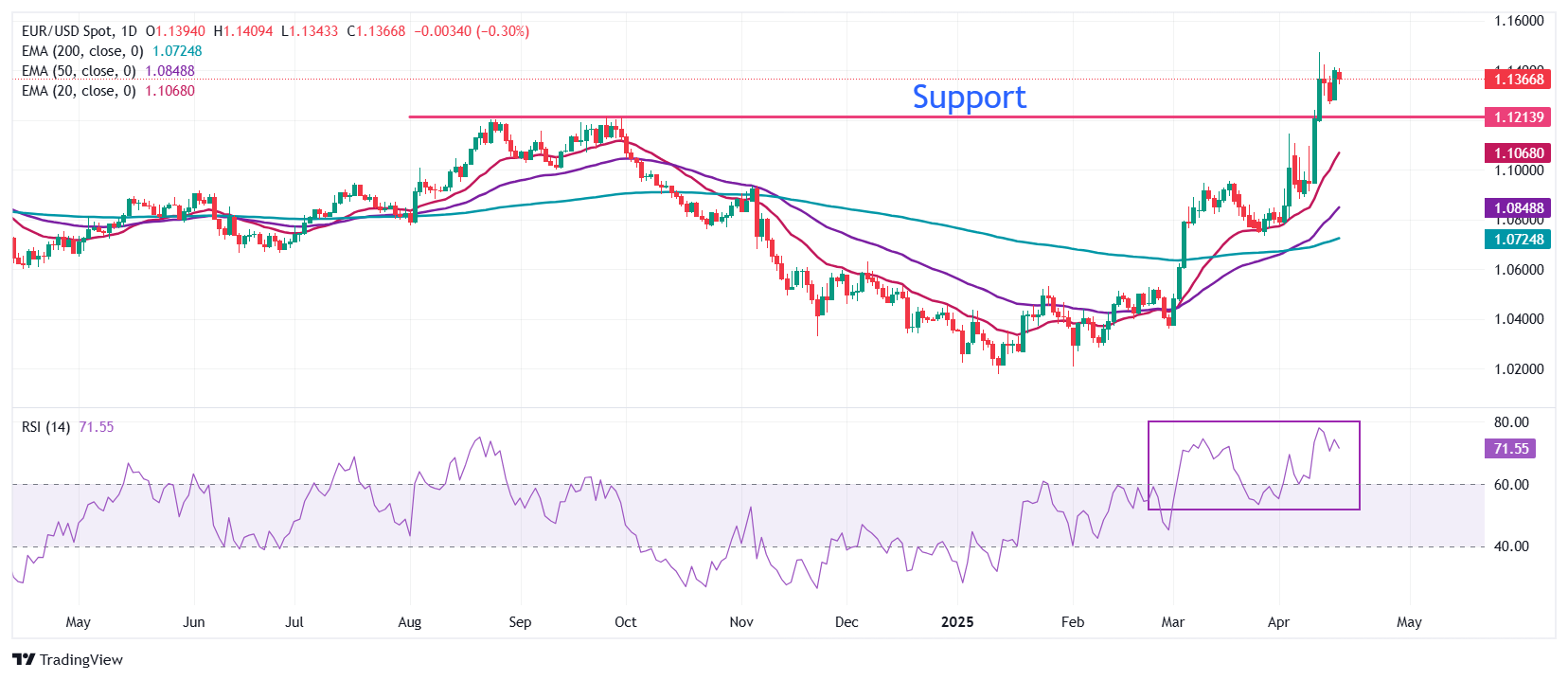
EUR/USD falls after failing to extend recovery above 1.1400 in Thursday’s European session. However, the overall outlook of the major currency pair is strongly bullish as all short-to-long Exponential Moving Averages (EMAs) slope higher.
The 14-day Relative Strength Index (RSI) holds above 70.00, indicating a strong bullish momentum.
Looking up, the psychological level of 1.1500 will be the major resistance for the pair. Conversely, the April 11 low of 1.1190 will be the key support for the Euro bulls.
BRANDED CONTENT
Finding the right broker for trading EUR/USD is crucial, and we've identified the top choices for this major currency pair. Read about their unique features to make an informed decision.
Author

Sagar Dua
FXStreet
Sagar Dua is associated with the financial markets from his college days. Along with pursuing post-graduation in Commerce in 2014, he started his markets training with chart analysis.